Where to Drink Coffee in Nazaré (and What to Order)
Most of the coffee on the seafront is bad, lukewarm and overpriced. Learn what to order (bica, meia de leite or galão), how to escape the crowd, and why Nazaré's best coffee is drunk up in the Sítio, facing the lighthouse.
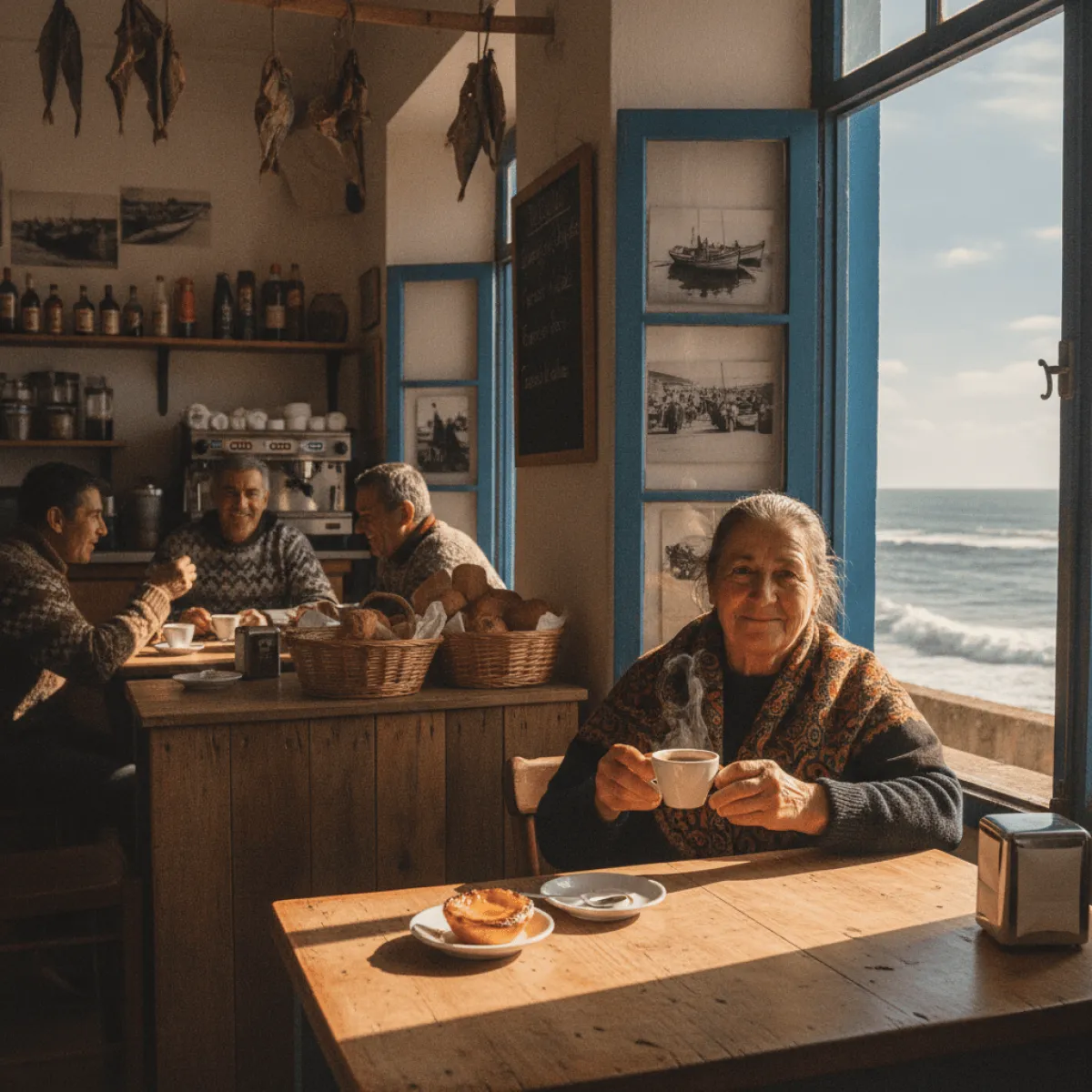
Here is an uncomfortable truth about Nazaré that the brochures will never print: most of the coffee served along the seafront of Avenida da República is bad. Not mediocre, bad. Lukewarm, in a paper cup, handed to someone who has just watched the giant waves at Praia do Norte and still has a phone in one hand. You pay two euros for an espresso that any neighbourhood bakery would sell for seventy cents and that would taste far better. The good news is that you only have to walk fifty metres back from the sand for everything to change.
This is an honest guide to where to drink well in Nazaré, what to order in each place, and, more importantly, how coffee behaves in a fishing town that lives on two floors: the beach below and the Sítio above, on top of the cliff, joined by a funicular that has been climbing since 1889.
First, learn how to order
Start with the vocabulary, because ordering badly is the visitor's first mistake. If you want a short espresso, ask for a bica (or simply "um café"). If you want something longer and milder, ask for an abatanado. An espresso with a splash of milk is a garoto. Half coffee, half milk, served in a large cup, is a meia de leite. And the famous galão arrives in a tall glass, much more milk than coffee, perfect at breakfast. In a decent place none of this costs more than a euro and a half.
The golden rule in Nazaré: the closer to the water and the more languages printed on the menu, the worse the coffee and the higher the price. The more old men playing cards inside, the better the coffee.
The morning ritual, away from the sand
The best breakfast in Nazaré is not a panoramic photograph of the ocean. It is eight in the morning, in the narrow streets behind the Avenida, when retired fishermen take the counters and the women in their seven skirts do their shopping. Order a meia de leite and a slice of toasted homemade bread with butter melting into it, the national classic that costs under three euros and fills you up more than any brunch. If there are pastéis de nata fresh from the oven, and in Nazaré there almost always are, order two. One for now, one for the cliff.
A word about regional pastries, because they are worth planning around. Nazaré has no flagship pastry as famous as Belém's, but it is surrounded by sugar country. Half an hour away, in Alfeizerão, they make the real pão de ló de Alfeizerão, so moist the centre looks almost raw, which is exactly the point. Further inland, in Caldas da Rainha, you find cavacas and trouxas de ovos. If you are stretching your legs that way, pair your coffee with scenery using our honest guide to walks around Caldas da Rainha.
Up top, in the Sítio: the view you pay for (and should)
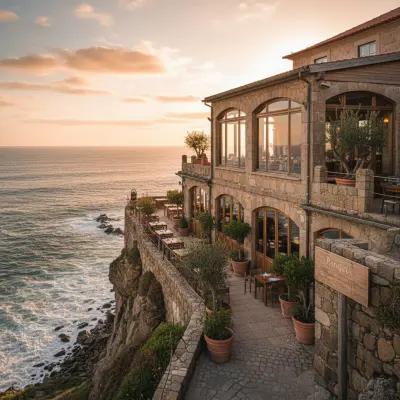
Take the funicular or drive the road that snakes up the cliff to the Sítio. Up here sit the Sanctuary of Nossa Senhora da Nazaré, the Suberco viewpoint with its postcard sweep over the shell-shaped beach, and the Fort of São Miguel Arcanjo with its red lighthouse, now an interpretation centre for the giant waves. This is also where it makes the most sense to sit down and take your time.
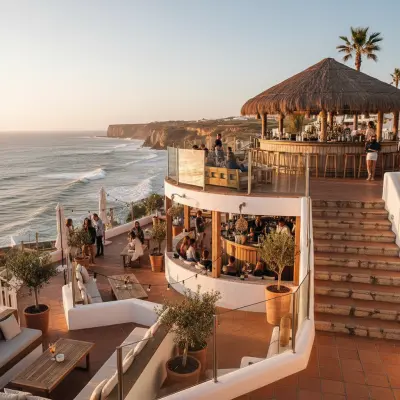
Up in the Sítio I recommend Zulla Terrace Bar for the late afternoon. It is not a fishermen's bakery, it is a terrace with a view, so you pay for the setting. But if there is ever a moment to pay for a view in Nazaré, it is when the sun drops over the Atlantic and the lighthouse cuts a silhouette against a tangerine sky. Order a coffee after lunch, or save it for sunset with something stronger. The rule holds: a bica is still a bica, and here it comes with one of the finest panoramas on the Portuguese coast.
While you are up there, it is worth understanding why these women wear seven layered skirts and what that says about the town's history. The guided walk through the seven skirts tradition with Alma Nazaré Tours gives context to what otherwise shrinks into an exotic photo opportunity. Do it before the coffee, not after, so the terrace already means something.
Where coffee meets the table
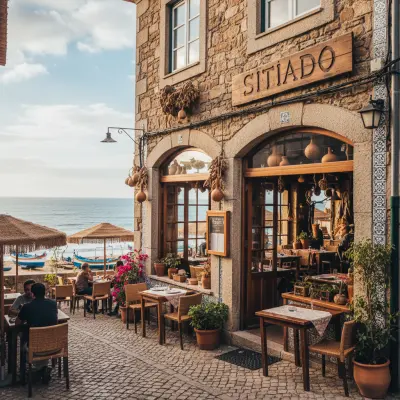
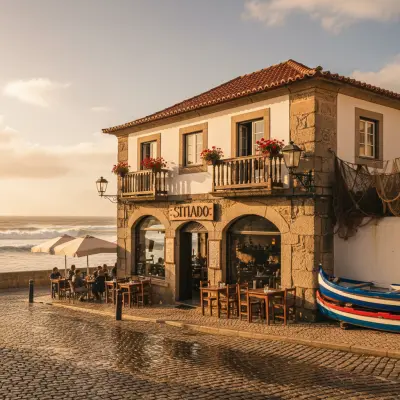
There is a thin border in Nazaré between coffee and a meal, and some of the best places for an espresso at the counter are, in fact, eating houses. Sitiado, up on the cliff, is one of those spots where you can stop in just for a coffee and a sweet in the middle of the afternoon, with the advantage that you are already in the right place when hunger hits and you feel like staying for dinner. There is, in fact, a second address under the same name worth knowing, because the brand has spread around town and you are not always near the first one.
For a coffee after a serious meal, Pangeia Restaurante is the safe bet when you want to close lunch properly: a short bica, perhaps a glass of aguardente, and the conversation stretching out. It is not a café in the traditional sense, it is a restaurant, but the best espresso in a fishing town is often drunk at the end of a good fish lunch, not at a quick-stop counter.
What to order, in practical terms
- Morning: meia de leite and toasted homemade bread. Cost: around 3 euros. Best time: before nine, before the coaches.
- Mid-afternoon: a bica and a pastel de nata, or a galão if it is cold and the north wind is blowing (and in Nazaré it almost always is).
- At sunset: a coffee up in the Sítio facing the lighthouse, then, in no hurry, something stronger.
- To take away: if you pass through Alfeizerão or Caldas da Rainha, bring back regional pastries. Nazaré's coffee deserves decent company.
The classic mistake: the giant-wave coffee
Between October and March, when the Nazaré Canyon pushes waves of over twenty metres against Praia do Norte and the surf world gathers at the fort, vans and improvised kiosks appear selling coffee at spectacle prices. Drink it if you must, but do not mistake it for the coffee of Nazaré. It is event coffee, like the stuff sold at a stadium. The real thing is in the back streets, at the table, at the counter, among the people who actually live here.
Another tip for big-sea days: dress properly. The cold on top of the cliff in January, with the Atlantic wind, is unforgiving, and no bica warms you enough from the inside. Bring a hat. Drink the coffee before you go out, not while you wait for the wave.
Coffee as a pause between trips
Nazaré works well as a base for exploring the region, and coffee slots naturally into those days on the road. A few kilometres away stand two of the country's greatest Gothic monuments, and some people see both in a single day. The tour of the Alcobaça and Batalha monasteries from Nazaré is the comfortable way to do it, and in Alcobaça, by the way, the coffee stop is mandatory precisely because of that local pão de ló.
Anyone heading south or inland can string Nazaré together with other very Portuguese rituals. If your trip falls in May, read our honest guide to the Fátima pilgrimage on May 13th, and anyone driving on to Coimbra during the academic season will find coffee of another world, the coffee of black-caped students, described in our guide to the Queima das Fitas. In every one of these places the lesson is the same: the best coffee is always where the locals are, never where the crowd is.
The essentials
Nazaré is not a town of design cafés or baristas with scales. It is a fishing town where coffee is drunk standing up, fast, hot and cheap, or else sitting with a view, slowly, watching the Atlantic do what it has done for centuries. Avoid the front line. Climb to the Sítio. Sit where the old men play cards. Order a bica, a meia de leite or a galão depending on the hour, pair it with a pastel de nata or with the region's pastries, and never, under any circumstances, accept coffee in a paper cup by the sea. The town deserves better of you, and you deserve better of the town.