Nazaré Monastery Tour: Alcobaça and Batalha in Half a Day
Four hours, two UNESCO monasteries, and a Nazaré-born guide who connects the monastic history of Alcobaça and Batalha back to the fishing village itself. Alma Nazaré Tours picks you up at your hotel from 60€, back in time for lunch.
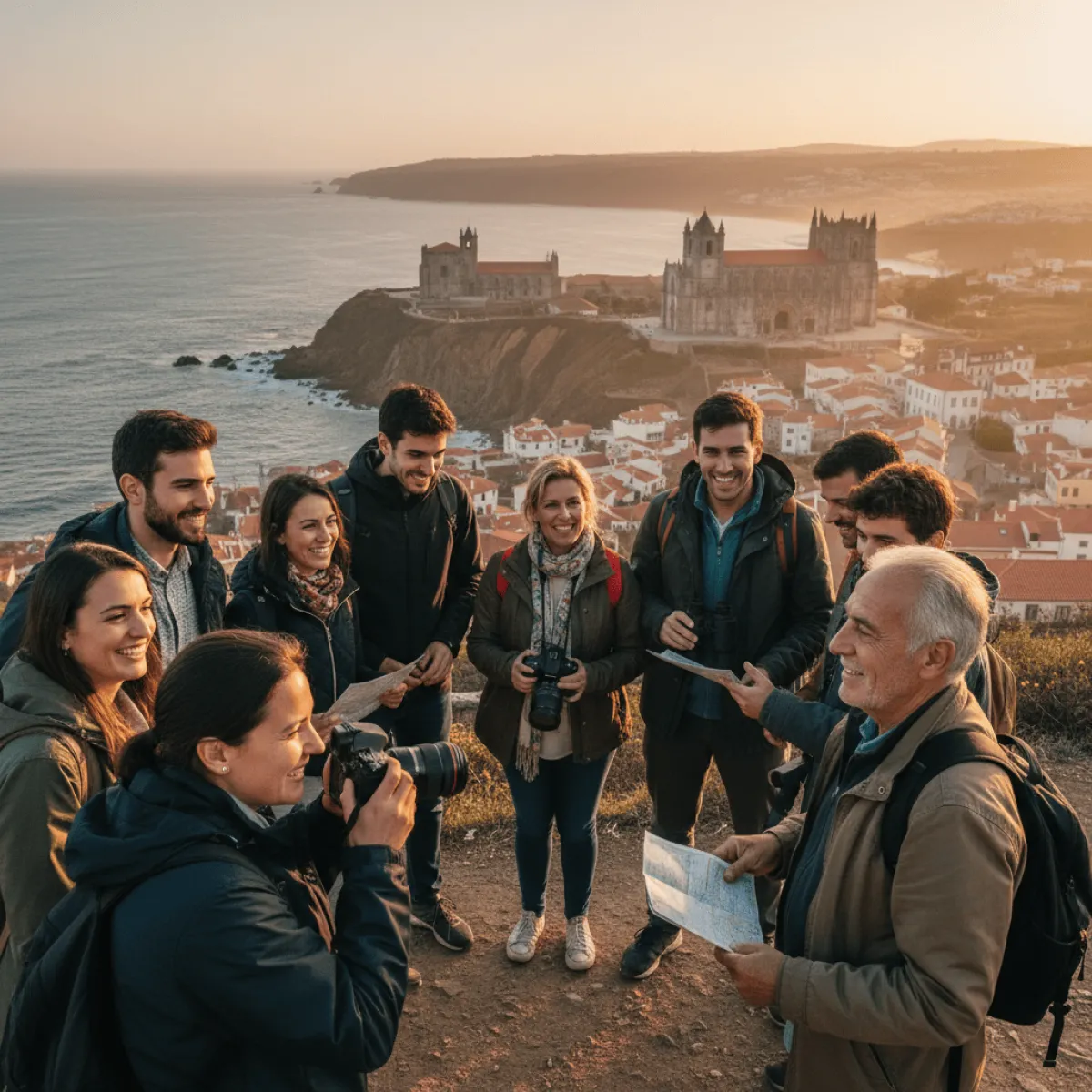
Nazaré has two faces. One is the cliff, the underwater canyon, and the giant wave obsession that fills every documentary. The other sits twenty minutes inland, in limestone and silence: the monasteries of Alcobaça and Batalha, two UNESCO World Heritage sites that most visitors see in passing on a coach tour from Lisbon. If you are staying a few days in town, it makes far more sense to go from here, with time, and ideally with someone who can tell the story without sounding like a brochure.
That is where Alma Nazaré Tours comes in, run by Joaquim Grilo, known locally as Quim-Zé. It is a small, registered animation tourism company (RNAAT nº 269/2015) based in Nazaré, and the two-monastery tour is one of their regular trips. It is not the cheapest option on the market, but it is one of the few that actually departs from Nazaré, so you do not have to be standing at a Lisbon meeting point at eight in the morning.
What the tour involves, step by step
The easiest way to book is through Civitatis, where it is listed as "Batalha & Alcobaça Monasteries Tour" at 60€ per person. Total duration is around four hours, with hotel pickup and drop-off in Nazaré, transport by minibus, an English or Spanish-speaking guide, and return to your accommodation. Monastery admission is not included: 15€ for adults and 7.50€ for seniors at each site, payable on arrival.
The first stop is usually Alcobaça. Leaving Nazaré via the A8, it takes just over fifteen minutes. The Mosteiro de Santa Maria de Alcobaça is Cistercian, twelfth century, and was one of the first Gothic buildings in Portugal. The central nave, seen from the entrance, is one of those moments where you realise photos do not do it justice: thirty metres of vertical austerity, no decoration to distract. The tombs of King Pedro and Inês de Castro, placed foot to foot, are the highlight. The story of the forbidden romance and the macabre revenge is told on every tour, but listen carefully because the carvings on the sarcophagi tell the story in order, like a fourteenth-century comic strip.
The medieval kitchen, with its huge central chimney and a stream channel that brought water directly from the Alcoa river, is one stop where you should linger. It is not a curiosity. It is one of the best-preserved monastic kitchens in Europe.
Batalha: the bright counterpart
The second stop is the Mosteiro de Santa Maria da Vitória in Batalha, about twenty minutes from Alcobaça. Commissioned by King João I to thank Mary for the victory at Aljubarrota in 1385, construction dragged on for two centuries and seven kings. The result is a mix of late Gothic and Manueline that does not work through silence. It works through light. If Alcobaça is Cistercian restraint, Batalha is the opposite.
The Unfinished Chapels, accessible through the exterior of the monastery, are the most striking thing there. They are literally unfinished, no roof, the octagonal pillars ending in sky. The Founder's Chapel, with the tombs of João I and Philippa of Lancaster, and the Royal Cloister, with that obsessive Manueline tracery, justify the entrance fee on their own. The guide will point you to the main portal, with 78 carved figures. If nobody tells you, you walk straight past it.
What makes this version of the tour worth it
The strength of the Alma Nazaré tour is not the transport. It is Quim-Zé. He is a Nazaré local who knows these monasteries the way you know your own living room, and he has a way of weaving monastic history together with the history of Nazaré itself, that medieval link between the monks of Alcobaça and the fishermen of the Sítio. To understand modern Nazaré, that context matters. He also runs a longer tour called "De onde vem a coragem?" linking Nazaré to three UNESCO sites (Alcobaça, Batalha, and Tomar). If you have a full day, ask about it.
The best moment, for me, is the cloister at Alcobaça around midday, when the sun comes in straight and the arches throw geometric shadows across the floor. Take your time at the Founder's Chapel in Batalha: stained glass light hitting that stone is a thing you watch for minutes, not seconds.
Practical tips
- Booking: minimum two participants. Civitatis takes bookings up to 24 hours before at civitatis.com. For private dates or custom itineraries, contact directly: almanazaretours@gmail.com or +351 912 460 967.
- What to wear: closed, comfortable shoes, the floors are uneven and old. A light jacket even in August. Inside Alcobaça's church it can be ten degrees colder than outside.
- What to bring: cash or card for tickets (30€ per person for both monasteries). A water bottle. A camera, though flash is not allowed.
- When to go: morning, no question. The big coaches from Lisbon start arriving around 11:30. The first hour at each monastery is clearly the quietest.
What to eat before or after
The tour finishes before lunch if you leave in the morning, or in late afternoon if you start after 1pm. If you come back hungry, Sitiado serves fresh fish up at the Sítio with a sea view, and Pangeia Restaurante is the better option if you want something more polished. To make sense of Nazaré beyond the monasteries, pair this with our guide to the market and the dried fish, and, if you are still curious about the giant waves, the canyon spectator guide explains how and when to actually see the show. If you want to escape the crowds afterwards, the secret sands guide points to quieter coastline.
The monasteries are not adrenaline or beach experiences. They are slow stops, and Nazaré has room for that, especially outside peak months. If you are here more than two days, this half-day pays you back, and it sits well outside the standard coach circuit that dumps people in Alcobaça at 2pm.