Nazaré: From Monster Waves to the Solitude of Secret Sands
Forget the tourist circus of the promenade. From the centuries-old art of drying fish to the deserted sands of Praia do Norte, discover how to experience the real Nazaré and where to eat the best fish without the traps.
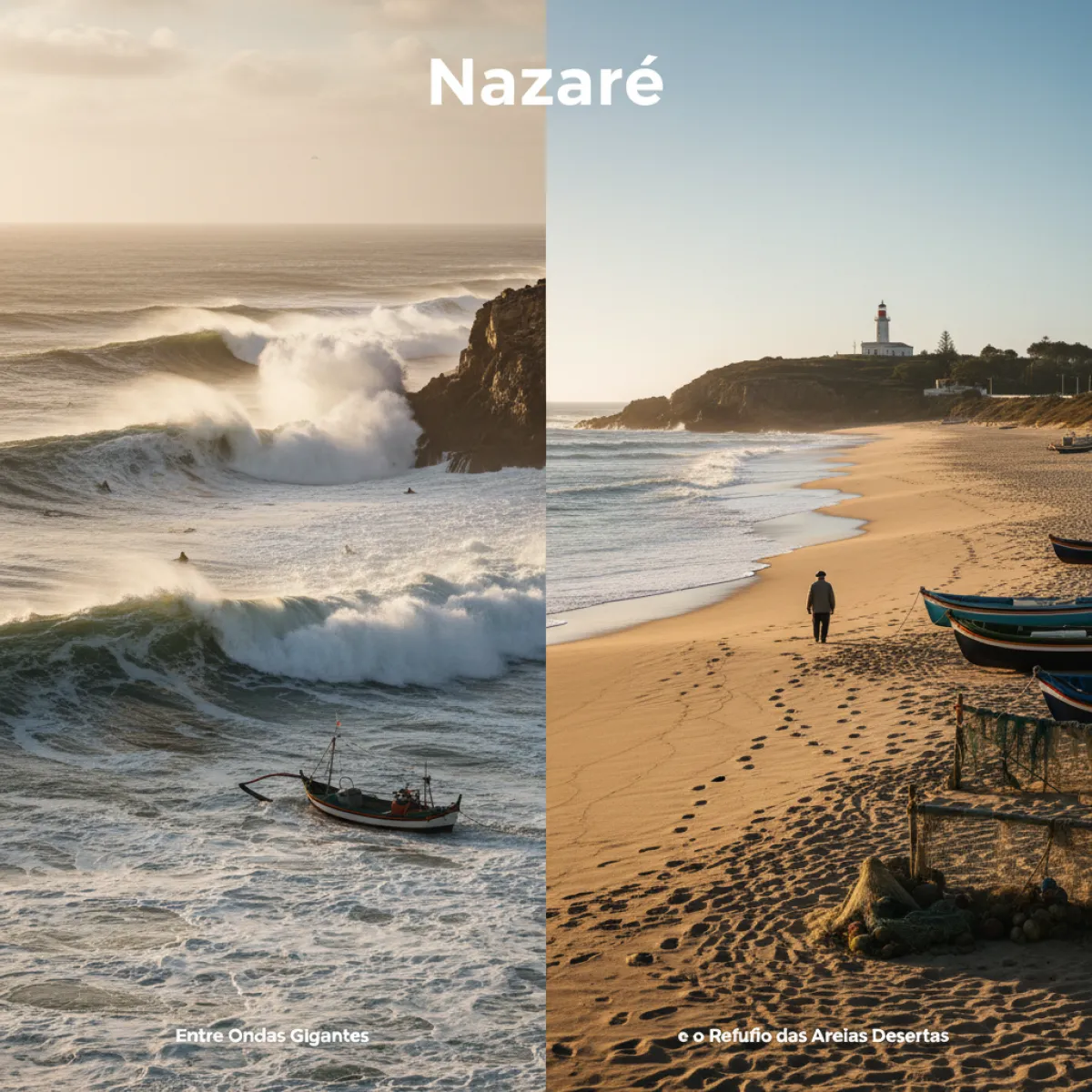
The Nazaré Paradox: Two Cities in One
Arriving in Nazaré on a Saturday in August is an exercise in patience that would test a saint. Traffic on Avenida Manuel Remígio moves at the pace of a tired snail, and the scent of sunscreen mingles with the smoke from grill-side terraces. Yet, there is a reason why, despite the chaos, we keep coming back. Nazaré isn't just a seaside resort; it's a brutal confrontation between Portugal's most stubborn traditions and the global circus of big-wave surfing.
The first thing you need to understand is that Nazaré is divided into three: the Praia (the center, by the sea), the Sítio (atop the cliff), and Pederneira (the historic neighborhood further up). If you want to avoid the crowds, the golden rule is simple: move when others sleep and eat where others won't go. At 7 AM, the promenade belongs to the fishermen and the women spreading fish on the sand. This is when the town is real, without the filter of mass tourism.
The Main Beach and the Art of Drying Fish
The main beach is a golden sand crescent that, in summer, disappears under a sea of colorful sunshades. To escape the muddle, walk south toward the fishing port. Here you'll find the Museum of Dried Fish. Don't expect interactive panels or air conditioning; what you'll see are the traditional "paneiros" (wooden racks) where mackerel, squid, and ray dry in the sun, protected by nets and watched over by women who have mastered this craft for generations. It’s a sharp, salty smell that clings to your clothes, but it is the essence of this land.
If you want to dive into the local culture without feeling like an intruder in a theme park, I highly recommend Nazaré's Seven Skirts Tradition with Alma Nazaré Tours. It is a genuine way to understand why the women here still wear seven overlapping skirts and how the long absences of husbands at sea shaped a powerful matriarchal society. This isn't folklore for tourists; it's the identity of a people who have always lived with one foot on land and the other on the abyss.
O Sítio: Where the Sea Becomes Myth
To reach the Sítio, you can hike up the Ladeira do Sítio (brace your legs) or take the funicular. The ticket costs about 5 euros return, and the few-minute journey offers the best view over the town. At the top, Largo de Nossa Senhora da Nazaré is the epicenter of the movement. Ignore the stalls selling plastic souvenirs and focus on the Ermida da Memória, where legend says D. Fuas Roupinho was saved from falling off the precipice by the Virgin Mary in 1182.
From the Sítio, an essential walk begins: the descent to the Lighthouse (Farol de D. Leonor) at the Fort of São Miguel Arcanjo. This is where the famous Nazaré Canyon, a 5-kilometer-deep underwater geological fault, works its magic. In winter, this place is the Colosseum of world surfing. In summer, the sea might look calm, but the energy felt at the fort, with waves crashing against centuries-old rocks, is overwhelming. The entry fee to the fort is symbolic (around 2 euros), and the exhibition of surfboards left by world record holders is worth every cent.
Praia do Norte: Where Crowds Fear to Tread
If the main beach is a kindergarten, Praia do Norte is the Wild West. To get there from the Sítio, just follow the dirt path descending to the north. Here, there are no lifeguards every fifty yards, no loungers for rent, and often, the morning mist covers the sand like a heavy sheet. It is the perfect beach for those seeking solitude and space. Even in August, you can walk for miles without crossing paths with anyone but a rod fisherman or a lone surfer.
Be warned: the sea here is no joke. The currents are incredibly strong and the depth drops off abruptly. This is a beach for contemplation, not necessarily for swimming, unless you are an expert swimmer and the sea is exceptionally flat. This dramatic coastline is part of a Portugal Itinerary: A Week in the Heart of the Country, which connects fishing traditions to the monumentality of Alcobaça and Batalha, both less than 20 minutes away by car.
Where to Eat (And Where to Avoid)
Rule number one in Nazaré: avoid restaurants with photos of dishes on the menu or touts at the door trying to convince you to enter. If you want the real Nazaré fish stew (caldeirada) or a seafood rice that isn't made for the masses, you must get lost in the narrow streets behind the promenade. Look for Rosa dos Ventos on Rua Gil Vicente. It’s a tiny space, no frills, but where grilled fish is treated with the respect it deserves. If you prefer something more established but still honest, A Tasquinha is an institution, portions are generous and the monkfish rice (arroz de tamboril) is mandatory.
For a quick snack, the Mercado Municipal on Rua Adrião Batalha is the place to be. It opens early (around 7 AM) and closes by 1 PM. Buy some fresh barnacles (percebes) or a handful of lupin beans and eat them by the sea wall. If you are exploring the region, you might find that Nazaré offers a gritty contrast to the intellectual heights of Coimbra: The Grammar of Time in Portugal’s Intellectual Capital.
Practical Tips for Surviving Nazaré
When to go
May, June, and September are the golden months. The weather is stable, the water is as warm as it gets (which is never very warm in Nazaré), and accommodation prices drop significantly. If your goal is to see the giant waves, you must come between October and March, but prepare for the cold and the uncertainty, the big swells depend on storms in the North Atlantic.
Getting there and parking
From Lisbon, it’s about 1 hour and 20 minutes via the A8. Parking in the town center is an absolute nightmare in summer. My advice: leave your car in one of the peripheral lots or in the Pederneira area and walk down. If you are coming from the north, you can include Nazaré as a strategic stop after visiting the central region, as detailed in The Measured Pace: A Seven-Day Passage from Lisbon to Porto via the Ria.
Approximate costs
- Meal at a mid-range restaurant: €25 - €35 per person.
- Coffee and a beer (imperial): €3 - €4.
- Funicular: €5 (round trip).
- Accommodation (Local guesthouse): €60 - €90 per night in mid-season.
Nazaré demands that you look past the tourist varnish. It is a land of contrasts, where jet-skiing surfers share the horizon with wooden fishing boats painted in bright colors and eyes to ward off the evil eye. Don't just come for the Instagram shot; come to feel the wind, the salt, and the grit of a community that refuses to be just a footnote in a travel guide.
