Chasing the Liquid Giants: A Spectator’s Guide to the Praia do Norte Canyon
Experience the adrenaline and tradition of Nazaré, home to Europe's largest underwater canyon and its colossal waves. An essential spectator's guide on where to stay, what to eat, and how to witness the giants of Praia do Norte.
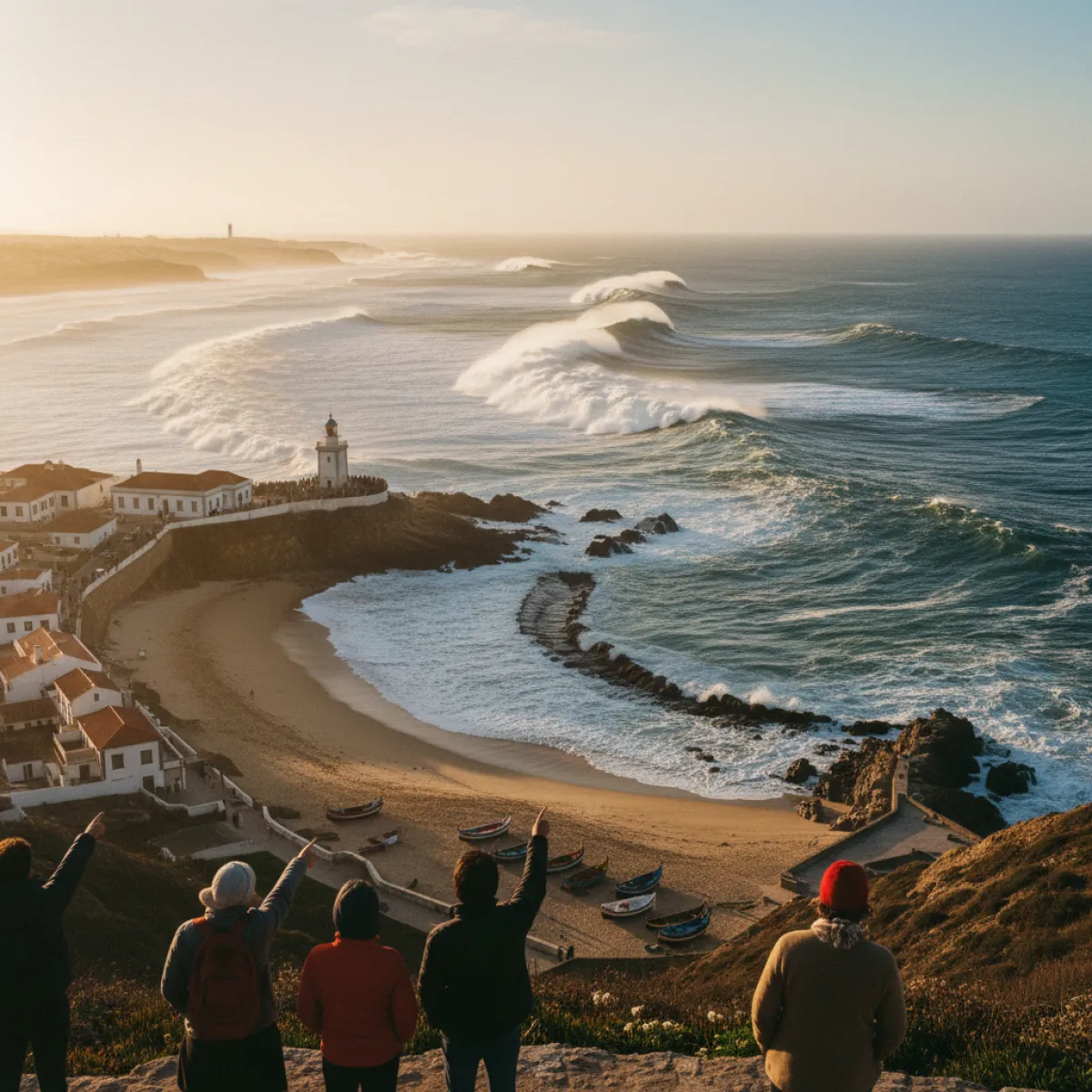
The Roar of the Atlantic
There is a specific sound that defines Nazaré during the winter months. It is not the common crashing of waves heard in any beach resort in the Algarve or Ericeira. It is a dull thud, a low frequency felt more in the chest than the ears. When the North Atlantic decides to flex its muscles, this small fishing village becomes the epicenter of a geological and human phenomenon without parallel. The Nazaré Canyon, a tectonic fault five kilometers deep and 230 kilometers long, acts as an invisible funnel, channeling the energy of distant storms directly to the base of the Forte de São Miguel Arcanjo.
For those arriving in Nazaré as part of a Portugal Itinerary: A Week in the Heart of the Country, the visual shock is immediate. The town is divided between the modernity of the lower beach area and the solemnity of the Sítio, the rocky promontory rising 110 meters above sea level. It is here, atop this cliff, that the scale of nature becomes almost incomprehensible. Watching a 70-foot wave rise at Praia do Norte is not just a sporting spectacle; it is a direct confrontation with the sublime indifference of the ocean.
The Mechanics of the Monstrosity
What makes Nazaré special is not just the size of the waves, but their architecture. The submarine gorge ends abruptly just a few hundred meters from the shore. As the swell travels over the canyon, it maintains its speed and energy due to the depth. However, when it hits the shallow continental shelf, the bottom of the wave brakes suddenly, forcing the crest to project upward with geometric violence. Add to this the backwash from the beach and an offshore wind, and you have the recipe for the largest waves ever surfed.
For the spectator, planning is essential. The "Big Wave Season" runs from October to March, but the gala days are rare. They require a specific swell, usually generated by depressions in the North Atlantic. For those traversing the country, perhaps following The Measured Pace: A Seven-Day Passage from Lisbon to Porto via the Ria, Nazaré serves as a technical stop where time dictates its own rules. You do not rush the ocean. Hours are spent staring at the horizon, where the mist often blends with the sea spray.
Logistics of the Vantage Point
Forget grandstands or reserved seating. The best place in the world to witness this spectacle is the wall of the Forte de São Miguel Arcanjo. Access costs two euros, a negligible fee to enter the building that houses not only the lighthouse but also a fascinating collection of surfboards that survived (or didn't) the giants. The wind here is relentless. Even on a sunny day, the salty humidity and northern gusts demand technical mountain gear or, at the very least, a high-quality windbreaker. If you plan to stay for several hours, and you will, mesmerized by the ballet of jet skis towing surfers into the abyss, bring binoculars. The distance between the fort and the wave's break point (the "peak") is deceptive.
Life Beyond the Cliff
Nazaré possesses a fascinating duality. While elite athletes like Sebastian Steudtner or Maya Gabeira discuss currents and safety over radios, just a few meters away, the women of Nazaré, the famous "seven-skirted" ladies, continue to dry mackerel in the sun on the sand. This coexistence between globalized extreme sports and the purest fishing tradition is what saves the village from becoming a tourist caricature. It is a place of work, whether in the deep sea or selling dried fruits in the Sítio.
For a break from the maritime intensity, many travelers opt for a cultural incursion inland. It is a sharp but necessary transition to visit Coimbra: The Grammar of Time in Portugal’s Intellectual Capital, where the silence of the libraries and the fado of the black-caped students offer an intellectual counterpoint to the raw brute force of Praia do Norte. That is the beauty of central Portugal: in less than an hour's drive, you pass from the liquid frontier of the world to the cradle of European knowledge.
Where to Eat and How to Budget
In Nazaré, luxury isn't measured by Michelin stars, but by the freshness of what comes out of the nets. *A Tasquinha* remains an institution. They do not take reservations, so arrive early or prepare to wait with a glass of white wine in hand. Order the Seafood Rice (Arroz de Marisco) or the Fish Pasta (Massa de Peixe). A budget for a generous meal is around 25 to 35 euros per person, including house wine. In the Sítio, for something quicker but with a view, *Taberna do Adélio* offers honest snacks (petiscos).
Regarding accommodation, if the goal is to watch the waves, *Hotel Praia* in the lower town is functional, but for a more authentic experience, look for family-run pensions in the Sítio. Waking up to the sound of the foghorn and the bell of the Church of Nossa Senhora da Nazaré is a privilege that modern hotels cannot replicate.
Pro Tips
- Transport: Renting a car is mandatory. Public transport to Nazaré is slow and limits mobility between the best viewpoints.
- Safety: Never, under any circumstances, go down to the sand at Praia do Norte on a big wave day. The current is treacherous and waves can surge across the sand in seconds. The fort's viewpoint is your safety limit.
- Technology: Install the *Windguru* or *Surfline* app. Learn to read the wave period (the time between crests). If the period is above 14 seconds and the swell comes from the Northwest, get your camera ready.
Nazaré is not just a destination; it is a reminder of our scale. When you see a wall of water the height of a six-story building collapsing, all daily worries seem appropriately microscopic. It is an experience of humility, written in the language of foam and granite.
