Coimbra's Queima das Fitas: An Honest Guide to Praxe
Eight nights, tens of thousands of people, and the Sé Velha cathedral in absolute silence at midnight: an honest guide to Europe's largest student festival, with practical advice on where to stay, what to eat, and where to escape when you need to breathe.
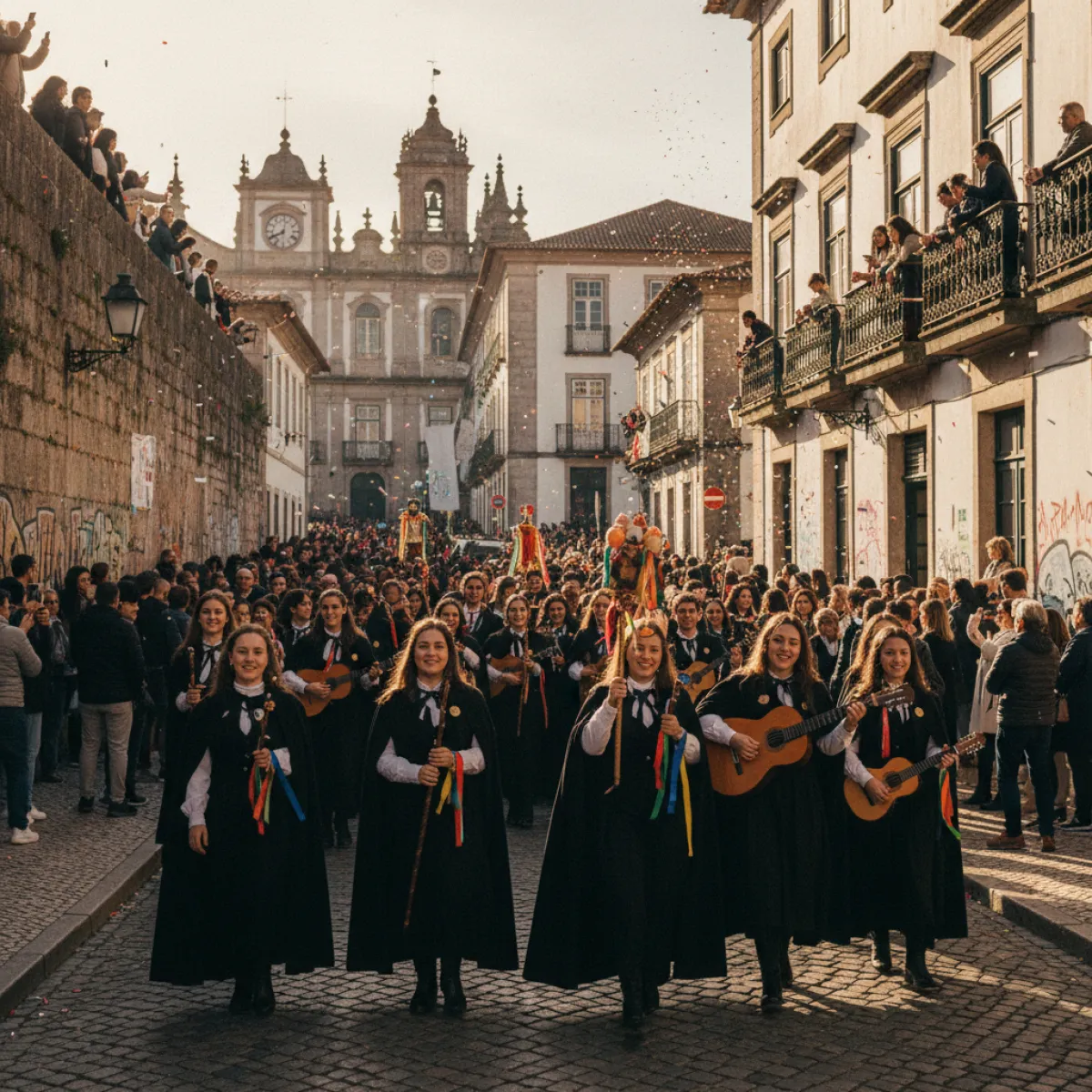
For one week each year, Coimbra stops being a city of 140,000 people and turns into a single organism dressed in black, coloured ribbons pinned to its chest, singing fado off-key at three in the morning. It's called Queima das Fitas, it always falls in the first week of May, and if you've never lived through it, brace yourself: nothing you read here will prepare you for the scale of the thing. But I'll try.
Let me be straight from the start. Queima is simultaneously one of the oldest student festivals in Europe and a logistical operation that makes a mid-sized city implode and reassemble itself across seven days. You'll see beautiful things, you'll see ridiculous things, you'll hear the best Coimbra fado of your life, and you'll probably wake up with swollen feet in a room that isn't yours. It's all part of the deal.
What Queima das Fitas actually is
The festival was born in the mid-19th century as a ritual where final-year University of Coimbra students burned the leather folders they'd carried their notes in throughout their degree. Today they burn the ribbons instead, one per faculty, in a ceremony that looks like a Wagner opera staged by sleep-deprived twenty-somethings.
Ribbon colours are a religion. Yellow is Medicine, dark red is Law, light blue is Humanities, bright red is Pharmacy, white is Theology, purple is Psychology. There are more, and finalists wear them for the entire week as if they were coronation robes. Don't joke about them with a senior who's been drinking. Trust me.
When exactly
Queima always starts on the first Friday of May with the Serenata Monumental, in front of the Sé Velha cathedral, and ends the following Sunday. That's eight nights, seven dawns, five working days where attempting to attend lectures becomes a punchline. In 2026, the Serenata falls on May 1st. Book accommodation now, or forget it. Seriously: even hostels out in the Olivais neighbourhood are full by January.
The Serenata Monumental: the one thing I beg you not to miss
If you can only see one thing during Queima, see this. Friday night, the steps of the Sé Velha, tens of thousands of people in absolute silence listening to the Capella Académica choir and soloists sing Coimbra fado. It's one of the rare moments in Portugal when you'll see a crowd without drinks in their hands actually shut up for an hour because the music demands it.
The ritual starts around midnight. Get there before ten if you want a spot on the steps. Bring a sweater, even in May Coimbra cools down at night and the humidity rises from the Mondego up through the alleys. Don't bring a chair, don't bring a giant umbrella, don't bring small talk: respect the silence or you'll be corrected by a grandmother from Cernache who's been coming for fifty years.
After the Serenata, if you're hungry for more fado, stretch the night out. The most credible Coimbra fado venue on any other night of the year is À Capella, a 14th-century chapel converted into a fado house. Book ahead: a night of fado and tradition at À Capella is not staged for tourists, it's the real choir of people who know what they're doing, and schedules shift during Queima week, so check locally.
The Cortejo: why standing in the right place matters
The Cortejo Académico, usually on Tuesday or Wednesday of the week, is when the city stops working. Over two thousand people, every faculty, floats packed with finalists hurling everything that can be hurled (warning: watch out for paint cans), parade through town for four to five hours at the speed of a drunk snail.
Practical tip: don't watch the Cortejo from Praça 8 de Maio. It's crammed, chaotic, and you'll spend three hours arguing with a Swedish guy who insists you're shoving him. Head instead for the upper end of Rua Ferreira Borges or, even better, climb up to Praça da República near the end of the route. Fewer people, decent queues for the fartura stalls, and a clean front view of the floats you missed earlier.
What to wear, what to eat, what it costs
- Wear: comfortable trainers, a sweater for the night, clothes you're willing to sacrifice. Queima is humid and dirty: paint from the parade, spilled beer, dust from the festival grounds. Don't wear white.
- Eat: have a proper dinner before nine in the evening, or accept that supper will be a bifana and a fartura. Restaurants in the Baixa close their kitchens early during Queima because their staff also want to be at the party. Zé Manel dos Ossos still serves its famous bones-in-sauce until reasonably late, but expect a queue.
- Cost: the Queima wristband (which gets you into the Queimódromo concert grounds) runs around 30 to 40 euros for the whole week, check locally for the current year. Beer at the venue, two and a half euros. Bifana, three to four. Decent hotel in Coimbra during Queima week: 120 euros and up per night, and that's optimistic.
The Queimódromo: the electric heart, and its weak point
The Queimódromo is the official concert venue, set up each year in the Choupal park or thereabouts. Seven nights, seven headliners, usually a mix of Portuguese pop, hip-hop, rock and DJ sets. The line-ups have ranged from veterans like Xutos to current acts like Plutonio.
The Queimódromo's flaw is simple: it's far from the Baixa, dusty, and getting out at four in the morning is an odyssey. There are shuttles, there are extra TUC buses, but the queue for the return bus could feature in a disaster movie. The real solution is walking. It's about forty minutes along the Mondego riverside, and however knackered you are, that walk at dawn with the river on your left is one of the best unscheduled moments of the festival.
If you'd rather skip a Queimódromo night, do it. You're not obliged to grind through seven nights in a row. The finalists do, on principle, but you don't have ribbons to burn.
Where to escape when you need to breathe
Even in the middle of academic delirium, you'll want to step away. Coimbra isn't only the Alta and the Baixa: it has green areas and residential streets that stay weirdly normal even during Queima.
For a morning getaway, climb up to the Miradouro do Vale do Inferno, on the Santa Clara side. The name (Hell Valley Viewpoint) sounds dramatic but the view is worth it: the whole city below, with the University tower dominating, and at the right hour, with mist rising off the river, you understand why everyone gets obsessed with Coimbra eventually.
For an afternoon out, leave town. Twenty minutes by car, in Condeixa, the Passeite olive oil journey is the perfect antidote to a Queimódromo hangover: fresh air, solid food, two hours discussing olive oil acidity with people who actually know the subject. Book ahead, they run on set times.
Walking the city while everyone sleeps
The half-told secret of Queima is what happens between eight and eleven in the morning. The city is half-deserted. Students sleep, tourists haven't yet reached the Sé Velha, and you have Coimbra practically to yourself.
It's the best time to walk the Alta slowly and notice what usually goes missed. For some years now, Coimbra has stopped being only the city of classical stone and become an open-air gallery. The murals reshaping the Alta tell another story about the city, younger, angrier, and they deserve an unhurried morning to be properly seen.
Have breakfast in a neighbourhood café off the main circuit. Avoid the Praça do Comércio spots that week, they're crammed and the staff are wrecked. Walk up Rua de Tomar, or explore the Santa Clara side, and order toast with butter and a galão. It costs you two and a half euros, three at most, and it's the kind of breakfast that makes Queima survivable.
For non-students who still want to feel the energy
Fair question: does it make sense to travel to Coimbra during Queima if you're not twenty and don't have university friends? Honest answer: depends.
- If you're up for staying out till morning, yes. The energy is genuine and contagious.
- If you want a calm cultural trip with good dinners, no. The city is exhausted, restaurants are short-staffed, and museums cut their hours.
- If you can come just for the Serenata weekend and the Cortejo, that's the best compromise: you see what matters, and escape before the exhaustion sets in.
If you're planning a wider trip across central Portugal, you can fold Coimbra into a one-week loop and use Queima as a high point without becoming a hostage to it. Our week-long itinerary across the heart of the country proposes a route that balances city and countryside, and works particularly well if you arrive in Coimbra on Thursday and leave on Monday.
The week before and the week after
Another option, possibly the smartest, is to come to Coimbra the week immediately before or after Queima. Prices drop, the city breathes, and you still catch the pre or post-festival mood, with finalists rehearsing for the Serenata in any patio of the Alta.
May, in central Portugal, is one of the best months of the year for walking. If you want to extend your trip toward the coast, there are quiet coastal trails two hours from Coimbra. The honest April walks around Caldas da Rainha work just as well in May, and provide the exact counterpoint to Queima's urban intensity.
What to bring, what to leave at home
- Bring: ID (it can be requested at the Queimódromo), cash for the food and drink stalls (the on-site ATM queues are absurd), a portable phone charger.
- Bring: sunscreen. Yes, even for a night festival. Cortejo afternoons are full sun.
- Leave behind: high heels, white skirts, expectations about timing. Anything scheduled for one hour starts forty minutes later.
- Leave behind: the car. Park it south of the Mondego and walk in. Driving in Coimbra during Queima is a form of medieval punishment.
Last note: Queima ages well
There are people who come back to Coimbra ten, twenty, thirty years after their final year, just for the Serenata. Watching them on the Sé Velha steps, ribbons stored away at home for decades but mouthing every chorus in silence, is the most moving part of the whole week. Queima isn't only a student party: it's a collective memory machine this city has built over 150 years, and it still runs with a precision that puts much more serious things to shame.
Go with patience, go with rested feet, go with curiosity. And when the Serenata begins, stay quiet, even if the people next to you are talking. The silence is part of the festival too.