Coimbra's Street Art: The Murals Reshaping the Alta
Coimbra's Alta district has gained a new visual dimension in recent years: large-format murals claiming blind gables and forgotten alleys between the Sé Velha and the University. A free two-to-three-hour walk, best in late afternoon, that serves as an entry point to one of Portugal's most interesting, and most vertical, neighborhoods.
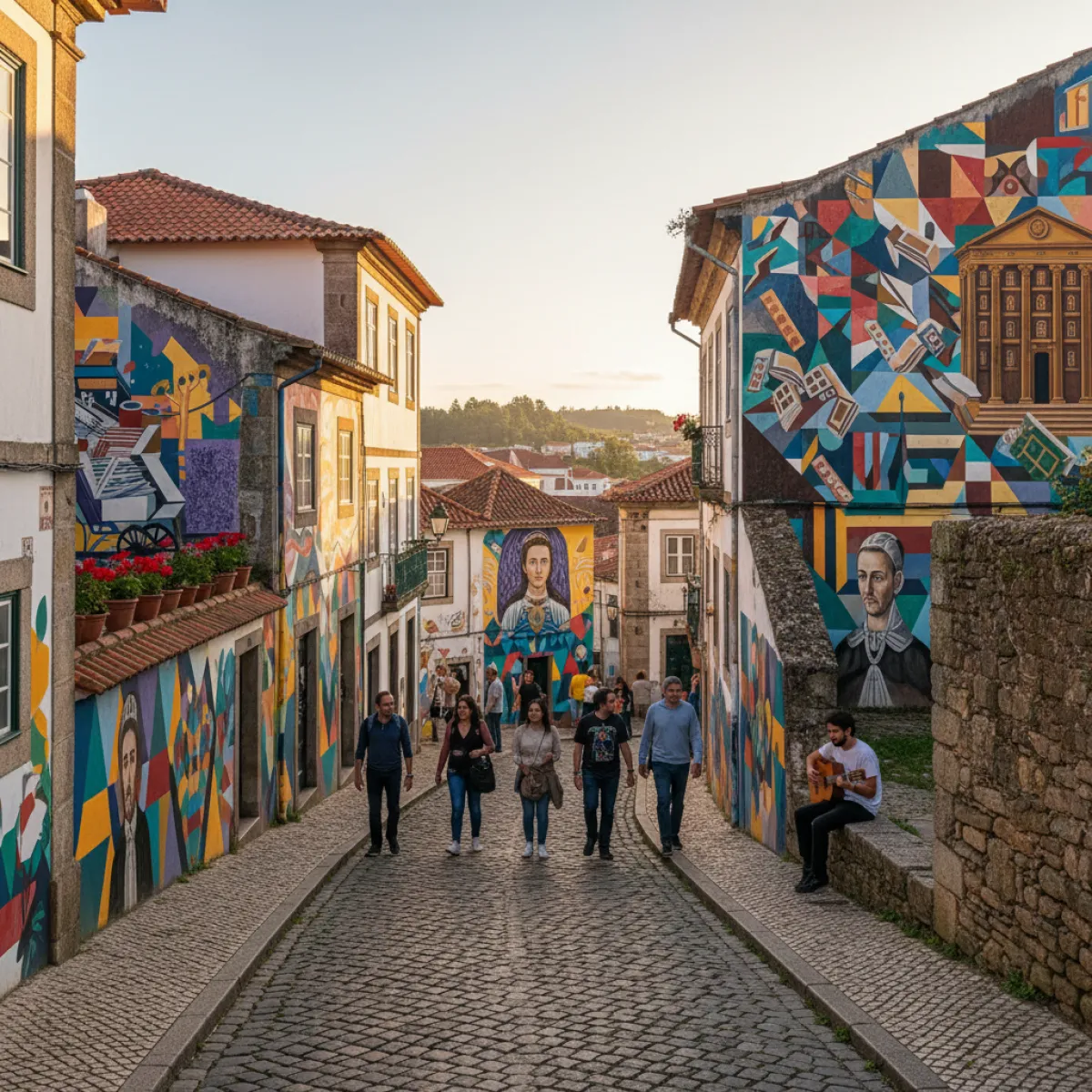
There's a productive tension running through the streets of Coimbra's Alta district that didn't exist a decade ago. On one side, the limestone walls of Portugal's oldest university, stairs worn smooth by centuries of student footsteps, the heavy quiet of the Sé Velha on a Tuesday morning. On the other, entire walls turned into declarations of color and intent, murals claiming blind gables, forgotten alleys, and building facades nobody used to look at twice. The Alta has changed, and it wasn't by municipal decree. It was by spray can.
The Context: An Alta in Transition
To understand the murals, you need to understand the neighborhood. Coimbra's Alta, the zone climbing from the Arco de Almedina up to the University, spent decades in relative decline. While the Baixa buzzed with commerce, the Alta emptied out. Derelict buildings, streets deserted after six in the evening, facades crumbling quietly. The student repúblicas, those legendary communal houses, kept some life going, but the urban fabric was fraying.
It was in this emptiness that street art found space, literally. Blind walls, gables exposed by demolitions, retaining walls with no aesthetic function. The first murals appeared more or less spontaneously, but in recent years there's been a more organized effort to turn the Alta into an open-air art trail. Coimbra doesn't have the scale of Lisbon's Bairro Padre Cruz or the riverside murals of Estarreja, but it has something those don't: the stark contrast between contemporary art and medieval stone.
The Route: From the Stairs to the Viewpoint
The best starting point is the Arco de Almedina, the medieval gate that still marks the entrance to the old city. Go up. There's no alternative, the Alta is vertical, and if you don't like stairs, you'll suffer. The Escadas do Quebra-Costas (literally "Backbreaker Stairs") are the first test of your legs and determination. But it's precisely on this climb that the first interventions start appearing, small pieces, stencils, paste-ups mixing with broken tiles and clotheslines.
The area between Rua do Corpo de Deus and the Sé Velha is where things get more interesting. Here, the building gables have enough scale for large-format murals. I won't invent names of pieces or artists I can't verify, the scene shifts fairly often, and the best approach is to go with open eyes and no fixed script. But what I can tell you is that the average quality is surprisingly high. This isn't random graffiti, these are considered interventions that engage with the space and its history.
Keep climbing toward the University. Rua da Alegria, ironic or prophetic name, depending on the day, has some notable pieces, and the area around the student repúblicas is a catalog of free expression mixing the political with the poetic. The repúblicas have always been territory for visual intervention: flags, posters, protest murals. The difference now is that professional artists have joined the conversation.
After exploring the university zone, descend on the opposite side toward Miradouro do Vale do Inferno. The name is dramatic but the view is real, from there you get a different perspective on the Alta's hillside, and on clear days you can spot some of the larger murals on building gables across the slope. It's also a good place to catch your breath and figure out what comes next.
What to Look For (and What to Skip)
Not everything painted on a wall is quality street art. Coimbra, like any university town, has its share of rushed tags and uninteresting vandalism. The difference lies in intention and execution. The murals worth your time, and there are several, share some characteristics: dialogue with the surrounding architecture, references to local history (the university, fado, the river), and a scale that transforms the experience of walking down the street.
Look for south-facing gables, which catch the best light in the afternoon. Look for the side alleys between Rua Corpo de Deus and Couraça dos Apóstolos, they're the least trafficked and, as it turns out, the most rewarding. And don't limit yourself to the Alta: the Rua da Sofia area and the descent toward the Jardim Botânico also have occasional interventions worth the detour.
What to skip? The broken tiles with pseudo-philosophical messages written in marker. Charming the first time, tiresome by the tenth. And the advertising murals disguised as art, there are one or two that are clearly commercial commissions with zero artistic value. It comes with the territory.
When to Go and How to Get There
The best time to photograph the murals is late afternoon, when the raking light hits the west-facing gables and creates shadows that add depth. Avoid midday, besides the heat in warmer months, direct light flattens everything and drains the drama from the colors.
The full Alta circuit, from the Arco de Almedina to the viewpoint, with detours, takes two to three hours on foot, depending on how many stops you make. It's free, obviously. The only cost is the stairs on your legs. Wear comfortable shoes, the pavement is traditional calçada portuguesa and there are uneven stretches.
If you're coming from outside Coimbra, the city connects easily by train to Lisbon (about two hours on the Alfa Pendular) and Porto (just over an hour). Coimbra-B is the main station, with a free shuttle to Coimbra-A in the city center. From the station to the Alta is about fifteen minutes on foot, climb included.
If you're planning a longer trip through central Portugal, this walk fits well into a week-long itinerary through the heart of the country, which can include stops in Tomar, Leiria, and Viseu. Or if you prefer a route linking Lisbon to Porto, the seven-day passage from Lisbon to Porto passes through Coimbra and gives enough time to explore the Alta properly.
After the Murals: What Else to Do in Coimbra
Street art is an excellent entry point into Coimbra, but it's not the only reason to come. After the walk, there are decisions to make.
For food: head down to the Baixa. The area between Praça do Comércio and Rua da Sofia has tascas serving honest lunches at student prices. Look for chanfana, goat slow-cooked in red wine from the Bairrada, the region's signature dish. It's not a pretty plate, but it's deeply satisfying. Pastéis de Santa Clara, made with almond and egg yolk, are the mandatory finish to any meal.
For the evening: Coimbra's fado is different from Lisbon's. More austere, traditionally male-only in its singing, rooted in academic culture. If you want to experience it in its most authentic form, a night of fado at À Capella is what you're after, the space is a former 14th-century chapel, and the acoustics do half the work.
If you have an extra day and want to get out of the city, the Condeixa area (twenty minutes by car) has the ruins of Conímbriga, one of the best-preserved Roman sites on the Iberian Peninsula, and also a professional olive oil tasting at Passeite that's worth the trip.
The Bigger Question
Some people look at the Alta's street art and see gentrification dressed up as culture. It's not an entirely unfair critique, the story of historic neighborhoods that gain murals, then specialty coffee shops, then Airbnbs is well-known across Europe. But Coimbra's case is more nuanced. The Alta was already emptied out before the murals arrived. The buildings were already derelict. The street art didn't displace anyone, it occupied what was already vacant.
That doesn't mean the future is guaranteed. If the murals attract speculative property investment rather than actual life, the Alta risks becoming an Instagram backdrop without substance. But for now, in 2026, there's an interesting equilibrium. The murals coexist with the repúblicas, with the students, with the old grocery shops that still hang on. It's an Alta in transformation, not a transformed Alta.
My advice? Go now. Not in five years, when the guidebooks have cataloged everything and organized tour groups are blocking the stairways. Go on a Wednesday morning, when the Alta is half-empty and the light is just starting to climb the walls. Bring a camera if you want, but mostly bring curiosity. The murals are there. The Alta is changing. And the best time to see a city in flux is while it's still in flux.