Liquid Gold in Coimbra: A Professional Olive Oil Journey at Passeite
Explore the science and sensory depth of authentic Portuguese olive oil at Passeite in Condeixa. Led by an international sommelier, this professional workshop teaches you how to identify quality in every drop of liquid gold.
The Science and Soul of Portuguese Olive Oil
In the rolling hills just outside the academic hub of Coimbra, a transformation is taking place. While most travelers associate Portugal’s central region with fado and ancient libraries, a family-run estate in Condeixa-a-Nova is inviting visitors to look closer at the ground beneath their feet. Passeite, an artisanal olive oil producer, has established itself as a premier destination for those seeking to understand the technical and sensory complexity of high-end Extra Virgin Olive Oil (EVOO).
Led by international olive oil sommelier Marije Passos and her family, the experience at Passeite is far removed from a standard farm visit. It is a deep dive into the world of "Liquid Gold," where the curriculum covers everything from soil chemistry to the precise mechanics of human taste buds. Just as one might explore the intellectual foundations of the city in Coimbra: The Grammar of Time in Portugal’s Intellectual Capital, a visit here provides a technical education in one of the country’s oldest traditions.
Terroir and Tradition in Condeixa
The journey begins in the groves of Atadoinha. The landscape here is defined by limestone soils and a specific microclimate that challenges the olive trees, forcing them to concentrate flavors in their fruit. Unlike industrial plantations, Passeite focuses on traditional Portuguese varieties, primarily the Galega and Cobrançosa. During the walk through the grove, you will learn why the timing of the harvest is the single most important factor in quality. While many producers wait for the olives to turn black to maximize oil quantity, Passeite harvests early, when the fruit is still green or changing color, to prioritize high polyphenol counts and vibrant aromatic profiles.
The commitment to quality reflects the same rigor found in the ancient halls of the university, a subject explored in Coimbra: The Vertical Soul of Portugal’s Intellectual Heart. Seeing this level of precision applied to agriculture shifts the visitor's perspective on what it takes to produce a world-class product.
The Sommelier’s Workshop: A Step-by-Step Tasting
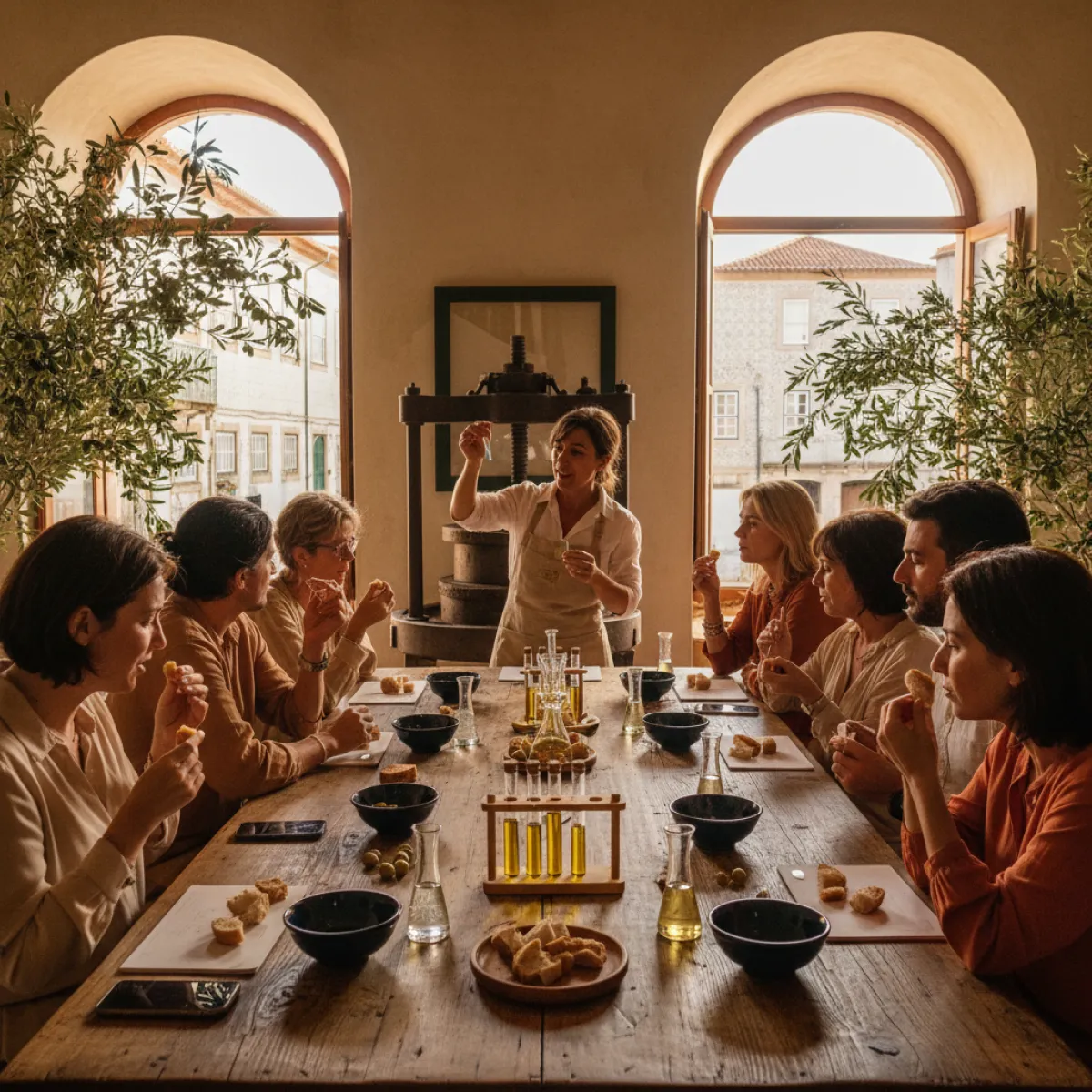
The core of the experience is the professional tasting session. Visitors are seated at a table equipped with cobalt blue tasting glasses. These specialized glasses are used to prevent color bias; in the world of professional olive oil assessment, a vibrant green hue does not necessarily equate to superior quality. By hiding the color, the sommelier ensures that your judgment is based solely on aroma and taste.
The tasting follows a strict professional protocol:
- Warming the Oil: You begin by cupping the glass in your hand and covering it with the other to bring the oil to body temperature (around 28°C), which releases the volatile aromatic compounds.
- The Aroma Check: After a few minutes, you remove your hand and take a deep breath. A high-quality EVOO should smell fresh and clean, notes of tomato leaf, green grass, artichoke, or green apple are common indicators of a well-made oil.
- Strippaggio: This is the most technical part. You take a small sip and, while keeping the oil in the front of your mouth, inhale air sharply through your teeth. This aeration spreads the oil across the palate, allowing you to detect the bitterness on the tongue and the distinctive peppery "burn" (pungency) at the back of the throat.
Understanding that bitterness and pungency are positive attributes, indicators of antioxidants, is often a "lightbulb moment" for many participants. Marije guides you through identifying the balance between these three pillars: fruitiness, bitterness, and pungency.
Practicalities for Your Visit
Passeite is located in the municipality of Condeixa-a-Nova, approximately 15 to 20 minutes south of Coimbra’s city center. The farm tours and workshops are conducted in both English and Portuguese, making it accessible to international visitors. Because the session involves walking through active agricultural land, comfortable, closed-toe shoes are essential. The terrain can be uneven, and depending on the season, you may be walking through tall grass or dry earth.
The best time to book depends on what you wish to see. Spring (April-May) is beautiful for the olive blossom, while the harvest season (October-November) offers a chance to see the mill in operation. However, the tasting workshops are available year-round and are held in a temperature-controlled environment to ensure the oil remains in peak condition.
After your session, consider driving to the nearby Miradouro do Vale do Inferno. This viewpoint offers a stunning perspective of the surrounding valley, allowing you to appreciate the geographical scale of the olive groves you’ve just explored. To ensure a spot, it is recommended to book at least a week in advance via the provider’s website, especially during the peak summer months.