April Walks Around Caldas da Rainha: An Honest Guide
Caldas da Rainha doesn't make the usual hiking lists in Portugal. In April, with deserted cliffs, the Óbidos Lagoon at full capacity, and perfect walking temperatures, that might be just fine, more trail for those who know where to look.

Let's get this out of the way: when people talk about hiking in Portugal, they mean Gerês, the Rota Vicentina, maybe the Azores. Caldas da Rainha doesn't come up. Which is precisely why you should lace up your boots and come here in April.
The Caldas da Rainha region has something that most popular hiking destinations lack: compressed variety. Within twenty kilometres, you go from limestone cliffs to brackish lagoons, from dense pine forests to wind-swept dunes. And in April, before the heat arrives and the beaches fill up, you'll have it mostly to yourself.
The Coast from Foz do Arelho to São Martinho do Porto
This is the walk that matters. If you only have time for one route, make it this one. It starts at Foz do Arelho, on the northern shore of the Óbidos Lagoon, and follows the coastline north to São Martinho do Porto. About 12 kilometres, moderate elevation gain, three to four hours at a reasonable pace, meaning you actually stop to look at the ocean.
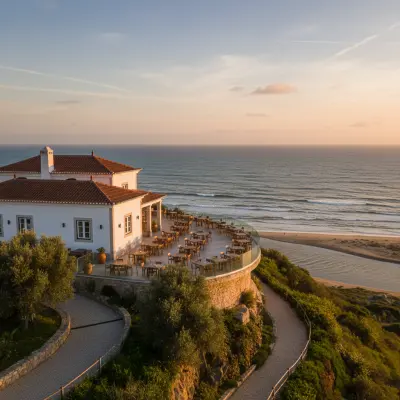
The ideal starting point is by the Miradouro da Foz do Arelho, which offers one of the best views on the Portuguese west coast. On one side, the open Atlantic. On the other, the Óbidos Lagoon spreading lazily inland. In between, the sandbar, a strip of sand that shifts shape with the tides and seasons. Get there early. At eight in the morning, with April's low-angle light, the place feels like a different country.
From here, the path follows the clifftops heading north. It's not officially waymarked with the consistency of a PR route, but the trail is well-worn and easy to follow. There are stretches along secondary roads, not glamorous, but short-lived. Most of the walk is on dirt tracks and narrow paths through low scrub, with the ocean always to your left.
Halfway through, the detour to Salir do Porto is non-negotiable. The village itself is small and unpretentious, half a dozen restaurants, a tiny harbour, houses in various states of repair and renovation. But the Miradouro de Salir do Porto is something else entirely. It sits atop the northern cliff of the São Martinho do Porto bay, and the view from there, the near-circular bay, the sea pushing through its narrow opening, is the kind of thing that justifies the entire walk.
Practical details
Free parking at Foz do Arelho outside peak season. In April, you won't have trouble. For the return, Rodoviária do Oeste runs buses between São Martinho do Porto and Caldas da Rainha (check schedules locally, they change). From Caldas, it's a ten-minute drive back to Foz. Bring water, there are no fountains on the trail. The only resupply point is Salir do Porto, at the midpoint.
Walking Around the Óbidos Lagoon
The Óbidos Lagoon is the largest coastal lagoon on the Iberian Peninsula, and walking its perimeter is a full-day project. It's roughly 25 kilometres around the edge, mostly flat paths along the shore, but with some road sections and forced detours where the terrain is marshy or private.
This is where things get interesting for people who care about nature beyond pretty landscapes. The lagoon is an ecologically significant wetland, and April is one of the best months for bird watching at the Óbidos Lagoon. Herons, flamingos (yes, flamingos, not many, but they show up), dunlins, sandpipers. If you bring binoculars, you'll use them.
The full loop is demanding in terms of distance, not elevation. The southern shore, more built-up, is less interesting. My recommendation: do only the northern shore, from Foz do Arelho to Bom Sucesso and back. That's about 14 kilometres, the terrain is prettier, and you skip the tedious stretches along the main road.
In April, the lagoon is usually full, winter rains see to that, and the shoreline vegetation is at its peak. The surrounding fields fill with wildflowers, especially daisies and poppies. It's not Gerês, but it has its own quiet appeal.
The Urban Route: Santa Catarina and the Thermal Park
This is the town walk, and don't underestimate it. Caldas da Rainha is a spa town with a compact historic centre and a public park, Parque D. Carlos I, that is one of the best public gardens in the country. Full stop. No need for hyperbole.
The route starts in the park, crosses the historic centre with its art nouveau buildings in various states of preservation, and climbs to the Miradouro de Santa Catarina. From there, you see the town spread below, the farmland around it, and on a clear April day, the sea in the distance. It's perhaps five kilometres round trip, but the point here isn't distance, it's what you discover along the way.
Caldas is a ceramics town. This isn't a tourist factoid thrown out for colour, it's the identity of the place. The Bordallo Pinheiro factory still produces those pieces everyone recognises without knowing the name. The ceramic shops in the centre sell both tourist tat and remarkable pieces by local artisans. Part of the fun is telling them apart.
If you combine this walk with the museum marathon in Caldas da Rainha, you have a full day. The Museu José Malhoa, inside the park, is worth the visit. The Centro de Artes, when it has exhibitions, too. But the Hospital Termal, the building that gave rise to the entire town, deserves the most attention. It was commissioned by Queen Leonor in the fifteenth century, and it still operates. Check locally whether it's open to visitors when you go.
Why April Specifically
The timing recommendation isn't arbitrary. The reasons are practical:
- Temperatures between 12°C and 20°C, perfect for walking without suffering.
- Days getting longer, there's still light at seven in the evening.
- Vegetation is at its peak. After May, the heat starts drying everything out.
- Very few tourists. Peak season on the west coast starts in June.
- The Óbidos Lagoon is full, with intense biological activity.
There's a catch: April on the west coast is unpredictable. You can have three sunny days followed by a morning of thick fog or horizontal rain. Always carry a waterproof windbreaker, even if the forecast says sun. The weather here changes faster than a politician's promises.
Where to Stay and How to Get There
Caldas da Rainha has a direct train from Lisbon on the Linha do Oeste. The journey takes about two hours, not fast, but scenic, especially after Torres Vedras. By car, it's just over an hour via the A8.
For accommodation, Caldas has options for every budget. There are a couple of hotels in the centre with reasonable rates outside peak season, and several guesthouses in the surrounding area, especially in Foz do Arelho. Check prices at the time, in April, they're usually still at winter rates, which is an advantage.
For food, the Mercado da Fruta in the town centre operates every morning and is the right place for fruit, cheese, and bread. For lunch after a hike, look for one of the restaurants in Foz do Arelho serving grilled fish, I won't name a specific one because quality varies, but the fresh fish here is consistently good.
Expanding Your Trip
If you have more than two days, the Caldas region fits perfectly into a week-long itinerary through central Portugal. Óbidos is ten minutes by car, Peniche half an hour, Nazaré forty minutes. And if you're planning something more ambitious, a seven-day route from Lisbon to Porto passes naturally through this area.
But don't try to do everything. The most common mistake in this region is treating every village and beach as an item to tick off a list. Pick two or three trails, do them properly, stop at the viewpoints, have a long lunch. April around Caldas da Rainha isn't about quantity, it's about reaching the top of a cliff at eight in the morning, the Atlantic below and no one around, and realising that maybe you don't need to go to Gerês for a good walk after all.