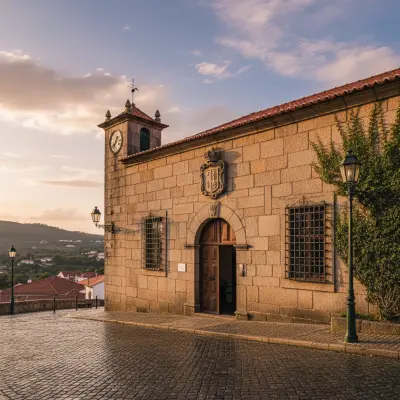
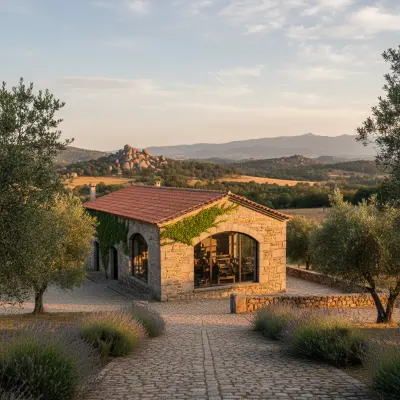
Guarda: Best Viewpoints and When the Light Is Right
Guarda becomes three different cities a day depending on the light. This is the honest guide to its viewpoints, the right hours, and the months when photography actually works. Skip noon. Go at October twilight.
Guarda has a problem with light, and I mean that as a compliment. At 1056 metres above sea level, Portugal's highest city is permanently submerged in an atmospheric quality that shifts hour by hour, sometimes minute by minute. Visitors arriving from Lisbon at three in the afternoon see a flat, harsh, dimensionless city. Those who stay until eight in the evening see another one. And those who get up at six thirty in the morning in October, with mist rising up the Mondego valley and the cathedral granite turning the colour of warm honey, see a third city entirely.
This guide is not for professional photographers with carbon tripods. It's for people travelling with a decent phone who want to come home with images that, five years from now, still feel like something. Let me be direct: skip the Penedo dos Saltos viewpoint at noon. Go in late September at sundown. The difference is the difference between a tourist postcard and an actual photograph.
The golden hour rule in Guarda (which is not the same as down on the coast)
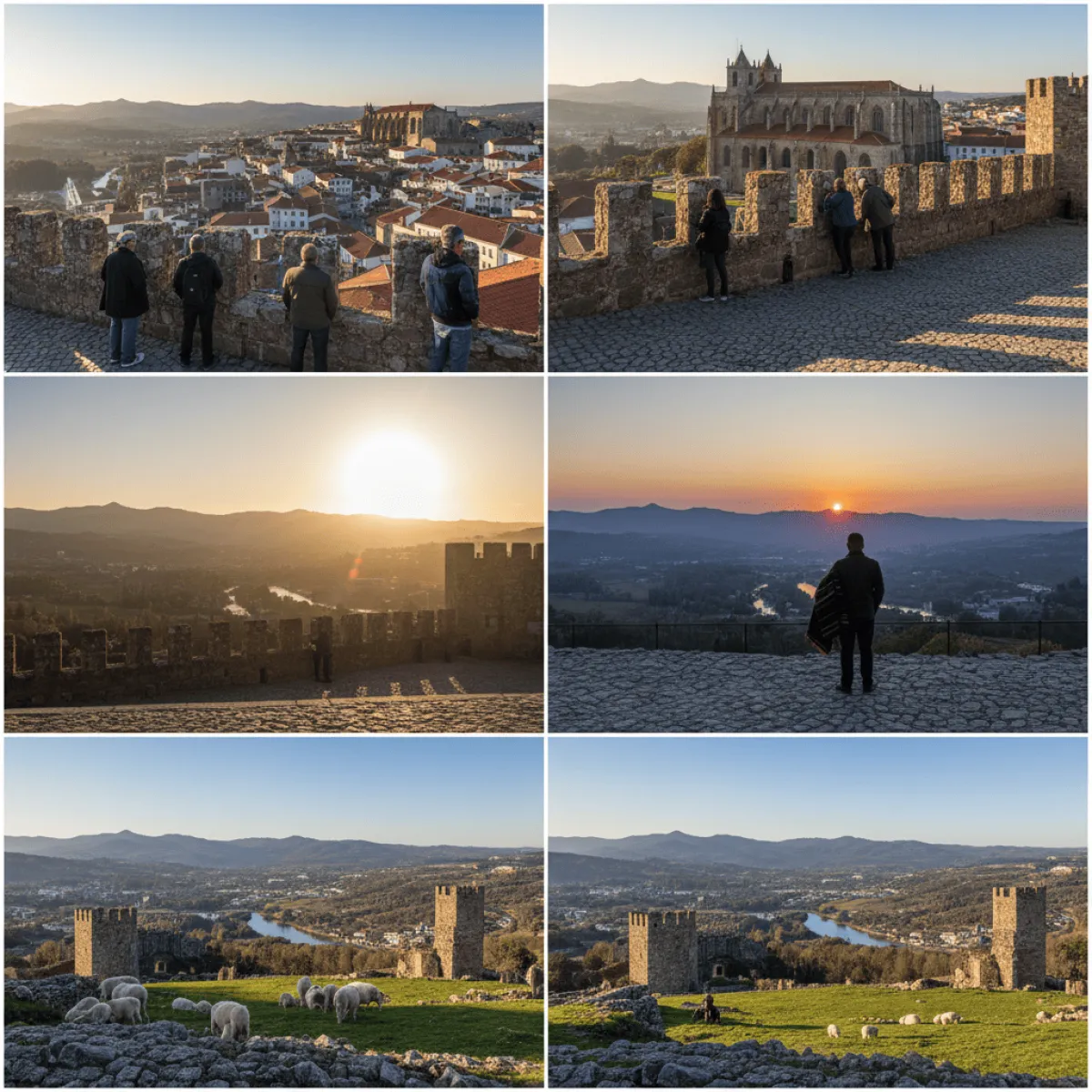
Everyone knows the best light is half an hour before sunset. In Guarda, that's incomplete. The altitude makes golden hour longer in summer, with the light lying across the stones for nearly forty minutes, and shorter and more dramatic in winter, with the sun dropping behind the Serra da Estrela in twenty cutting minutes.
The second factor nobody tells you about: summer is a bad season for photographing Guarda. Yes, bad. The sky goes pale, washed-out, textureless. The city wants clouds, wind, the threat of rain. The good months are September to mid-November, and then March to mid-May. January and February are unpredictable but, when they line up, they deliver breathtaking shots with the snow-covered Estrela in the background.
Castle viewpoint: the obvious one, but do it right
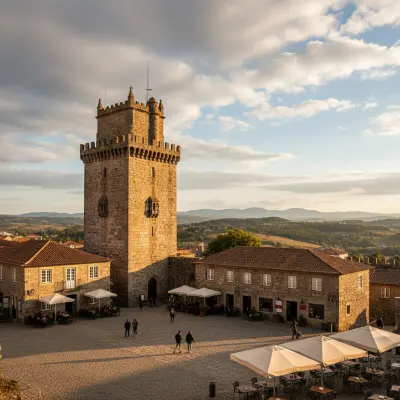
Let's start with the obvious. The Torre de Menagem, the keep, is the highest point in the historic centre, the surviving piece of the medieval castle that King Sancho I ordered built in the twelfth century. The view from the top, facing south and west, takes in the valley, the rural surroundings, and on clear days the silhouette of the Serra da Estrela.
The mistake everyone makes: climbing the tower at noon, shooting into the sun, coming down. Result, flat photos with a burned-out sky and a city in shadow. The fix is simple. Go an hour before sunset. The light comes in from the west, sideways, and draws texture out of the stones that midday flattens. Photos of the tower itself work better in early morning, when the sun rises in the east and lights the granite face with that yellow winter light you don't get anywhere else.
Practical note: the tower closes early in winter, and the December sunset is around 5:15 pm. Check opening hours locally before making the trip so you don't arrive at a locked gate. If that happens, the cathedral square next door offers a decent alternative, although a lower one.
Cathedral square: the blue hour is your friend
The cathedral square is one of Guarda's most underrated photography spots. Everyone shoots the cathedral facade in the morning. Almost nobody comes back at twilight, twenty minutes after sunset, when the sky goes that deep cobalt blue and the square's lamps come on.
This is the famous blue hour, and in Guarda it lasts about fifteen to twenty minutes. The cathedral, in dark granite, becomes almost black, and its Gothic outlines cut against the cobalt sky. Use a longer exposure, lean your phone against a stone, hold your breath. The photos you get will beat ninety per cent of the postcards in the souvenir shops.
To frame it well: position yourself in the southeast corner of the square, near the statue of King Sancho I. The cathedral sits on the diagonal, with the sky opening up to the right.
Rua Direita and the detail that's the real photograph
The big temptation for tourist photographers is the panoramic shot. But Guarda gives more to the detail. Rua Direita, the street that connects Praça Luís de Camões to Porta da Erva, is one of the city's oldest, and it contains what I call the real Guarda light: the light that slants in between narrow buildings late in the afternoon and paints the yellow and brick-coloured facades with a near-theatrical drama.
Go between 5:30 and 6:30 pm in October. Walk slowly. Photograph doors, doorsteps, lintels, balconies, cats. The detail shots will age better than the panoramas. Ten years from now, you'll come back to those images and you'll be able to smell the street. That's what matters.
Penedo dos Saltos: the viewpoint nobody visits (and should)
North of the city, on a rocky knoll, sits Penedo dos Saltos. It's not on the main itineraries, and that's an advantage. From the top, on a clear day, you see the entire city, the cathedral, the keep, and the pine slopes falling away towards the valley.
Go at dawn. Yes, I know, it's hard. But if you can drag yourself out of bed at 6:45 am in October and be up there by 7:10, you'll watch the city emerge from the mist as if it were being slowly developed. It's the only hour this view actually works. At noon the sun burns everything out, and at the end of the day the sun is behind you and the city falls into shadow.
Take a thermos of coffee. Take a coat, even in summer. At 1100 metres, seven in the morning is cold even in August.
When rain is your friend
Good Guarda photographers pray for rain. Not torrential rain, but that fine, persistent drizzle that cleans the air and leaves the stones dark and shining. Guarda in the rain is more beautiful than Guarda in the sun. The wet granite streets reflect the lamps, the facades saturate with colour, and there's a Sunday-morning silence that creeps in even in the middle of the week.
October is the ideal month for this: it rains regularly but rarely all day. There are those half-hour gaps when the sun peeks through the clouds and lights up, for three minutes, one specific corner, and that corner is your photograph. Be ready.
For days when the light won't cooperate: indoor options
There are days when the sky is sheet-white, no texture, no drama, and nothing you shoot outside is going to work. Don't force it. Retreat. Guarda has two museums worth your afternoon, and ironically they offer good photographic opportunities precisely because of their controlled interior light.
The Museu da Guarda occupies the former Bishop's Palace and holds collections of archaeology, sacred sculpture, and sacred art covering centuries of Beira history. The rooms have tall windows, and in mid-morning the light that pours in forms yellow rectangles on the wooden floors that make for very pretty photos without needing tricks.
More curious, and significantly less visited, is the Museu de Tecelagem dos Meios, devoted to the traditional weaving of this region. The old looms, the wool skeins, the tools, are unusually photogenic. The light is low, granted, and you'll need to lean your phone or push the ISO up. But the images that come out have a flavour no panoramic can give you.
Beyond photography: the sense of place
Here's where I want to be honest with you. The best photograph of Guarda is not the panoramic view. It's the photograph you take after you've understood the city. And to understand Guarda, you have to leave it for a bit.
I recommend, if you have a full day, driving out to Maçainhas, about twenty minutes from the city, and doing the cobertor de papa weaving workshop. It is not an Instagram thing. It's a slow, manual, deliberate thing where you realise that the wool you saw in the museum is the same wool that still comes out of these valleys today, transformed by hands that know what they're doing. After a day like that, the photograph you take of a Guarda facade carries more weight. Don't ask me why. It does.
The same applies to the mindful walking experience in Folgosinho, in the Serra da Estrela. Folgosinho is forty minutes by car from Guarda, and the air up there at 1100 metres, with that view across the Beira valleys, is a kind of antidote to the world's velocity. Come back to Guarda at the end of the day. You'll see the city with different eyes.
Where to eat between photographs
A word about food, because nobody takes good photographs hungry. Guarda has two serious dishes: roast kid in the wood oven and bacalhau à Lagareiro, salt cod with olive oil and roasted potatoes. Both demand time, both demand a fork. Don't have lunch in places serving burgers with chips; you're in the Beira Alta, eat properly.
For a practical lunch between photo sessions, look for small family-run places in the historic centre, ask for the daily special, drink a glass of Beira red. Pay around twenty euros, take an hour, leave content. That's how it works here. Rushing through lunch to shoot more is a beginner's mistake.
Getting there and basic logistics
From Lisbon, Guarda is about three and a half hours by car via the A23 motorway. By train, the Intercidades takes around four and a half hours, with stops. If you come by train, note that the station sits below the historic centre. There are taxis and a city bus that climbs up to the upper town.
For lodging, there are options in the historic centre that allow you to photograph early in the morning without needing a car. Book in advance for October and November weekends, which are the city's prime tourist months.
Other trips, other honest guides
If you like this kind of guide, opinionated and unfussy, you'll also want the honest guide to April walks around Caldas da Rainha, which applies the same logic of light and season to a very different city. Or, if May catches you in Coimbra, the honest guide to Queima das Fitas is pure urban photography. And for those who prefer something more introspective, the honest pilgrimage guide to Fátima on May 13th offers a different kind of light, a different scale, a different thing entirely.
In summary: three hours, three viewpoints
If you only have an afternoon in Guarda, do this:
- 4:30 pm: Climb the Torre de Menagem. Shoot south and west.
- 5:30 pm: Walk down to the cathedral square. Wait for blue hour.
- 6:30 pm: Walk along Rua Direita to Porta da Erva. Shoot details.
Go back to your hotel. Eat the kid. Sleep. Wake at 6:45. Climb to Penedo dos Saltos. Drink the thermos coffee. And go home with photographs that, five years from now, will still mean something. That's what counts.