Thermal Melgaço: Bicarbonate Waters and Where to Drink
In Melgaço you drink the spring on an empty stomach, three cups a day, with a metallic taste and the discipline of an old termalista. An honest guide to the bicarbonate waters, the Alvarinho that justifies the trip and the cinema museum nobody expects to find 80 metres from the river Minho.
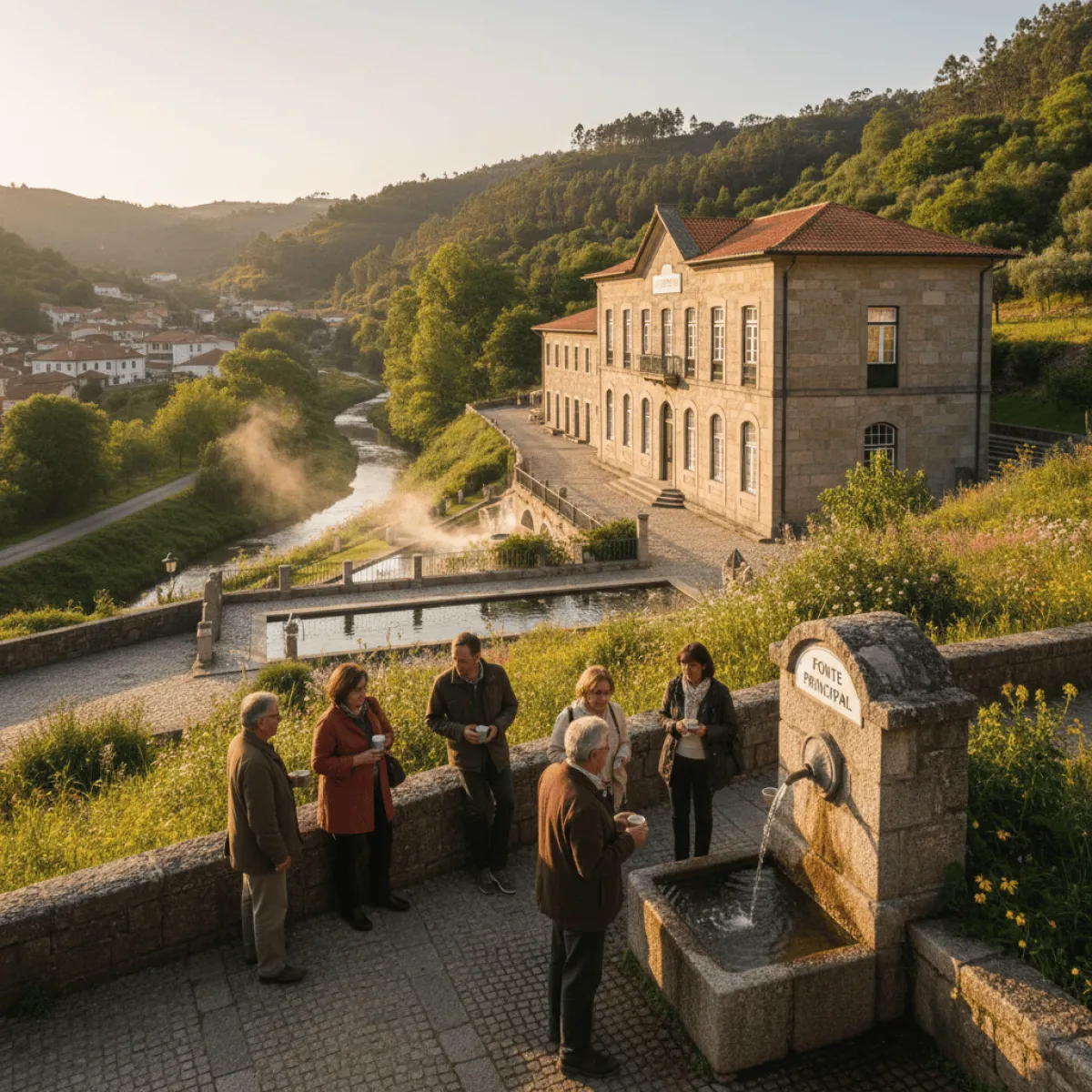
There's a gesture in Melgaço that looks simple and isn't. Fill a plastic cup at the spout of the thermal spring, drink it on an empty stomach, pull a face because it tastes of metal, then fill it again. The regulars bring five-litre water bottles from their cars, leave them empty at the park entrance and come back loaded as if from a market. This isn't folklore. It's home medicine with a century and a half of medical prescription behind it, and it's the reason this town at the far edge of the Minho, pressed against Galicia by the river, has a hotel, a casino and a thermal park despite barely passing nine thousand inhabitants.
I came to Melgaço for the Alvarinho, like everyone else. I stayed for the water. And this deserves a warning: if you're looking for a weekend spa with aromatic herbs and scented candles, there are more comfortable places. Thermal Melgaço is something else. It's clinical, austere, effective. The bicarbonate gasocarbonic, sulphurous, ferruginous and fluoridated waters come out of the ground at 20 degrees Celsius from two main springs, Fonte Nova and Fonte da Calda, and are clinically indicated for liver, biliary tract, diabetes, stomach and rheumatic conditions. This isn't marketing. It's what the Termas brochures state and what hydrology doctors have written on patient cards for generations.
What a bicarbonate water actually is
Let's get the chemistry out of the way, because without it the rest makes no sense. A bicarbonate water is a natural mineral water dominated by bicarbonate ions, usually above 600 mg per litre. Add dissolved carbon dioxide (the gasocarbonic component that makes the water tingle on your tongue) and you have a classic digestive profile. Bicarbonate neutralises acidity, stimulates bile production, eases gastric emptying. In village language: it cleans the liver and helps digestion.
The Melgaço waters add a hefty iron load on top of the bicarbonate, which is why after five minutes in the cup the surface gains an orange film and the unmistakable metallic taste. Habitual drinkers know you drink quickly, don't sniff too much, and the laxative effect arrives somewhere between twenty minutes and an hour depending on the person and the cup. If it's your first time, start with half a cup. The fact that the park has bathrooms every fifty metres is not a joke.
Where you drink the spring
The Melgaço Thermal Park sits about four kilometres from the town centre, in Peso, on the bank of the river Minho. It's a seven-minute drive on the N202 or a fifty-minute walk along a pretty ecovia that follows the river and cuts through Alvarinho vineyards. I recommend walking at least once, early in the morning, just to understand the landscape that makes everything else coherent: granite, water, vines, Galicia on the other side.
Inside the park there are two distinct zones not to be confused. Drinking the waters, which is free and open to the public on a broad schedule (early morning to late afternoon, check locally because it varies seasonally), and the actual thermal programme of baths, showers, inhalations and bertholaix, which is paid and requires advance booking. The medical admission consultation costs around twenty euros and is practically mandatory for the full programme. To drink the spring you just turn up with your cup. Disposable cups sell at the kiosk for under one euro, but if you're serious about it, buy a ceramic cup at one of the town shops and carry it with you. You'll use it for a week and take it home.
The canonical routine goes like this: three cups a day, on an empty stomach or at least an hour before meals. First cup at eight in the morning, second mid-morning, third at the end of the day. Between cups, you walk. The park has signposted loops of one hundred and fifty metres, three hundred metres and five hundred metres, and the old hands follow them with the discipline of someone saying the rosary.
When to come, when to stay away
The official thermal season runs from April to October or November. In August it's packed, mostly with older Portuguese visitors from the north and with emigrants on holiday doing the classic two-week cure. If you want the park to yourself, come in May or mid-September. The weather is good, the vines are green or in harvest, and you'll get a table anywhere without booking.
Winter is another story. The town sits at 80 metres altitude, but the Peneda mountain range starts right behind and January can be three degrees with fine slanting rain that finds its way down your back. The thermal park runs on reduced hours. Drinking the spring is still worth a stop if you're passing through, but for the full programme prefer spring.
Sleeping, eating, surviving
The Hotel do Parque, inside the thermal grounds, is the obvious choice for anyone doing the treatment, with indoor thermal pool and direct access to the bathhouse. It isn't luxurious, it's functional, and the breakfast has actual fruit instead of industrial yoghurts. If you prefer the town, there are local guesthouses in restored granite houses at sensible prices outside high season.
For eating, the recommendation shifts with the day. For lunch with a view, head up to the Miradouro do Castelo, the highest point in town, next to the keep. The terrace pays you back in scenery: the Minho below, Galicia opposite, and on clear days you can see all the way to the Soajo mountains. Order the kid goat when it's on the menu, the bacalhau à lagareiro the rest of the time, and don't skip the house Alvarinho. For dinner, prefer the small taverns on the main street: narrow doors, short menus, an owner who comes to the table to explain what arrived fresh.
One detail everyone forgets: Melgaço's thermal water does not go with wine. The bicarbonate neutralises acidity and ruins the nose of an Alvarinho. Termalistas who know the game do the programme in the morning and drink wine at dinner, well away from the last cup. Don't try to taste everything at once.
The Alvarinho that justifies the trip
Talking about Melgaço without talking about Alvarinho is like talking about Pinhão without mentioning port. It's the grape that defines the microclimate and that put this town on the world wine map. The Monção and Melgaço sub-region is the only Portuguese territory where Alvarinho reaches full character: body, minerality, ageing potential. Drink it young for the citrus and white blossom, drink it at three years old for the saltier, more complex side.
If you want to do this properly, book a guided tasting of seven Alvarinhos from the same grape at a single producer, to see how terroir, year and method change everything. For those who prefer autonomy and a few extra kilometres, there's a self-guided cellar tour you can do in half a day by car with set stops. Either way, always book ahead. The small cellars don't take walk-ins.
The museum no one expects
There's a museum in Melgaço that's worth a trip on its own, in one of those Portuguese towns where, at first glance, no one would expect to find it. The Melgaço Cinema Museum, dedicated to the Jean-Loup Passek collection, holds one of Europe's most important private collections of film posters, antique projectors and cinema memorabilia. Passek, a French critic who died in 2016, left his archive here through a family connection to Castro Laboreiro. The result: you can see a 1908 Pathé machine and original Fellini posters a stone's throw from the parish church. Perfect irony.
Admission is cheap, it opens Tuesday to Sunday, and an hour well spent is enough. Go after your second cup of water, before lunch. That's the right rhythm.
Stretching up to Castro Laboreiro
If you have two days and a car, drive up to Castro Laboreiro. Some twenty-five kilometres up, on a road that feels like an exercise in patience, you arrive at one of the highest and oldest villages in Portugal, with a ruined castle at a thousand metres and dogs of the breed that gave the place its name herding among granite. Lunch on something simple in the village, roast kid goat and rye bread will do, and come back down before dark. The road at night with fog is unforgiving.
Logistics without ornament
From Porto, Melgaço is roughly two and a half hours by car, all on the A3, then A28 and a national road at the end. By public transport it's a chore: train to Valença and a local bus with sparse timetables. For non-drivers, the serious alternative is a taxi from Valença (around 30 euros, check locally) or renting a car in Braga.
If you're coming from Spain, Melgaço is half an hour from Salvaterra de Miño across the international bridge. Splitting a night on each side is one of the best logistical ideas you can have in this corner of the peninsula.
What NOT to pack: five-star spa kit. Here you use simple flip-flops, a towel, and if you're doing the thermal programme, a discreet swimsuit. What TO pack: a ceramic or metal cup for the spring, a thermal flask to refill on the way out, walking shoes for the park, and patience for the slow pace. Nobody hurries here.
If you like this kind of trip, you'll like these too
For anyone putting together a Minho route with time on their hands, two or three towns almost always come into play. Barcelos is one of them, and it has three pieces worth reading before you arrive: an honest guide to the Festa das Cruzes in May, which steers you past the classic first-timer mistakes; a guide for travellers with small children, if you're moving with the family; and a café-by-café order guide, for anyone who takes the espresso ritual seriously. They work as a road map between Melgaço and the rest of the Minho.
The whole thing in three sentences
Melgaço is a place you do slowly. The bicarbonate waters work if you drink them in series and on an empty stomach, not as a single curious sip, and the Alvarinho is best at night, away from the spring. Come in May or September, sleep two nights, climb to Castro Laboreiro on one day, visit the Cinema Museum on another, and head home with a refilled bottle in the boot and your digestion working in a different gear. It isn't glamorous. It's better than that.