February White: Chasing Almond Blossoms in Monsaraz
Discover the ephemeral beauty of the almond blossoms in Monsaraz, a spectacle of white and schist that signals the early Alentejo spring. An essential guide to capturing the light, flavors, and starlit skies of the region.
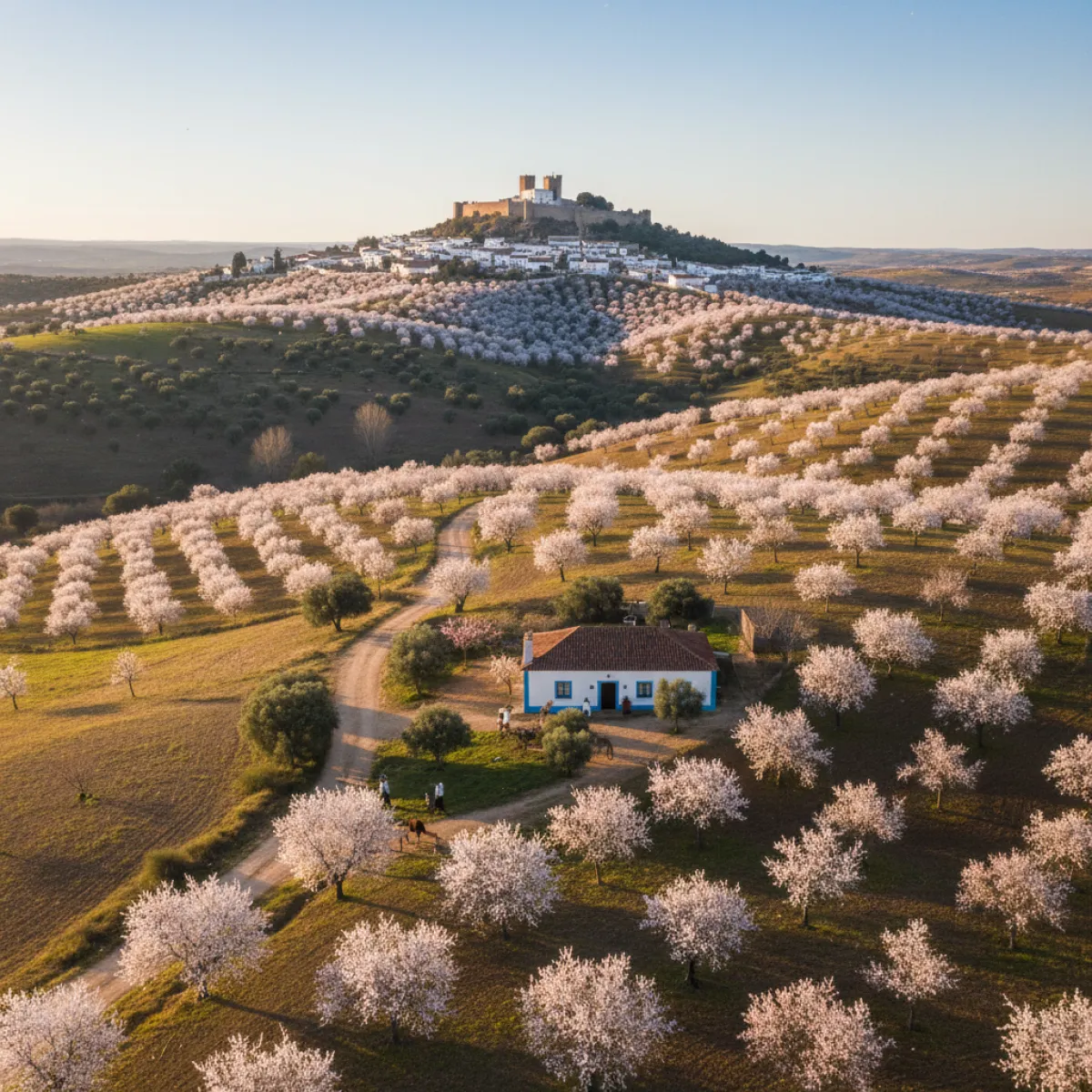
The Alentejo Awakening: A Study in White and Schist
There is a specific, almost liturgical moment in mid-February when the Alentejo sheds its winter gloom. It doesn't happen with the dramatic surge of a northern spring, but through a delicate, silent transformation: the blooming of the almond trees. While the Algarve often captures the headlines for this seasonal spectacle, those in the know head east, toward the medieval crag of Monsaraz. Here, the white blossoms don't compete with the Atlantic; instead, they provide a fragile counterpoint to the dark, severe schist of the fortifications and the vast, mirror-like expanse of the Alqueva Lake.
Chasing the almond blossom is a pursuit of the ephemeral. The window of perfection is narrow, rarely lasting more than twenty days before the petals drift away like unseasonal snow. The journey usually begins in the regional capital, where the pace is set. Following the insights in Évora: The Slow Pulse of the Alentejo is essential for anyone wishing to calibrate their senses to the region’s deliberate tempo. As you drive from the granite-heavy streets of Évora toward the schist-laden borderlands, the almond trees appear first as lone sentinels in the cork oak forests, eventually clustering in dense, pale clouds as you approach the base of Monsaraz.
The Geometry of Silence
Monsaraz is a village carved from the very rock it sits upon. Its lime-washed houses and narrow alleys offer a stark, monochromatic beauty that serves as the perfect stage for the February bloom. Unlike the modern, industrial orchards found in the Ribatejo, the trees around Monsaraz are often ancient, gnarled survivors planted along traditional property lines and stone walls. This creates a landscape that feels organic, ancient, and deeply connected to the local identity.
From the ramparts of the 14th-century castle, the view is staggering. The blooming trees dot the landscape below like a pointillist painting. To truly understand the weight of this silence and the cultural significance of the stone beneath your feet, Stone and Silence: A Sentimental Guide to Évora offers an invaluable perspective on the Alentejo’s unique relationship with time and architecture. It is a necessary companion for those who find beauty in the austere.
Gastronomy: The Flavors of Late Winter
Dining in the Alentejo during the almond blossom season requires a focus on what the land yields during this transition. This is the time for wild asparagus (espargos trigueiros), often scrambled with eggs or served as "migas." The local lamb (borrego) is at its peak, infused with the scent of the wild herbs that carpet the plains. In the small taverns of Monsaraz and the nearby village of Telheiro, look for dishes that emphasize these bitter, earthy notes which contrast so beautifully with the local, full-bodied red wines.
For those using the regional capital as a base, the precision of One Day in Évora: A Precision Itinerary for the Alentejo Capital provides a structured way to balance urban exploration with these rural excursions. Budget roughly €30 to €45 for a proper lunch or dinner in a reputable local restaurant, ensuring you sample the local olive oil, perhaps the finest and most overlooked product of the Alqueva basin.
Celestial Observance: The Night After the Bloom
While the daytime belongs to the botanical, the night in Monsaraz belongs to the stars. The village is the centerpiece of the Alqueva Dark Sky Reserve, the first of its kind in the world. The absence of light pollution creates a nocturnal landscape as vivid as the daytime bloom. Engaging in Monsaraz After Dark: Stargazing from Europe's First Dark Sky Reserve Village is not merely a tourist activity; it is a profound immersion into the scale of the universe.
For a more technical engagement with the heavens, a visit to the local observatory is recommended. The experience Celestial Precision: Astronomical Observation at the Alqueva Lake Observatory provides access to professional telescopes and expert guidance, allowing you to see the rings of Saturn or distant nebulae with startling clarity. There is a certain poetry in looking at the white dust of the Milky Way just hours after walking through the white petals of the almond trees.
Practical Intelligence for the Discerning Traveler
- The Timing: The bloom typically occurs between February 10th and February 28th. Weather variations can shift this by a week in either direction. Keep an eye on local reports.
- The Wardrobe: Do not be fooled by the bright sun. The Alentejo wind in February is sharp. A high-quality wool sweater and a structured trench coat or windbreaker are essential for the transition from the sunny afternoon to the freezing desert-like night.
- The Drive: Rent a car with good clearance. The best views and the densest clusters of trees are often found down unpaved tracks (caminhos rurais) that lead toward the water's edge.
- Budgeting: February is technically low season, so accommodation prices are reasonable, but the best guest houses (Turismos Rurais) fill up quickly with Portuguese travelers who know the season’s value. Expect to pay €120–€180 per night for premium lodging.
Ultimately, visiting Monsaraz for the almond blossoms is an act of intentionality. It is about choosing the subtle over the obvious, the quiet over the loud. In the brief moment when the white flowers bloom against the dark stone, one finds the very soul of the Alentejo, resilient, ancient, and breathtakingly fragile.
