Rainy Monsaraz: Indoor Options That Are Actually Good
Monsaraz is a village built for sunshine. But when rain hits, there are talha wines to taste, pottery workshops five minutes away in São Pedro do Corval, and a fourteenth-century secular fresco hidden in the old courthouse. You just need to know where to look.
Let's be honest: Monsaraz was built for good weather. The castle walls, the Alqueva reservoir stretching to the horizon, the megalithic sites scattered across the plains. When rain rolls in over the Rua Direita, your first thought might be that the day is wasted. It's not. But you need a different plan.
Monsaraz is tiny. You can walk the entire village in twenty minutes. There are no shopping centres, no museums the size of city blocks, no urban safety net to catch you on grey days. What there is, though, is a handful of spots that, approached the right way, can turn a rainy day into a different (and sometimes better) version of your visit.
The Fresco Museum: Small But Worth Every Minute
Inside the old courthouse, now converted into a museum, sits one of the most curious pieces of art in the Alentejo. The secular fresco "O Bom e o Mau Juiz" (The Good and Bad Judge), dating from the fourteenth century, is rare for a simple reason: secular medieval art that survived to the present day is almost non-existent in Portugal. One side shows a just judge, the other a corrupt one. The message was unmistakable for anyone being tried in that room.
The space is small. You won't spend two hours here. But the visit is dense and genuinely interesting, and the courtroom itself, with its arches and filtered light, is beautiful in a way that doesn't need sunshine to work. Check opening hours locally, as they change with the season.
The Parish Church: More Than a Quick Glance
The Igreja Matriz de Nossa Senhora da Lagoa, by the main square, deserves more than the thirty-second peek most visitors give it. The interior is austere, as Alentejo churches tend to be, but there are details that reward those who linger: a medieval marble tomb, side altars with quiet craftsmanship, and the thick silence of a space with centuries behind it.
It's not a cathedral. It won't compete with the Jerónimos Monastery. But that's precisely why it works. No crowds, no audioguides, no queues. Just stone, whitewash, and the sound of rain outside.
Alentejo Wine: The Perfect Rainy Day Activity
If there's one thing the Alentejo does well, it's wine. And the Reguengos de Monsaraz sub-region is one of the most interesting, with producers doing serious work with grapes like Trincadeira, Aragonez, and Antão Vaz.
Within Monsaraz's walls, a few shops offer informal tastings. Don't expect the polished enotourism experience of the Douro. Here it's more direct: a table, some glasses, someone who knows their subject and will explain the difference between a vinho de talha (fermented in clay, the old way) and a barrel-aged red. The talha wines are the real speciality of the region. If you've never tried one, this is the place.
For a more structured visit, Herdade do Esporão and Ervideira are a short drive away and run tasting programmes that work perfectly in the rain. Expect to pay roughly 15 to 25 euros per person for a guided tasting. Book ahead, especially on weekends.
São Pedro do Corval: Portugal's Pottery Capital, 5 Minutes Away
São Pedro do Corval, just a few kilometres from Monsaraz, is the largest pottery centre in Portugal. That's not an exaggeration: dozens of workshops are packed into one village. And when it rains, the workshops are open.
Some let you watch potters at the wheel. Others sell directly, without middlemen and without the inflated prices of tourist shops. Look for traditional Alentejo earthenware, especially the pitchers and glazed terracotta dishes. These are objects that cost a few euros and last a lifetime. Far more interesting than a fridge magnet.
The advantage of going on a rainy day is obvious: fewer people, more attention from the craftspeople, longer conversations. This is the kind of activity that actually improves in bad weather.
Lunch as the Main Event
On a rainy day in Monsaraz, lunch isn't just a meal. It's the centrepiece of your day. And Alentejo cuisine was built for exactly this.
There are half a dozen restaurants within the walls. I won't fabricate specific recommendations I can't guarantee, but I can tell you what to look for: migas com carne de porco (breadcrumb-based dish with pork), ensopado de borrego (lamb stew), açordas (bread-based soups thickened with egg). These are dishes that exist for days exactly like this: heavy, comforting, impossible to eat in a rush. A proper Alentejo lamb stew, with bread soaking up the sauce, is reason enough to thank the rain.
Always ask for the homemade bread and, if available, Serpa cheese to start. And a local wine, of course. Don't overthink it.
The Observatory: When the Rain Clears by Evening
Monsaraz sits at the heart of Europe's first Dark Sky Reserve, and the Alqueva Lake Observatory is one of the best stargazing locations on the continent. Now, the truth: if the sky is overcast, you won't see stars. But sessions at the observatory often include an indoor component with telescopes and explanations that work even through clouds.
Astronomical observation at the Alqueva Lake Observatory is an experience worth booking in advance. If the rain stops by nightfall (and in the Alentejo, it often does), you could have the best evening of your trip. The stargazing experience from Monsaraz is the kind of thing that stays with you long after you've forgotten the name of the restaurant where you had lunch.
For When the Rain Stops (Because It Will)
In the Alentejo, rain rarely lasts all day. And when it eases, Monsaraz has things worth getting wet shoes for.
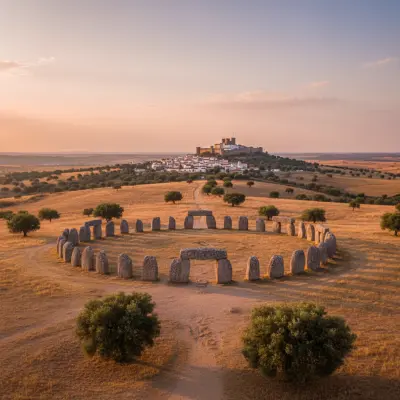
The Cromeleque do Xerez is one of the most impressive megalithic monuments in southern Portugal. It's outdoors, yes, but with a decent jacket and shoes that grip, a visit on damp ground under the diffused post-rain light can be more atmospheric than in the full August sun.
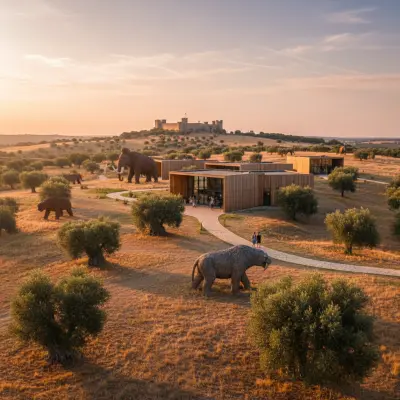
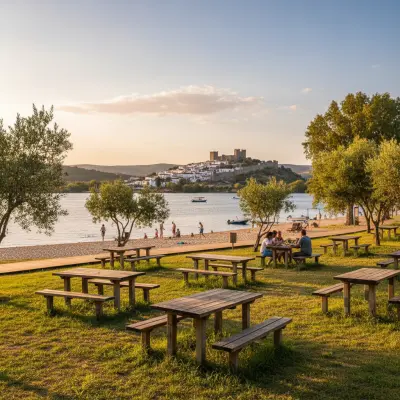
Parque Megafauna Monsaraz is another option once the weather improves. And the picnic park by the river beach, next to the Alqueva, takes on a special light when the clouds start to break.
If the Rain Really Won't Stop
If it's a day of constant rain and you've exhausted Monsaraz (which, let's be honest, is possible), consider a detour. Évora is about an hour away and has enough museums, churches, and the famous Chapel of Bones to fill an entire day. Reguengos de Monsaraz is fifteen minutes away and has more restaurants and shops.
For those wanting to explore another less obvious Alentejo destination, Portalegre is a surprise worth the detour. It has an excellent tapestry museum, a wool factory with real history, and food that draws from both the Alentejo and the Spanish border region.
Practical Notes
The Alentejo's rainy season runs from October to March, peaking in November and December. Even so, full days of continuous rain are uncommon. Intermittent showers are the norm, which means that with patience, you'll get windows to step outside.
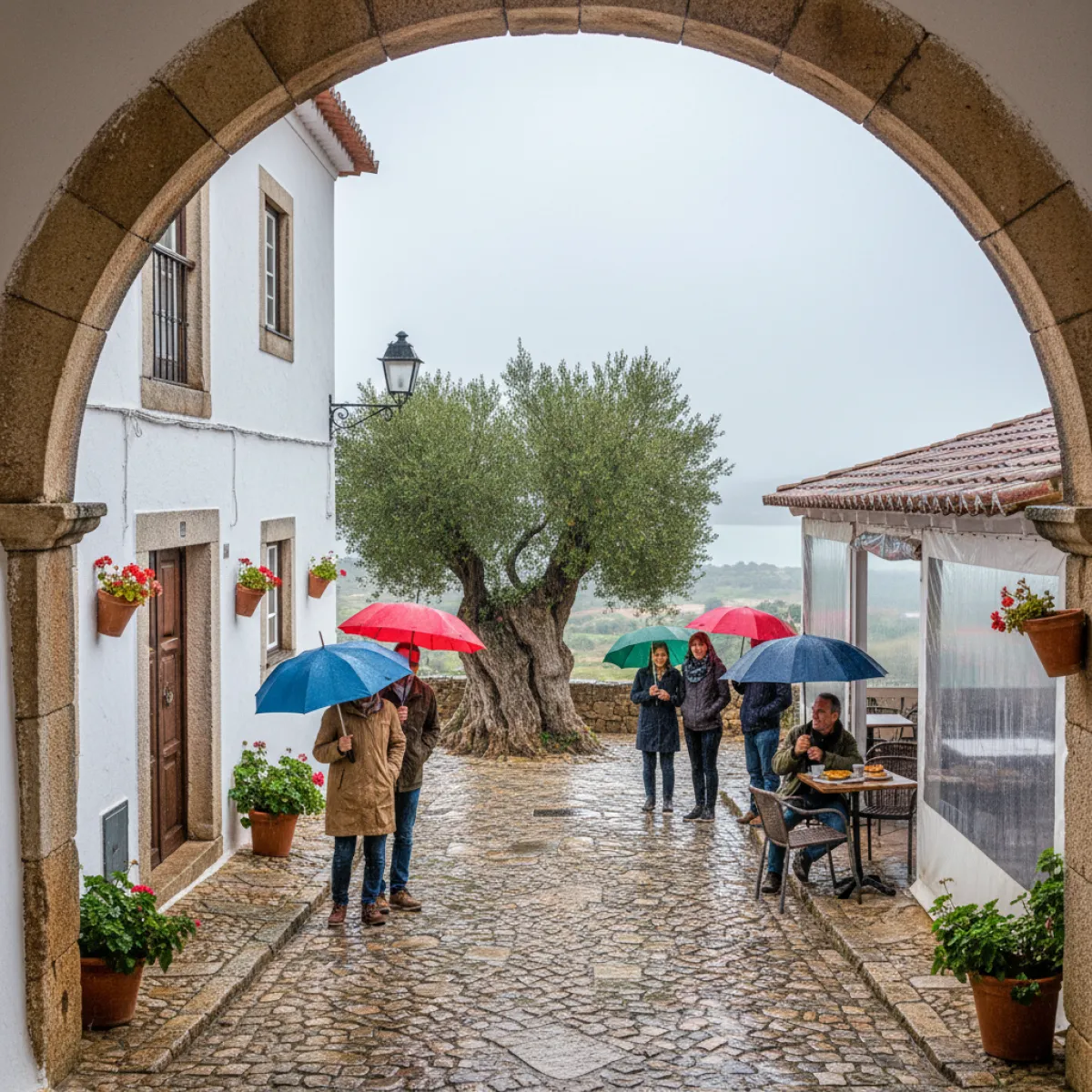
Bring waterproof footwear. Monsaraz's streets are uneven stone and get slippery. An umbrella works fine within the village, but if you're planning to visit the cromeleque or the parks, a good waterproof jacket is the better choice.
And one last thing: don't underestimate the pleasure of simply being in Monsaraz when it rains. Sitting at one of the covered terraces by the wall, coffee in hand, a slice of cake, watching rain fall over the Alqueva. No agenda. No checklist. Just being there. Sometimes the best plan for a rainy day is no plan at all.