Monsaraz on Foot: Inside and Beyond the Walls
Monsaraz fits in a twenty-minute walk, they say. But anyone who sticks to Rua Direita misses 7,000-year-old megaliths, the descent to the Alqueva shore, and the best starlit sky in Europe. A guide for those willing to stay longer than two hours.
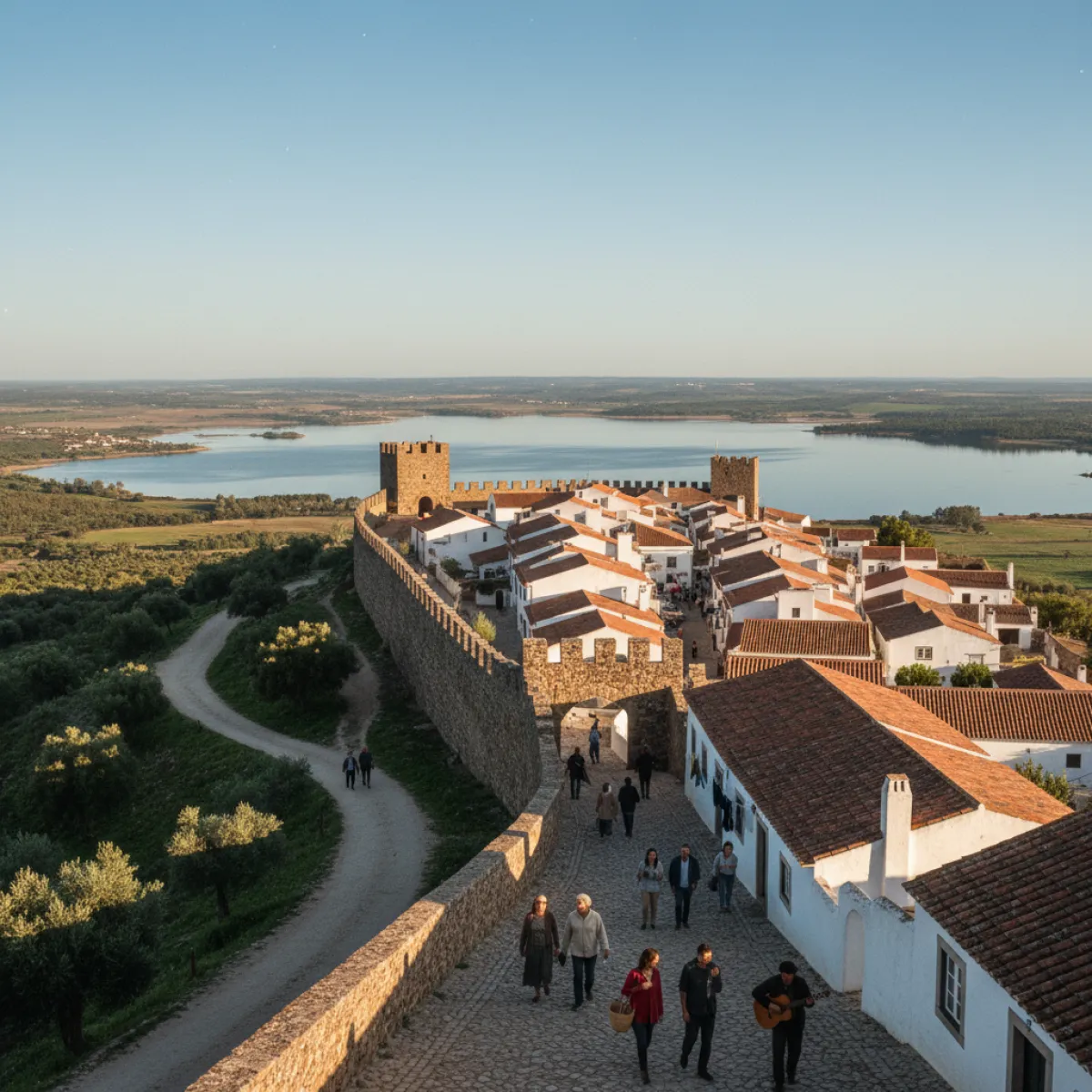
Monsaraz fits inside a twenty-minute walk. From the Porta da Vila to the castle, Rua Direita takes you in a straight line through the center of the village, whitewashed houses on both sides, the Alqueva reservoir as a permanent backdrop. That's why most visitors treat Monsaraz as a two-hour stop: enter, photograph, eat something, drive away. This is a mistake. Because Monsaraz doesn't end at its walls, and even inside them, there are corners most people walk right past.
Inside the walls: Rua Direita and its detours
Let's start with the obvious. Rua Direita is, literally, the village's backbone. It connects the Porta da Vila (the main entrance, where everyone arrives) to the castle at the opposite end. Along it, you'll find the Igreja Matriz, the Igreja de Santiago (now used as an exhibition space), a handful of craft shops, and the most visible restaurants. In summer, especially between 11am and 4pm, this street fills with organized tour groups. If you can, arrive before 9am or after 5pm. The difference is dramatic.
But the trick is stepping off Rua Direita. The narrow side alleys, often dead ends, lead to improvised viewpoints over the Alentejo plain that most visitors never see. The north side of the walls, facing farmland instead of the lake, is consistently ignored. That's where you'll find the village cats sleeping in the sun and the quiet that everyone claims to be looking for but rarely finds.
At the top of the village, the castle deserves more than the obligatory photo. The interior courtyard has functioned as a bullring since the fifteenth century, making it one of the oldest on the Iberian Peninsula. Climb the keep: the 360-degree view over the Alqueva and the plains justifies the effort. On clear days, you can see Spain without squinting.
The descent to the lake: the walk almost nobody takes
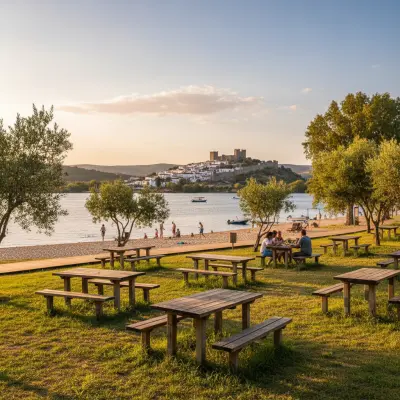
Most people see the Alqueva from above and call it done. But walking down to the shore is a completely different experience. The Parque de Merendas da Praia Fluvial de Monsaraz sits below the village, right by the water, and it's the kind of spot where locals spend summer afternoons while tourists jostle for space up above. There are picnic tables, shade, and lake access. In warm months, bring food and drinks from home. Don't expect resort infrastructure. This is Alentejo, not the Algarve.
The walk down from the walled village takes about 20 to 30 minutes, depending on the route you choose. Dirt paths wind down the hillside through olive and cork oak trees. If the heat is serious, do this descent in the late afternoon. It's the climb back up that hurts.
Megaliths and walks beyond the village
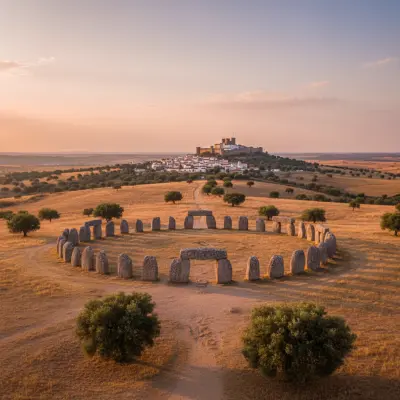
If Monsaraz impresses you with its medieval presence, what surrounds it goes much further back in time. Much further. The Cromeleque do Xerez is one of the most important megalithic monuments in southern Portugal, a stone circle roughly 7,000 years old that was only rediscovered in the 1960s, when the construction of the Alqueva threatened to submerge the site. The stones were relocated to higher ground but maintain their original arrangement. It's a few kilometers from the village, reachable by car or, if you have the legs for it, on foot along rural paths.
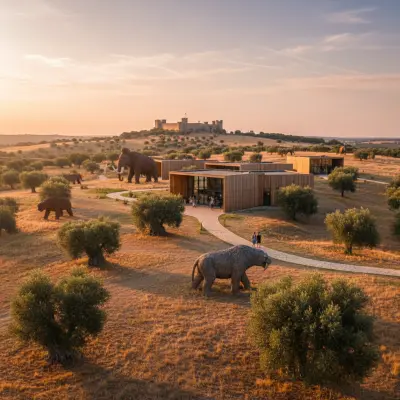
Closer to the village, Parque Megafauna Monsaraz is a surprise you don't expect in this landscape. Life-size sculptures of prehistoric animals spread across an open-air park, designed for families but honestly interesting for anyone with curiosity. It's free and worth a half-hour stop, particularly if you're traveling with children who've had enough of churches and castles.
A suggested walking route
If you have a full day, the best way to explore Monsaraz and its surroundings on foot follows roughly this logic:
- Early morning (before 9am): walled village, castle, side alleys. The cafés near Porta da Vila serve decent coffee.
- Mid-morning: descent to the lake area and picnic park. Bring water.
- Lunch: return to the village to eat. There are three or four restaurants inside the walls. Prices are slightly inflated for an Alentejo village, but nothing outrageous. Ask for migas with pork or açorda alentejana if they're on the menu.
- Afternoon: drive to the Cromeleque do Xerez and the Megafauna Park. Both are just a few minutes away.
When the sun goes down, the village changes
The real privilege in Monsaraz is staying for the night. And I don't say this out of cheap romanticism. Monsaraz sits at the heart of the Alqueva Dark Sky Reserve, the world's first certified reserve for night sky observation. Light pollution is essentially zero. On clear nights, the Milky Way is visible to the naked eye, which in an increasingly illuminated Europe is almost a luxury.
If you want to take stargazing seriously, the Monsaraz After Dark stargazing experience is the best way to do it with professional guidance. For those who want telescopes and scientific explanation, the astronomical observation at the Alqueva Lake Observatory is the more technical alternative. Book ahead, especially in summer months.
But even without an organized program, just walk outside the walls after dinner and look up. It's the kind of thing that makes you feel foolish for living in a city with LED streetlights every ten meters.
Practical notes
Monsaraz belongs to the municipality of Reguengos de Monsaraz, which is the nearest town with full services: supermarket, pharmacy, gas station. The village itself has the essentials for a day visit or one night, but don't expect an ATM inside the walls. Bring cash for the smaller cafés.
Parking outside the walls is free but limited. On summer weekends, arrive early. The alternative is parking further below and walking up, which, honestly, is actually preferable because the approach to the village from the hillside is one of the best ways to understand the scale of this thing: a tiny medieval settlement perched on a hilltop, commanding the territory in every direction.
From Lisbon, it's about two and a half hours by car. From Évora, just over an hour. Public transport exists but is sparse and impractical. Monsaraz is, no way around it, a destination for people with a car.
If you're exploring the interior Alentejo with more time, the town of Portalegre, further north, offers an interesting contrast. Our Portalegre on foot guide follows the same logic of pedestrian exploration in a town with a completely different scale and character.
What Monsaraz isn't
Monsaraz is not an undiscovered village lost in the countryside. It's in every guidebook, on every list, and during peak months it receives tourist buses daily. But most of those visits last under two hours and stay on Rua Direita. If you stay longer, if you walk down to the lake, if you visit the megaliths, if you stay for the stars, Monsaraz becomes a completely different place. It's the difference between looking at a postcard and actually being there.
And that's what a good walk does: it forces you to be present, to notice details, to feel the heat of the ground through your soles. In Monsaraz, there's surprisingly a lot of ground to cover.