Portalegre on Foot: Neighborhoods Worth the Walk
Portalegre has no beach, no airport, and the nearest train stops in Elvas. But it has medieval quarters with traces of the old Jewish community, a tapestry museum that rivals any Lisbon gallery, and old-town tascas where lunch with wine stays under €15.
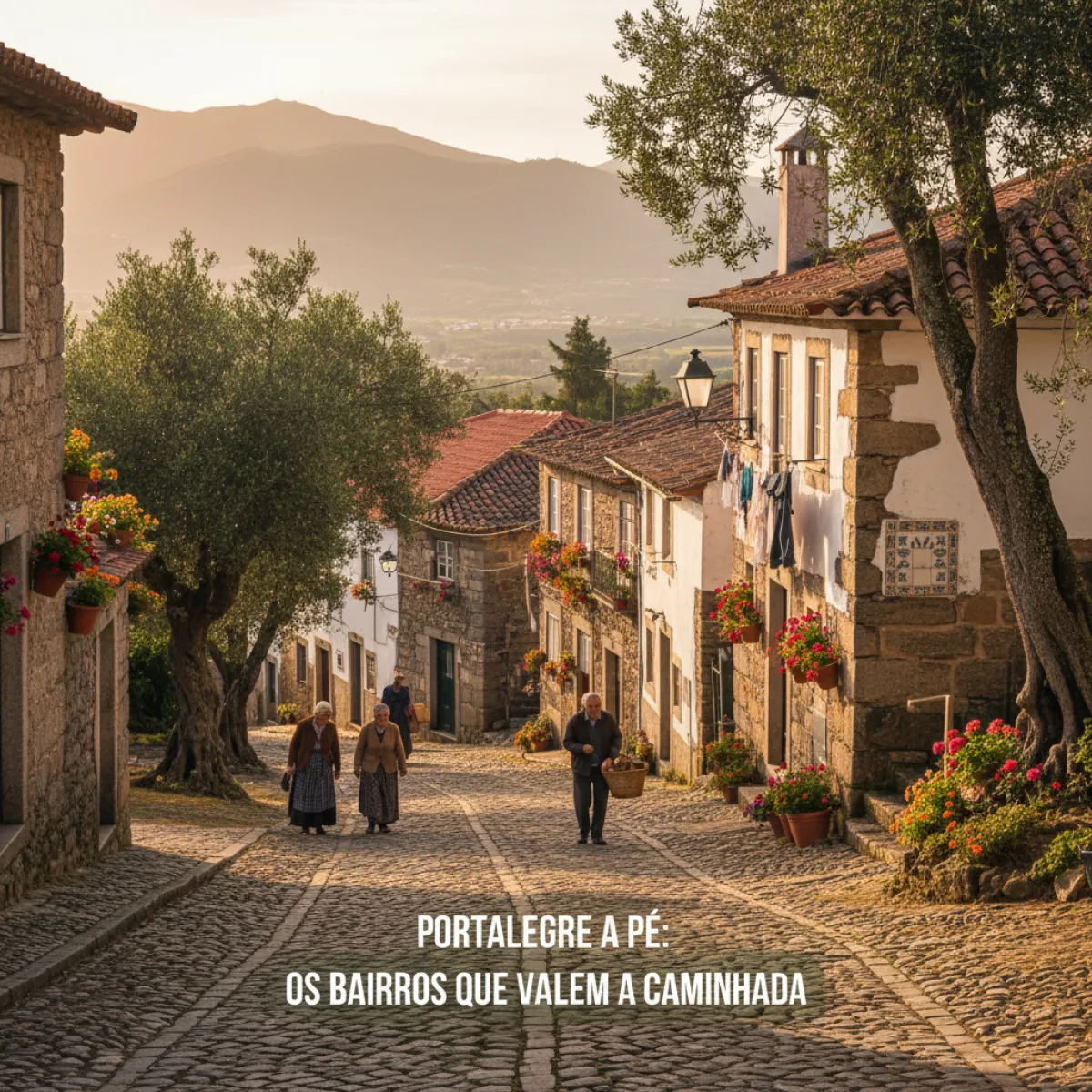
Portalegre has a marketing problem. It sits in the Alto Alentejo, a region most Portuguese associate vaguely with plains and heat, and most foreign tourists can't locate on a map. No beach, no airport, and the nearest train station with regular service is in Elvas, about 50 km away. And yet, anyone who walks its cobbled streets, preferably on an autumn or spring morning, when the cool air from Serra de São Mamede rolls down over the rooftops, quickly realizes this place is something else entirely.
Portalegre is a city built for walking. Not because there's no alternative, but because that's how it makes sense. The neighborhoods unfold across slopes, alleyways, and small squares that only show you what they have when you go slowly. And what they have is surprisingly varied for a city of barely 15,000 people.
The Historic Center: From the Cathedral to the Castle
The natural starting point is the Sé Catedral, in the heart of the upper town. Built in the 16th century, it's a building that doesn't try to impress with scale, it impresses with restraint. The azulejo panels inside deserve more attention than they usually get. The square in front is small, unpretentious, and in the early morning has the kind of quiet you only find in cities where nobody is trying to sell you anything.
From here, the climb to the ruins of Castelo de Portalegre takes just a few minutes. Don't expect meticulously restored ramparts, what remains are sections of wall integrated into the neighborhood houses, medieval stone serving as kitchen walls. It's precisely this improvisation that makes the walk interesting. The views over the city and the serra make up for the effort.
Walking down Rua do Castelo takes you past the facades of 17th and 18th-century manor houses, some in excellent condition, others in dignified decay. Portalegre was, for centuries, a wealthy city, first from wool, then cork, then tapestries. That accumulated wealth shows in the architecture: carved granite doorways, wrought-iron balconies, pediments that wouldn't exist in a poor inland village.
The Rossio and the Bourgeois City
If the historic center is medieval and vertical, the Rossio is its opposite: flat, airy, 19th century. The boulevard running through this area is where Portalegre breathes. This is where people sit in cafés in the late afternoon, where kids ride bikes, where old men argue about football with an intensity wildly disproportionate to the stakes.
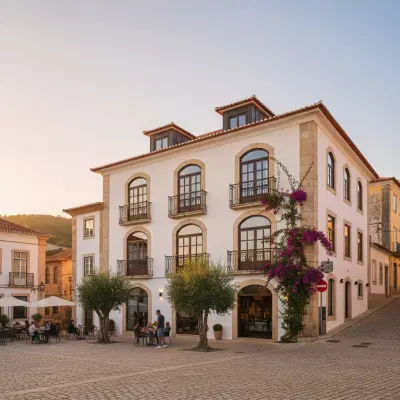
The Rossio is also where you'll find the Rossio Hotel, a practical option for anyone wanting to explore the city without relying on a car. The central location means everything worth seeing is within walking distance, and in a place like Portalegre, that's exactly what you want.
Rua 19 de Junho, the main commercial street, connects the Rossio to the historic center. It's not a photogenic street, it's a useful one, with pharmacies, stationery shops, and at least two or three cafés where coffee costs under a euro and comes with free counter conversation. It's the backbone of daily life in the city, and worth walking without any rush.
The Assentos Quarter and Jewish Memory
North of the historic center, between the cathedral and the old wall, hide the narrow streets of what was Portalegre's Jewish quarter. The Bairro dos Assentos doesn't have explanatory plaques on every corner or signposted tourist routes, and perhaps that's for the best. What it has are lanes where two people can barely pass side by side, low doorways, and a human scale that contrasts sharply with the grandeur of the manor houses uphill.
Portalegre's Jewish community was significant until the expulsion edict of 1496. Many converted, stayed, and left subtle marks on the architecture, inverted crosses on doorframes, ambiguous symbols that could be read as Christian or Jewish, depending on who was looking. Searching for these signs in the stone facades turns a walk into a detective game.
If you come this way, make a point of passing by the Convento de São Bernardo. The Renaissance cloister is one of the most elegant in the Alentejo, and you'll likely have it nearly to yourselves. The entrance isn't always open, check locally for visiting hours before making the detour.
The Riverside and Jardim do Tarro
Portalegre has a green zone that many passing visitors never discover. The Jardim do Tarro, in the lower part of town near the stream, is a municipal park with century-old trees, iron benches, and the kind of peace that in other cities would cost an entrance fee. It's not a spectacular garden, it's an honest one, well kept, where you can sit and read for an hour without anyone bothering you.
The riverside area in general is the Portalegre that guidebooks ignore. There are decommissioned factories, improvised urban gardens, and the kind of semi-industrial landscape that tells an economic story without needing captions. The city lived on manufacturing for centuries, and this lower zone is where that history reads most clearly.
The Tapestries: The Reason to Stay an Extra Hour
You can't talk about Portalegre without talking about tapestries. The Museu da Tapeçaria de Portalegre, Guy Fino, housed in the former Palácio Castelo Branco, is probably the best cultural reason to visit the city. The Portalegre stitch technique, developed in the 20th century, allows paintings to be reproduced with a detail that rivals photography. There are pieces based on works by Almada Negreiros, Vieira da Silva, and Júlio Pomar that are genuinely impressive.
The museum is in the historic center, a few minutes' walk from the cathedral. If you only have time for one thing in Portalegre, do this. If you have time for two, add the walk up to the castle.
What to Eat and Where
Alto Alentejo cuisine is hearty and unadorned. Migas à alentejana, sopa de cação (dogfish soup), lamb stew, these are dishes made for people who worked the land and needed fuel. Portalegre adds to this Alentejo base the influence of the serra: goat cheese, black pork sausages, and wild mushrooms in season.
I won't recommend specific restaurants because turnover is real and my picks might not apply when you arrive. What I will say is: avoid the roadside places on the national highway serving tourist set menus on paper tablecloths, walk into the old-town tascas where the menu is handwritten on a slate board instead. A full lunch with wine at these places rarely exceeds €12-15.
Conventual sweets are another story. The Alentejo is abundant in egg and almond pastries inherited from the convents, and Portalegre is no exception. Look for local specialties at the pastry shops around the Rossio, ask what's regional and trust the suggestion.
When to Go and How to Get There
Portalegre in summer is hot. Not Lisbon's humid heat, but the dry inland kind that at 38-40°C in July and August turns any walk into an endurance test. The best time to explore on foot is March to May or September to November, when temperatures hover around 18-25°C and the Alentejo light is at its finest.
By car from Lisbon, it's about two and a half hours via the A6 and then the IP2. There's no direct train, the nearest station with regular connections is Elvas, about 50 km away. Rede Expressos operates buses from Lisbon, but schedules are limited. Frankly, Portalegre is a city that calls for a car, especially if you want to explore Serra de São Mamede in the surroundings.
If you're planning a fuller weekend, our weekend guide to Portalegre has a practical itinerary that sidesteps the usual traps.
The Serra at Your Doorstep
One of Portalegre's advantages is its proximity to Serra de São Mamede, the highest point in southern Portugal. The Natural Park is literally at the city's doorstep, there are trails starting just a few kilometers from the center. If you have an extra day and a car, it's worth driving up to the peak (1,025 meters), if only for the views over the Alentejo plain and the Spanish border.
The serra has vegetation you wouldn't expect to find in the Alentejo: chestnut trees, oaks, centuries-old holm oaks. It's a microclimate that explains why Portalegre was always different from the plains towns, cooler, greener, oriented toward the mountain rather than the flatland.
Portalegre in the Alentejo Context
Portalegre is not Évora. It doesn't have the Roman Temple, the Chapel of Bones, or the steady stream of tour groups. And for anyone looking for the Alentejo without filters, that's precisely the point. If you already know Évora, or want a counterpoint to what you found there, our guide to Évora's slower rhythm helps frame the differences between the two cities.
Portalegre is the district capital that forgot to act like one. It has the heritage, the history, the food, but not the pretension. The streets are empty at noon because people are at home having lunch. The shops close between one and three because they always have. And the neighborhoods worth exploring on foot reward you not because someone packaged them for tourist consumption, but because they're simply there, as they've always been.
For those wanting to go deeper into the Alentejo sensibility, our sentimental guide to Évora offers another lens, more contemplative, more attentive to stone and silence. But Portalegre asks for a different kind of looking: less romantic, more curious. It's a city that rewards anyone who walks with open eyes and no hurry to get anywhere in particular.