Stone and Silence: A Sentimental Guide to Évora
Évora is not just visited; it is felt. Between Roman walls and medieval alleys, this guide explores the Alentejo capital for those seeking the luxury of time and the silence of stone.
The Pulse of the Plains
To arrive in Évora is, first and foremost, an exercise in patience and observation. As one leaves behind the frantic pace of Lisbon and crosses the Tagus, the landscape undergoes a profound transformation. The dense greens of the coast give way to the golden hues of wheat fields and the silver-blue of cork oaks. This is the Alentejo revealing itself, a region where time doesn't fly; it settles. Évora, its spiritual and administrative capital, rises atop a gentle hill, protected by walls that whisper two millennia of history without ever raising their voice.
The city does not demand haste. On the contrary, it punishes it. Those who try to 'do' Évora in a few hours end up seeing only cold stones, missing the soul that dwells in the shadows of its arches. To truly understand this place, it is essential to consult the guide Évora: The Slow Pulse of the Alentejo, which accurately translates the local philosophy of life. Here, modernity is a thin veneer over thick layers of past civilizations, Romans, Visigoths, Moors, and Portuguese kings have all left their mark on the granite and the marble of Estremoz.
A Legacy in Granite
The Temple and the Cathedral
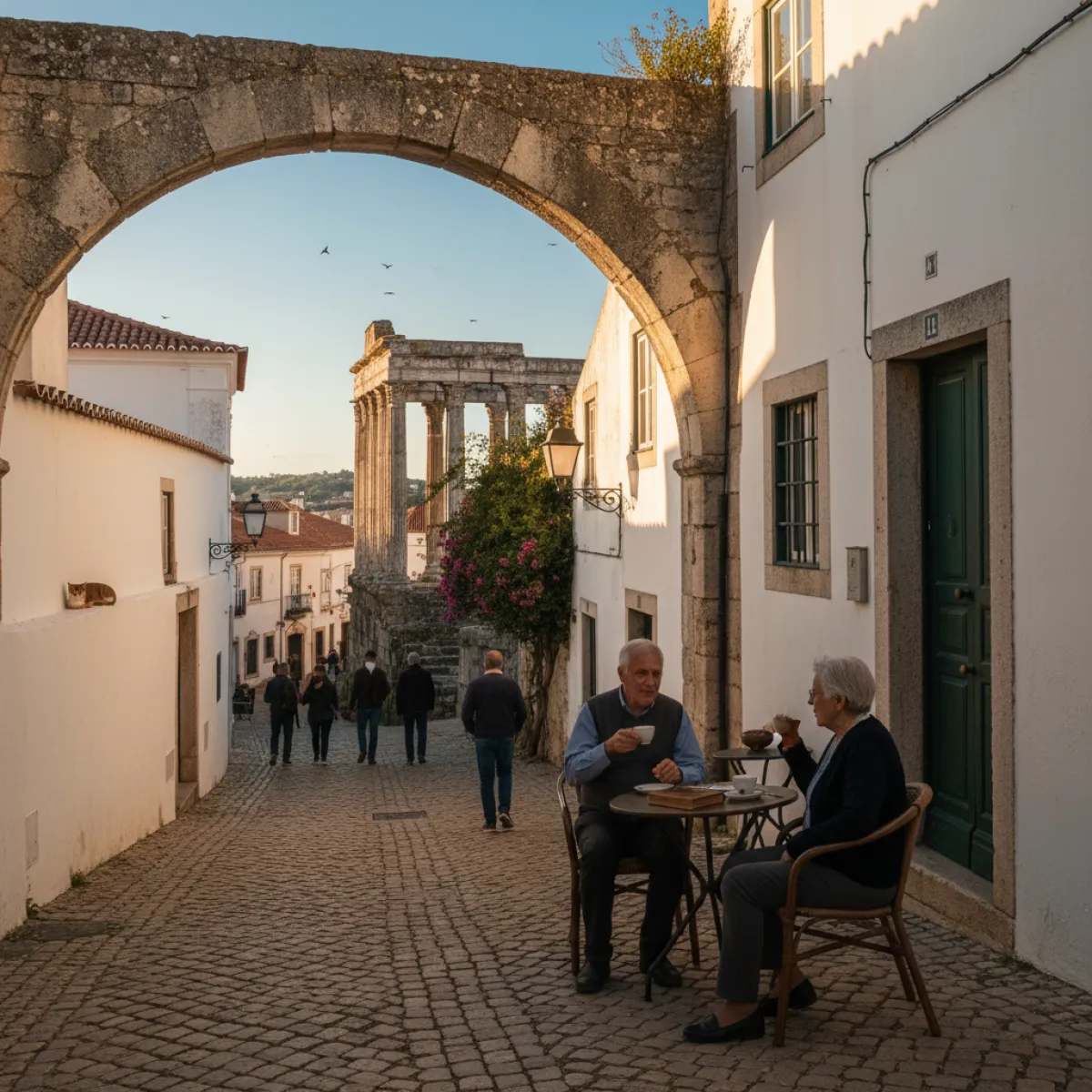
The monumental heart of Évora is a dialogue between the sacred and the imperial. The Roman Temple, often (and incorrectly) attributed to Diana, stands with a resilience that commands respect. Its Corinthian columns, carved from local granite, are the skeleton of a past that refuses to fade away. Beside it, the Cathedral (Sé), the largest medieval cathedral in Portugal, offers a contrast of granitic solidity. Climbing to its terrace is mandatory; from here, the view over the city's sea of white rooftops and the surrounding plains is the finest map one could wish for.
Inside the Sé, the Gothic cloister invites contemplation. It is a space of absolute silence, broken only by the occasional tolling of bells or the flight of swallows. It is in this transition between the sun-drenched exterior and the somber interior that one perceives Évora's architecture as a refuge against the merciless heat of the Alentejo summer.
Dancing with Death
No visit is complete without stopping by the Church of Saint Francis and its famous Chapel of Bones. 'We bones that are here, for yours we wait', the warning at the entrance is a stern reminder of our transience. The walls lined with skulls and femurs are not a macabre exercise, but rather a Franciscan lesson on the ultimate equality of all men. It is an introspective pause that contrasts with the vibrant light waiting for us outside in Giraldo Square.
Life in the Square
Praça do Giraldo is the city's living room. With its Manueline arches and eight-spouted marble fountain, it is where social life happens. Sitting at one of the terrace cafes to watch the locals is a worthwhile pastime. Here, coffee is sipped slowly, and conversations stretch long past the last drop. It is the starting point for exploring the narrow alleys of the Mouraria (Moorish quarter), where white houses with yellow or blue trims create a geometric labyrinth that feels like a Chirico painting.
The Água de Prata Aqueduct is another marvel of engineering that defines the city's silhouette. What makes it fascinating is not just its scale, but how the city has swallowed it: houses and shops have been built between its arches, integrating the monument into daily life in an organic and almost nonchalant way. This casual cohabitation with history is what makes Évora unique.
The Alentejo Table
Eating in Évora is an act of devotion. Alentejo cuisine is the art of making a lot out of almost nothing, bread, olive oil, aromatic herbs, and black pork. In the many restaurants in Évora, tradition is respected with almost monastic rigor. Dishes like 'migas com entrecosto' (bread-based crumbs with pork ribs) or 'açorda de poejos' (bread soup with pennyroyal) are pillars of local identity. Do not look for molecular sophistication; here, luxury lies in the quality of the product and the patience of the cooking.
For an authentic experience, look for taverns where 'vinho de talha' (amphora wine) is served directly from large clay vessels. It is a rustic, honest wine that tastes of the earth it came from. The conventual sweets, inherited from the many convents that once populated the city, are the perfect finale. The 'Encharcada' or 'Pão de Rala' are bombs of sugar and egg yolks that test our endurance and satisfy our soul.
Beyond the Walls
While the historic center is magnetic, it is worth venturing beyond the walls. The Almendres Cromlech, one of the largest megalithic complexes in Europe, is just a few kilometers away. Visiting this site in the late afternoon, when the low light highlights the engravings on the millennial stones, is an almost mystical experience. It is a reminder that Évora was a center of power and spirituality long before the Romans even thought of conquering the Peninsula.
Practical Information
- When to go: Spring (April to June) is ideal, with the plains covered in wildflowers. Autumn is perfect for the harvest. Avoid August, unless you enjoy temperatures above 40 degrees Celsius.
- Budget: Évora is affordable compared to Lisbon. Dinner at a good restaurant costs between €25 and €40 per person.
- What to buy: Cork, of course, but look for contemporary design pieces. The pottery from São Pedro do Corval (40km away) is also an excellent option.
Évora is not a city to see; it is a city to be. It is an invitation to slow down, to read, and to enjoy a good meal. When you leave, you will take with you not just photographs of ancient stones, but the echo of a silence that is rarely found in the modern world.
