The Rescued Stones: The Story of the Xerez Cromlech
There is something profoundly stubborn about the Xerez Cromlech. Had political decisions and hydraulic engineering taken their natural course without archaeological intervention, these stones would currently be serving as an artificial reef at the bottom of the Alqueva reservoir. In 2004, as the gates of Western Europe’s largest dam closed and the water began to swallow the landscape, the monument was meticulously dismantled from the Herdade do Xerez and transported to the foot of the Monsaraz hill. Today, it rests next to the Convento da Orada in Telheiro (7200-175 Monsaraz), a location that, while not its original birthplace, grants it a dignity few relocated monuments manage to retain.
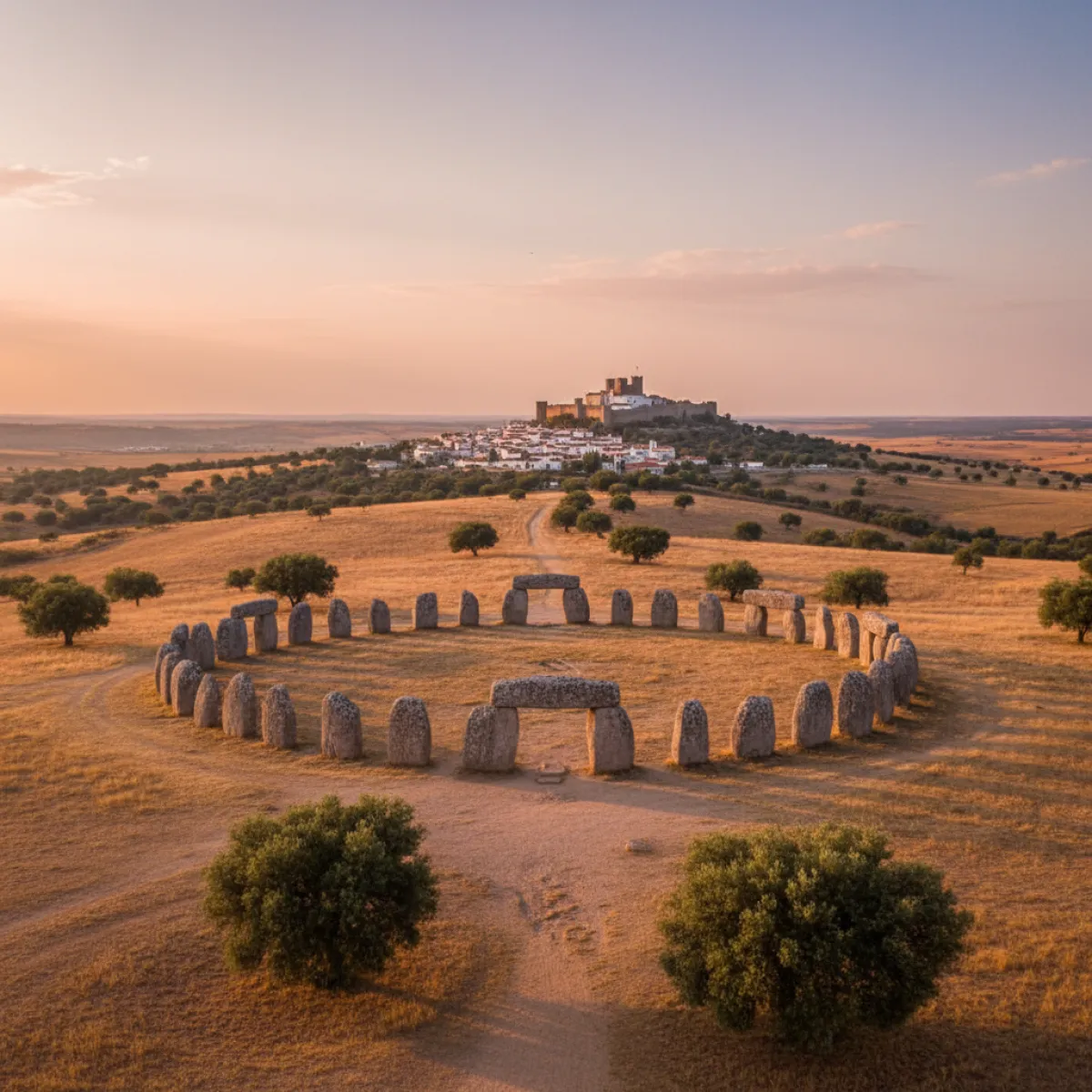
Visiting Xerez isn’t like walking into a climate-controlled museum in Lisbon. It is an exposed, raw experience, entirely dependent on the whims of the Alentejo sky. The monument is a square, and I emphasize square, because in European megalithic archaeology, the norm is the curve, the circle, or the horseshoe. Here, 55 granite menhirs form a rigid geometric structure that challenges our understanding of 4th-millennium BC rituals. At its center, an imposing menhir stands roughly seven meters tall, dominating the assembly and surrounded by smaller stones that seem to guard its authority.
Geometry and Mystery in Telheiro
The current location in the Telheiro neighborhood is strategic. While most tourists elbow each other in the narrow streets of Monsaraz Castle to buy pottery and take the same sunset photo, the Xerez Cromlech offers a silence that money cannot buy. It is a space of human scale, where you can touch the rough granite and feel the heat stored by the sun. The fact that it is a square enclosure raises questions that experts still debate: was it an astronomical observation structure or a tribal meeting place with a clearly defined spatial hierarchy? Regardless of the answer, the power of the place is undeniable.
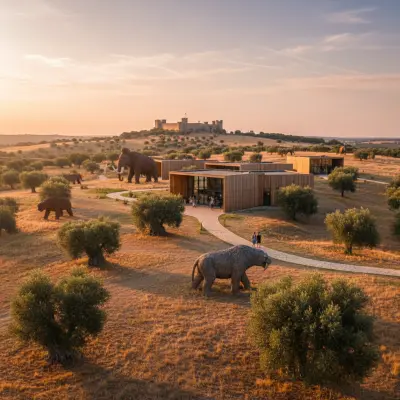
For those who like to put these stones into context, it’s worth a visit to the Parque Megafauna Monsaraz, where the scale of local prehistory is explained in a more didactic way. But Xerez has that advantage of direct access, without ticket booths or turnstiles. It is Alentejo at its most pragmatic: the monument is there, the field is there, and the visitor is free to interpret what they see.
Practicalities and the Alentejo Heat
The entry price is unbeatable (€), which is to say, it’s free. However, the real cost is paid in hydration. There is no shade here. If you decide to visit in mid-August at three in the afternoon, the experience will quickly shift from historical contemplation to a survival test. The ideal time is early morning or when the sun begins to dip, and the lateral light highlights the carvings and shapes of the 55 stones. The official website (cm-reguengos-monsaraz.pt) doesn’t list fixed hours because, in practice, the archaeological park is always there, integrated into the landscape.
If you have questions about access or if the Convento da Orada is open for complementary visits, the contact number is +351 266 508 040. Telheiro is a small, charming village with whitewashed houses that serve as the perfect frame for the monument. After walking among the menhirs, my recommendation is to head down a bit further to the Parque de Merendas da Praia Fluvial de Monsaraz. It is the perfect contrast: from the dry Neolithic granite to the coolness of the Alqueva waters, the very same waters that almost claimed the cromlech forever.
Expert Tips
- Footwear: Forget thin-soled sandals. The terrain is a field with dry grass and loose stones. Wear sneakers or light hiking boots.
- Parking: It is easy and free next to the Convento da Orada. Don’t try to drive right up to the stones; walk the last few yards.
- Seasonality: If you come in February, you can witness the contrast of the grey stones against the blossoming almond trees, as described in our February White guide. It is, visually, the best time to visit the region.
- Photography: The best perspective of the cromlech is obtained from a slightly elevated point, looking toward Monsaraz Castle, which watches over everything from the hilltop.
The Xerez Cromlech isn't just a pile of old stones. It’s a survivor. It’s a reminder that, sometimes, we manage to save the past from the unstoppable march of progress. Don’t expect interactive panels or high-tech audio guides; expect only the silent, powerful presence of 55 granite blocks that refuse to be forgotten.