Beja When It Rains: Indoor Spots Actually Worth It
Rain in the Alentejo is rare, but when it falls on Beja it turns the city into a different, slower, truer place. From the Pousada do Convento to the tiles of the Museu Rainha D. Leonor, from migas with pork ribs to honey-coloured light at dusk: the honest guide to a day ninety percent of tourists miss.
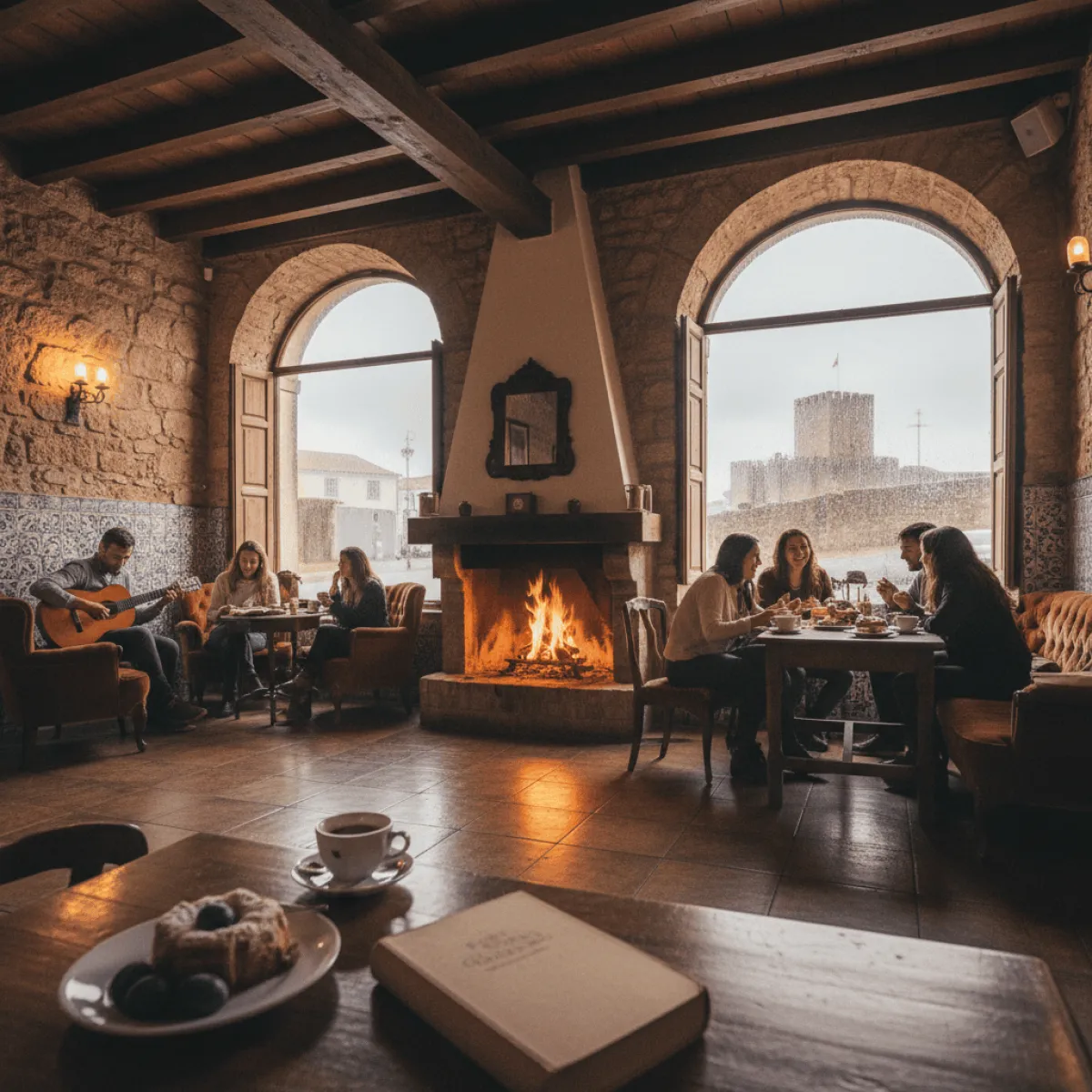
Rain in the Alentejo is rare enough to make headlines at the corner café. When it falls in Beja, it falls with conviction: that horizontal kind of downpour that turns Praça da República into a grey mirror and sends everyone indoors. The good news is that Beja, against all touristic expectations, knows how to handle bad weather. The bad news is that half the visitors give up and flee to Lisbon. Their loss.
This guide is for those who stay. For those who understand that a city revealed in the rain, with empty streets and museums almost to yourself, is a different city, a better one even. Beja gets three hundred sunny days a year, but the other sixty-five are when locals exhale, when cafés fill with slow conversation, when the Alentejo stops being a postcard and becomes an actual place.
First: where to sleep when the deluge arrives
A confession upfront: spending a rainy day in Beja without decent lodging is an exercise in masochism. You need a base. Not to hide in, but to come and go from, dry your boots, drink tea, head out again.
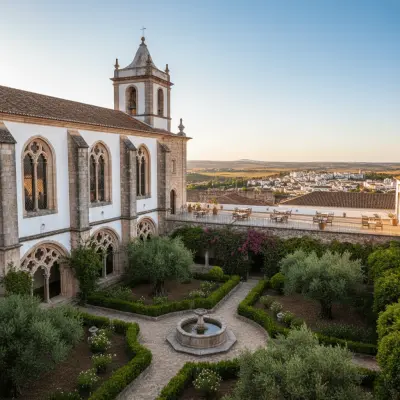
The obvious choice, and for once the obvious is the right one, is the Pousada Convento de Beja, set inside the 13th-century Convento de São Francisco. It's not just the Pousada brand prestige: it's because a covered cloister, with rain hitting the stones outside and the smell of coffee drifting from the inner bar, is literally the most Alentejan setting possible for a wet day. Ask for a room facing the cloister, not the street. The view difference justifies the extra twenty or thirty euros.
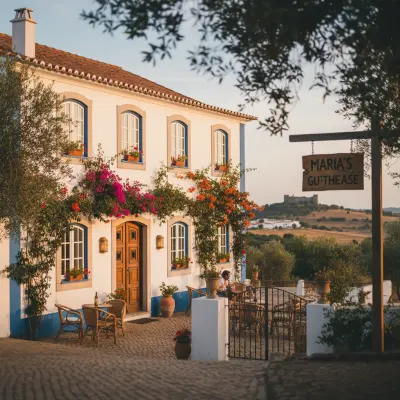
For something less institutional, Maria's Guesthouse is what I'd recommend to couples or solo travellers. It's a small house, breakfast served at the kitchen table, and Maria, if you catch her in a good mood, will give you Beja tips that aren't in any guidebook, this one included. Book ahead, there are only a handful of rooms.
The Castle and the Keep: climbing it even in the rain
Controversial take: the Torre de Menagem of Beja Castle is better in the rain than in sunshine. Hang on, let me explain.
The keep, nearly forty metres tall, is the highest in Portugal and was built by King Dinis. In August, with thirty-eight degrees in the shade, climbing the two hundred-something stone steps is punishment. In January or February, with light rain falling outside, it's a completely different experience: the plain stretches grey and infinite, the olive groves look like blurred watercolour, and the wind hits your face in a way that makes sense. Wear rubber-soled shoes. The spiral stairs get slippery.
Entry costs a few euros and the castle typically opens 10am to 6pm, but check locally because hours vary by season. On your way out, cross the square and take refuge in the Núcleo Visigótico, housed in the small Church of Santo Amaro, one of the very few pre-Romanesque churches that survived in Portugal. It's tiny, you'll see it in twenty minutes, but the columns with their Byzantine capitals, the kind that look like they walked straight out of the 7th century, are worth the detour.
The museum nobody expects: Rainha D. Leonor
The Beja Regional Museum, known as the Museu Rainha D. Leonor, occupies the former Convento da Conceição, and it is, no exaggeration, one of the most underrated museums in the country. The tile room is what everyone goes to see, and they're right to: it's one of the most complete collections of Mudéjar and Hispano-Arabic azulejos in Portugal, with 15th to 17th century pieces covering entire walls, floor to ceiling.
But what nobody tells you is to head straight for what's called the Janela de Mértola, the Mértola Window. It's the Manueline window where, according to tradition, Mariana Alcoforado, the nun who wrote the Letters of a Portuguese Nun, waited for her French cavalier, Noel Bouton de Chamilly. The Letters, published in Paris in 1669, are considered by many to be the first epistolary novel in European literature. Truth or legend, standing there with rain running down the carved stonework is a good reason to lose half an hour.
The museum is usually closed on Mondays. Check before going. Entry is cheap, around two or three euros.
Cafés where you can spend the day (without anyone giving you side-eye)
The great Alentejan talent is the café chair. In Beja, on a rainy day, this talent ascends to art. There are unwritten rules: order a coffee and a pastry, sit for two hours, nobody throws you out. That's how it works.
Café Luiz da Rocha, on Rua Capitão João Francisco de Sousa, is an institution. It's been operating since 1893 and the interior, with dark wooden counters and convent-pastry display cases, is a time capsule that has nothing staged about it: it's simply how it has always been. Order a queijada de Beja or a trouxa de ovos. Drink an espresso. Don't order cappuccino. Please.
For something less self-conscious, any café around Praça da República will do. The trick is not to order tourist food (the seven-euro smoked salmon toast) and stick to basics: a half-and-half coffee with milk, buttered toast, pastel de nata. You'll spend three euros and last until lunch.
Rainy lunch: cozido, açorda and migas
Here things get serious. Alentejan cooking was invented for cold days, even if the cold only shows up three months a year. A wet day in Beja is the perfect excuse to eat what would feel too heavy on a beach day.
I recommend migas with fried pork ribs. Alentejan migas, unlike the Beira version, are made with bread, garlic, olive oil and herbs, ending up as a compact golden mass served alongside meat. This is serious country food, you won't leave light. Dom Dinis, near the castle, does a respectable version. For açorda à alentejana with cod and a poached egg, any tasca on Rua Combatentes will do, but always ask if it's made fresh. Reheated açorda is a crime against the Alentejo.
Average cost of lunch at a serious place: twelve to eighteen euros per person with house wine. If they ask more than twenty-five for a daily menu, you're at a tourist spot. Walk out.
For when the rain stops: the fresh air that follows
The Alentejo has this trait: rain passes quickly. In two hours the sky opens, the sun comes out, and the smell of wet earth is one of the best things you'll experience in Portugal. When that happens, and it will, consider bird watching in Beja with Salva Fauna. Post-rain fields fill with activity, especially between October and March, when great bustards and little bustards pass through. It's not exactly an indoor activity, but it's the logical sequel to your indoor day: you rest, the rain rests, then you go out.
And if the rain, against all forecasts, lasts two or three days running? There's a radical option few consider: go to the sea. Yes, in winter. The Praia da Zambujeira do Mar, a little over an hour from Beja, is dramatically beautiful in rough weather. Cliffs with the ocean smashing below, nobody on the sand, a café open by the sea, it's an experience ninety percent of tourists miss because they associate beach with summer. Mistake.
Books, wine and silence: the luxury of an indoor afternoon
There's a certain kind of traveller, and I suspect many boa.pt readers are this kind, who doesn't need a programme. For those, the best thing to do on a rainy afternoon in Beja is literally nothing in particular.
Buy a bottle of regional Alentejan red at a local wine shop (don't buy supermarket, for the love of god), pick up fresh cornbread and Serpa cheese at a traditional grocer, and head back to your room. If you're at the Pousada, borrow a book from the small library in the hall. If you're at a guesthouse, bring your own. Spend three hours doing absolutely nothing productive. This is, in my considered opinion, the most Alentejan thing you can do in Beja.
Queijo de Serpa: a buttery sheep's milk paste, DOP-protected, runs about thirty euros a kilo at a good shop, but you can buy a 150-gram wedge for five. Pair it with mountain honey from the Mértola hills if you find it.
And if you're tempted to flee: the alternatives
Let's be honest: three days of rain in Beja with a tight schedule can wear out even the patient. If you're calculating a plan B, an hour and a half by car, heading north into the Alentejo, you'll find Portalegre, and Portalegre has a different urban landscape, more mountainous, more granite-built, colder. Our destination guides exist for this: a real weekend in Portalegre without the tourist traps, or if you prefer urban walking, the neighborhoods worth covering on foot. And if you travel with your stomach, as one should, read first where the locals actually eat in Portalegre before falling for any tourist menu.
How to get there and move around in the rain
Beja has daily train connections from Lisbon (about three hours, around fifteen euros) and the station is a fifteen-minute walk from the centre. On a rainy day, ask for a taxi at the door. It's four or five euros to the historic centre. Driving yourself is practical but parking in the centre is restricted, opt for the large car park on Avenida Vasco da Gama and walk down.
Inside the historic centre, everything is a fifteen-minute walk away. You won't need another taxi. Bring a small fold-up umbrella and waterproof boots. Don't try a large umbrella, the Alentejan wind will turn it inside out in two minutes.
Last thing: the light after the rain
There's a moment, late afternoon, after a full day of rain in Beja, when the light that escapes through the gap in the clouds is absolutely impossible to photograph and impossible to forget. The white buildings, the walls, the keep, all of it bathed in a rare honey colour. Step outside then, even if it's still drizzling. Walk up to the castle area, look south across the plain. This is what you came to Beja in January for. Summer tourists will never know it.