Walking Praia da Vitória: Architecture and Memory in the Old Town
Rebuilt stone by stone after the 1980 earthquake, Praia da Vitória is the only Azorean city designed with a ruler and a set square. A walking route through the historic centre, with stops at the Casa Museu Vitorino Nemésio, the Matriz Church, and the alcatra that's been slow-cooking since dawn.
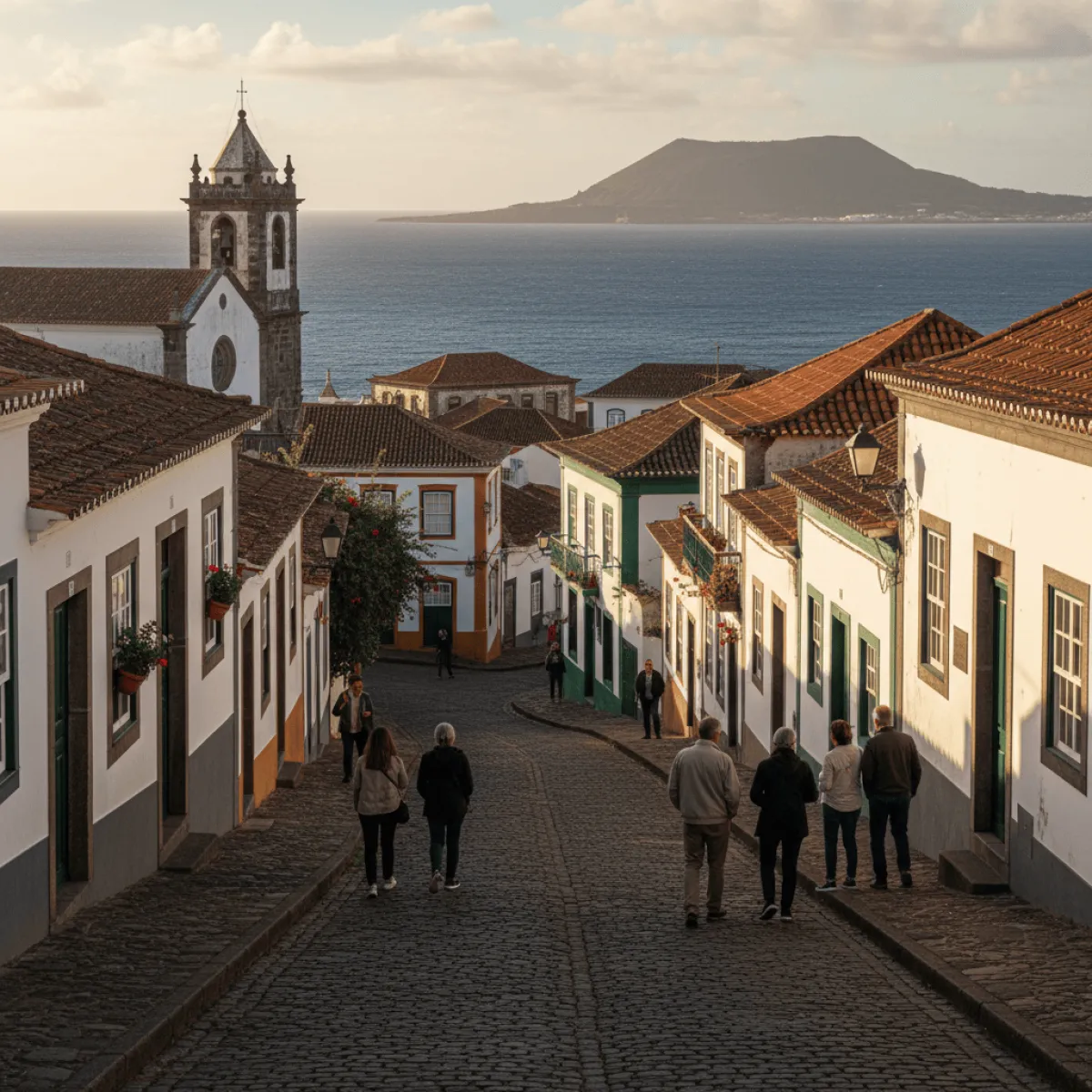
Here's something the official Azores brochures won't tell you: Praia da Vitória is the only city in the archipelago designed with a ruler and a set square. That's not an exaggeration. After the 1980 earthquake almost split Terceira in half, the historic centre was rebuilt stone by stone, often with the very same stones, following the original sixteenth-century street grid. The result is disconcerting: a city that looks ancient but smells of fresh lime, a chequerboard urban layout, white facades framed with black basalt cornerstones, and a light that, around four in the afternoon in summer, turns everything into a black-and-white photograph splashed with bougainvillea.
This is the side of Terceira that visitors heading straight for Angra tend to miss. Which is exactly why it's worth lacing up a decent pair of trainers (the cobblestones are uneven, leave the heels at the hotel) and doing this route on foot, slowly, on one of those days when the Atlantic is cobalt blue and the wind has decided to give you a break.
Start early, start in the square
Begin at Praça Francisco Ornelas da Câmara, known locally as Praça Velha. If you arrive before nine, you'll have the place almost to yourself, shared only with town hall employees unlocking doors and the café staff next door stacking chairs. The town hall building, a nineteenth-century construction, sets the tone: mansard roof, symmetrical facade, and that whitewashed paint job that, when the sun hits, forces you to wear sunglasses even on cloudy days.
Order a coffee and a malassada (between 1.20 and 1.80 euros, depending on where you sit) and look around. What looks like a simple plaza is in fact the product of a Pombaline obsession. When Sebastião José de Carvalho e Melo reformed Portuguese urbanism in the eighteenth century, he wanted squares like this: regular, hierarchical, with the church marking the axis. And here the axis is precisely the Matriz Church of Santa Cruz, opposite, with its Manueline facade where sixteenth-century stonemasons left details as strange as dolphins carved into volcanic rock.
A detail most people walk straight past
On the Matriz facade, look at the two asymmetric towers. It's not a construction error, it's history. One is late Gothic, the other was rebuilt after one of the many earthquakes the island has endured. The Manueline portal, with stone ropes carved around it, is among the oldest in the Azores. Step inside if the door is open (typically between 9am and noon, then 3pm to 6pm, but check locally). The coffered painted ceiling alone justifies the detour.
Up to the writer's house
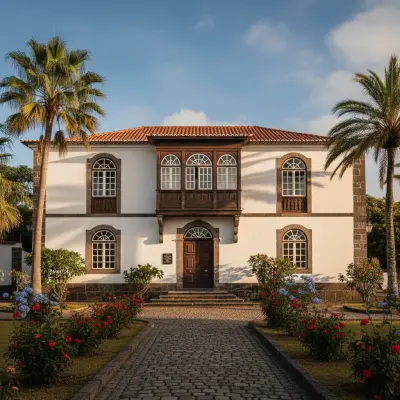
Next, head up Rua Jervis de Atouguia towards the Casa Museu Vitorino Nemésio. It's a short climb, but the angle is enough to grasp the city's topography: Praia da Vitória leans against the sea like someone sitting on a beach, with the bay opening in a crescent. Nemésio, Terceira's greatest writer and one of the giants of twentieth-century Portuguese literature, was born here in 1901. The building is modest, a plain facade, but inside it's a time capsule: original furniture, family photographs, the desk where he wrote Mau Tempo no Canal, which for the Azores is what Os Maias is for Lisbon.
Entry runs around 2 euros and the visit takes 30 to 40 minutes. Walk in with a question in mind: how did a man who grew up here, with a view of the harbour and the smell of seaweed, end up teaching French literature in Coimbra and Paris? The answer is in the books you can leaf through in the library room. For anyone who has never read Nemésio, start with O Açor, a collection of poems where the island appears without ornament, with proper names, winds catalogued, clouds listed by hour.
The new neighbourhood that's actually the oldest
Leaving the museum, follow Rua de Jesus towards the Riviera area. The character of the walk changes here. Streets are narrower, houses smaller, and almost all of them share the same colour scheme: white with coloured trim around windows and doors, usually yellow, blue, red or green. This is an Azorean tradition, but in Praia da Vitória it reaches almost obsessive levels of perfection. There's a practical reason for the coloured trim: it helped illiterate sailors identify houses from the harbour. Today it functions as a kind of permanent folk art.
Pay attention to the corner stones. The black basalt forms the skeleton of these houses, contrasting with the whitewash. This is Azorean vernacular architecture at its purest, and it's there in plain sight, with no plaques explaining anything. Those who know how to see, see. Those who don't will say everything looks the same.
Where to stop for lunch and what to order
By now, if you started early, you should be hungry. Two options. Option one: walk down to the waterfront, where several restaurants face the bay. Order alcatra, Terceira's defining dish: beef slow-cooked for hours in a clay pot with wine, garlic, local pepper paste and bacon. Expect to pay between 12 and 16 euros per person at a decent spot. Warning: this is not a dish you eat before continuing to walk. Eat it and write off the afternoon, guilt-free.
Option two: go lighter, have a sopa do Espírito Santo (beef, mint, bread, cheese, in a meaty broth, around 6 euros) and save space for a salt cod fritter at any café. Espírito Santo, here on Terceira, isn't just religion, it's gastronomy, it's architecture (the gaudily painted impérios you see in every village), it's the cultural engine of the island. May and June are festival months across nearly every parish. If you happen to be here during that window, abandon the itinerary and follow the smell of slow-cooked beef.
The Misericórdia Church and the side-street treasures
After lunch, return to the centre via Rua de São Paulo. The Misericórdia Church is less spectacular than the Matriz but more intimate. Late Baroque facade, modest gilded woodwork inside, a small lateral cloister where, if you're lucky and the sacristan is in a good mood, you'll get a peek. There's no guaranteed official schedule, opening hours during the week are irregular. Worth trying.
From here, get lost. Seriously. The urban grid is so regular that you can't get badly lost: five minutes walking in any direction puts you back on a familiar axis. But it's in the side streets that the best details appear: wrought-iron gates from the 1930s, hydraulic floor tiles peeking through chipped paint, balconies with potted geraniums, cats sleeping on thresholds, bakeries exhaling the smell of massa sovada (the Azorean sweet bread, dense and faintly brioche-like, eaten warm with butter and immediately addictive).
Don't skip Biscoitos: the detour worth taking
Praia da Vitória isn't only the historic centre. A few kilometres away, on the north coast of the municipality, sits the Biscoitos area, where black lava meets the Atlantic and where, for centuries, vines have been planted in stone corrals. It's a different sight, a landscape architecture born of necessity: the wind won't let anything grow without protection, so locals built thousands of small walled compartments, each housing one or two vines. From above, it looks like a labyrinth.
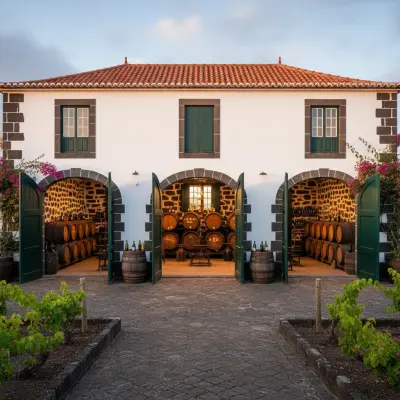
The Museu do Vinho dos Biscoitos tells that story. It's a small museum, run by a local family for generations, and it always ends with a tasting of Verdelho dos Biscoitos. It's not the best wine in the world, let's be honest, but it's one of the rarest and one of the most historically loaded. The vinho de cheiro, red and slightly fortified, is the most distinctive. Take a bottle home, expect to pay between 8 and 15 euros in the museum shop.
A few steps away is something else worth your attention: the Brianda craft brewery, a micro-operation putting out IPAs and stouts that are surprisingly competent for a brewery on a rock in the middle of the Atlantic. For anyone who prefers hops to grapes, it's a mandatory stop.
The military museum that's better than it sounds
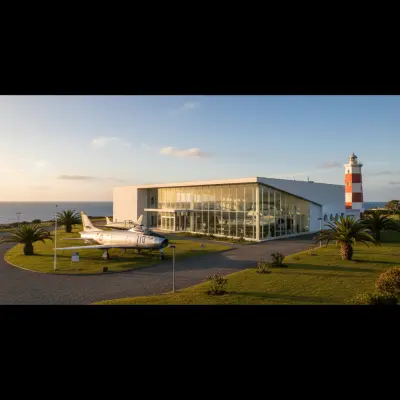
Back in Praia, and if you still have energy for one more stop, it's worth visiting the Núcleo Museológico da Base Aérea Nº4. Yes, I know, it sounds like the kind of museum that only appeals to aviation buffs. But there's a story here that most visitors overlook: during the Second World War, this base was a strategically crucial point. The Allies, particularly the Americans, used it as a stopover for transatlantic flights. Later, throughout the Cold War, it remained relevant.
The result is that Praia da Vitória had, for decades, a temporary American population that left its mark: vocabulary, certain habits, imported goods in local grocery stores, even some American-inspired residential architecture in the outskirts. It's a layer of the city's identity that the casual visitor never picks up on.
How to get there, where to stay, when to go
Getting to Praia da Vitória is easy because Terceira's airport (Aeroporto das Lajes) is literally next door, about five minutes by taxi from the centre. Daily direct flights from Lisbon (around 2 hours 15 minutes) via TAP and SATA. From Angra do Heroísmo, the island's other main town, it's about 25 minutes by car on the Via Rápida.
For accommodation, stick to the historic centre if you want to walk everywhere. Several restored townhouses have been converted into small hotels or guesthouses, with rates between 60 and 120 euros a night in low season, doubling in July and August. For a quieter stay, consider Biscoitos, but you'll need a car.
When to go: May, June and September are the sweet spots. Stable weather (within reason, this is an Atlantic island, conditions can change in minutes), fewer tourists, and a good chance of catching the Espírito Santo festivals or the Festas da Praia in August, when the bayfront becomes a week-long open-air concert.
Beyond walking
If the walk leaves you hungry for more, consider an electric bike tour that covers more ground, including the coastline and Biscoitos, without the punishment of pedalling into an Atlantic headwind.
Don't stop here
Terceira is just one of nine islands. If your itinerary allows, consider a hop over to Faial, especially Horta, the cosmopolitan port town where sailboats from across the world drop anchor, or scout out the finest panoramic spots in Horta to understand why this is the Azorean city with the strongest maritime pulse. For those who prefer to enter via the kitchen, the gastronomic trek through Ponta Delgada, on São Miguel, is the natural starting point.
But come back to Praia da Vitória. It's one of those small cities that reveals more on a second visit, when you're no longer trying to figure out the map and can just notice the window-trim palettes, the morning smell of salt air, the call of the seagulls which, unlike Lisbon's, still seem to retain some dignity.