Praia da Vitória: Surf, Learn, or Just Watch
The roundest bay in the Azores doubles as the archipelago's friendliest surf classroom, with metre-and-a-half waves, a sandy bottom and water at 22 degrees in July. Learn, watch from the seawall, or escape to Biscoitos for lava pools and Verdelho grown inside stone enclosures.
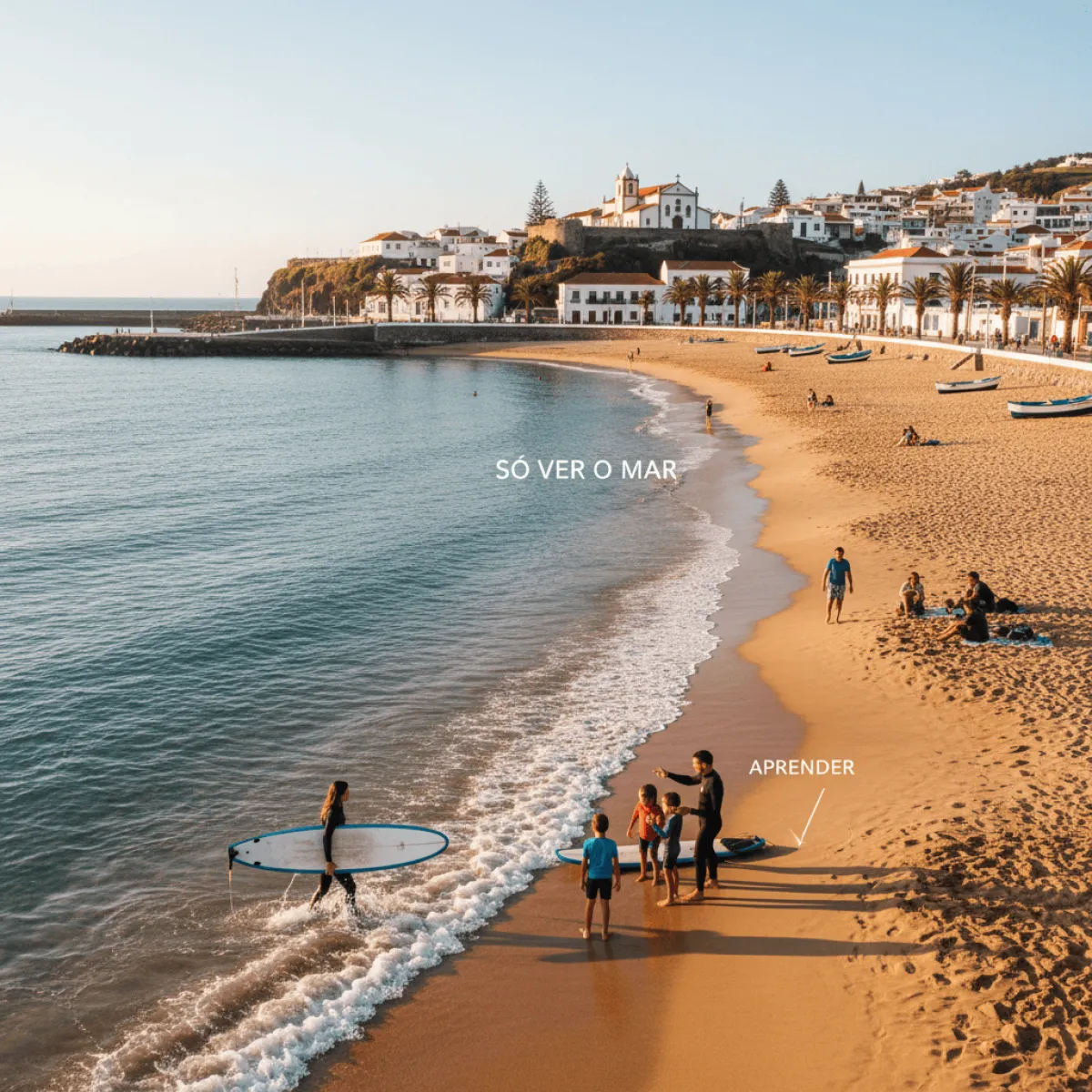
Here is what nobody tells you about Praia da Vitória before you arrive: the bay is so neatly rounded it looks drafted by an architect with a compass obsession. Almost three kilometres of pale sand facing east, sheltered to the north by Monte Brasil and to the south by the Espigão headland. The result is that while the rest of Terceira takes punches from the Atlantic, here the sea breathes. That is one reason this quiet town has become, without much fanfare, the best place in the Azores to learn how to surf, and one of the few where you can catch decent waves in the morning and snorkel in the afternoon without leaving the parish.
This is not a surf guide written by surfers for surfers. Those people already know where to go and frankly do not need me. This one is for everyone else: the never-touched-a-board crowd, the families with kids, the people who want to look at the sea seriously without getting wet, or those who simply want to understand why, in an archipelago of wild coastline, this gentle bay is the one that ended up named after a victory.
The bay that changed names (and character)
Before 1837 this town was just Praia. Plain Praia. After the liberal battle of 1829, in which the locals held off the Miguelist troops, Queen Maria II added the surname. The history matters because it explains the central square, the statue, the wide orthogonal streets that are rare in the Azores, and also why the town has always had a practical, rather than mystical, relationship with the sea. People here do not contemplate the ocean, they use it.
The sand you see today is largely man-made. A major beach reinforcement project in the 1990s gave the town that long urban stretch of fine sand between the public garden and the fishing harbour. Blue Flag for over two decades, supervised in summer, with showers, terraces thirty metres away, and the sunset behind you, which here means morning light, afternoon shade. For someone learning to surf, this is just about the perfect setup: small waves, sandy bottom, no rocks in the middle.
Where to catch your first wave
The learners zone sits at the south end of the bay, roughly opposite the parking area along Avenida Beira-Mar. Waves form from a swell filtered by the Espigão and rarely top a metre and a half in this section. That is exactly what a beginner wants: generous whitewater, easy recovery, and if you fall there is nothing to hit but sand.
What to expect from local schools (offerings change year to year, check locally before booking):
- Group classes of two hours, generally 35 to 50 euros, board and wetsuit included
- Private lessons more expensive, in the region of 70 to 90 euros
- Five-day packages, which is where the per-session price actually starts looking reasonable
- Simple board rental for those who can already manage: around 15 to 20 euros for half a day
Tip from someone who has watched this play out plenty of times: book the morning slot. The thermal wind almost always picks up after lunch, and what was a clean wave at 10am turns to mush by 2pm. From June to August water temperatures hover at 20 to 22 degrees Celsius, which by Azorean standards is practically the Caribbean. In October and November you can still get in with a 3/2 wetsuit, and the waves are usually better, more consistent and less crowded. Winter is serious business: a 4/3 is mandatory, and that is when locals start eyeing spots outside the bay that I will leave for another conversation.
For those who prefer to watch, not get wet
There is a quiet ritual every afternoon that most tourists miss: the slow walk along the seawall between the fishing harbour and the Santa Catarina fort. You go slowly, into the wind. To your right, the whole bay. To your left, the low town, white-walled, with that cobalt-blue trim Azoreans paint on stone with the confidence of people who know it is the only colour that holds up against the salt.
If you would rather gain altitude, the Facho viewpoint to the north gives you the bay in plan view, like a map. It is a fifteen-minute walk from the centre, moderately steep, and there is a stone bench that seems purpose-built for someone who brought a sandwich of Ilha cheese. Another good and quieter spot is the lane that climbs to the chapel of Nossa Senhora da Conceição at the south end.
For a more ambitious coastal plan, swap the town for a bicycle. The e-bike tour through Praia da Vitória is the most civilised way I know to see this stretch of Atlantic frontage. You pedal from Biscoitos to the urban shoreline without dying on a single hill, and stop wherever you want. Honestly, with the motor helping, even people who have not been on a bike in twenty years manage just fine.
Biscoitos: natural pools and the other face of the sea
Eight kilometres north of town, Biscoitos begins, and here the sea changes personality completely. Where the Praia bay is round and gentle, Biscoitos is pure black lava, the rock that poured into the sea, cooled in twisted shapes, and left a labyrinth of bowls, channels and platforms. The natural pools here are among the best in the Azores, and that is coming from someone who has seen nearly all of them.
What to do in Biscoitos:
- Pool swimming: follow the main cobbled road until you see the concrete stairway. There are showers and a simple summer kiosk
- Snorkelling: at the right tide you spot ornate wrasse, white seabream, salema, sometimes octopus. Visibility here is ridiculous, in a good way
- Scuba diving: several island operators work this coast, with 15 to 25 metre dives a short swim from the rocks
- Lunch with a sea view: very few places have the view, so reserve ahead
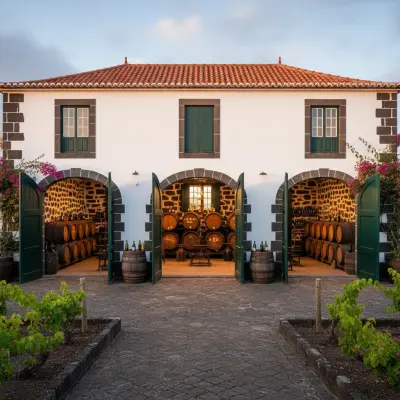
Biscoitos is not only water. It is also the only place in the world where vines grow inside small enclosures of lava stone, a protected denomination based on the Verdelho grape. The Wine Museum of Biscoitos tells this story with rare honesty: it is the Brum family who built the museum inside their original winery, and the visit ends with a tasting of dry or fortified Verdelho, depending on the mood. Go with time, and if you like what you taste, bring some home. It costs no more than a good mainland wine and you will not find it anywhere else.
A few hundred metres away, another kind of fermentation: Brianda craft beer. Small-batch Azorean brewing with a brewery visit, tasting, and a serious conversation with the people who make it. For two people, it costs less than two cocktails in Lisbon and you learn far more.
Two land-based museums (and why you will want them)
I know what you are thinking: you came for the sea, and now I am sending you to museums? Yes, but two very specific ones, and both change how you look at the coast outside.
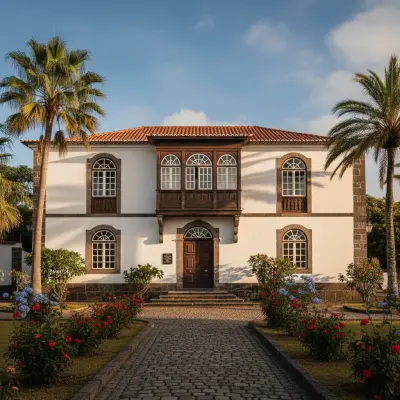
The first is the Casa Museu Vitorino Nemésio, in the town. It is the birthplace of the author of Mau Tempo no Canal, arguably the finest novel ever written about the Azores. The museum is small and modest, with personal objects, photographs, manuscripts. But reading a page of Nemésio afterwards, sitting on a seafront terrace with the wind snapping the canvas awnings, is a completely different experience from reading it in a Lisbon apartment. Trust me on this one.
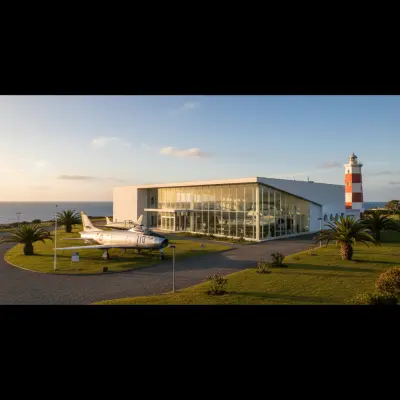
The second is the Museum of Air Base Nº4, next to Lajes. Yes, an air base. Yes, it is worth it. It tells the unlikely story of how this end of Terceira became, during the Second World War and then throughout the Cold War, one of the most strategic chunks of the North Atlantic. There are aircraft, uniforms, photographs of world leaders who landed here for discreet meetings. It is also a fair way to understand the slightly schizophrenic relationship the town has always had with its coastline: at once a swimming beach and an international military airstrip.
Eating and sleeping without regret
The town has more food options than first appearances suggest. Concentrate on the seafront strip and the little square behind the public garden. Order the fish of the day (badejo, forkbeard, wreckfish if you are lucky), stewed octopus, and alcatra terceirense, which is beef slow-roasted in wine inside a clay vessel, a dish in the same spiritual family as Bragança's posta mirandesa but served here with sweet massa sovada bread instead of potatoes. If you like soups, the Espírito Santo soup, especially between May and September, is a ritual worth observing.
For sleeping, avoid the resort-style places facing inland golf courses if you want to wake up to the sea. The small options in restored houses in the town centre are almost always better. In high season (July and August, plus the first half of September with the Festas da Praia), book weeks ahead. Outside those windows, the town has decent availability and far friendlier prices.
Getting there, getting around, what it costs
Lajes airport is seven minutes by car from town. There are direct flights from Lisbon and Porto, and in summer from several European cities. Rent a car. Without one, Terceira frustrates; with one, it opens up. Buses exist but their schedules are designed for residents, not visitors.
Rough budget for a decent week, off peak:
- Mainland-Terceira flight: from 120 to 180 euros return if booked ahead
- Rental car: 30 to 50 euros a day for a compact
- Simple but good accommodation: 70 to 110 euros per night
- Lunch with a main and a drink: 12 to 18 euros
- Fancier dinner: 25 to 40 euros
- Two-class surf pack: 70 to 90 euros
Hopping to other islands (and when it makes sense)
Terceira combines well with any other island in the central triangle. If you have ten days or more, it is worth adding two, without making it a sprint.
Faial is 30 minutes away by plane and 24 hours is enough for the essentials: our guide to 24 hours in Horta explains how to organise the day, from Peter Café Sport to the caldera. If you really care about views (and in Horta the views earn their keep), see what we wrote about the best rooftops and panoramic spots in the city.
São Miguel, further east, demands more time. But if you go, go for the table first: the volcanic plate trek through Ponta Delgada shows how the city has evolved well beyond Furnas stew and pineapple cliché.
The last wave
What makes Praia da Vitória interesting to write about, in the end, is not the surf itself. It is the way this town, which few people put on their list, packs into a single bay a beginner-friendly surf school, lava pools eight kilometres away, a literature museum, a Cold War museum, wine grown inside stone enclosures, and an e-bike coastal route where even your knees survive. You come for the wave, you stay for the rest. Or you stay for the wave, and the rest is a bonus. Either version works. Just do not come expecting the sea to impress you with its violence: here, the victory is precisely the opposite. It is the sea, behaving itself.