Rainy Sintra: Indoor Palaces, Quintas and Pastry Houses
There's a theory nobody tells the tourists: Sintra is better in the rain. An indoor itinerary through palaces, quintas and pastry shops where the windows fog up and a queijada costs one euro.
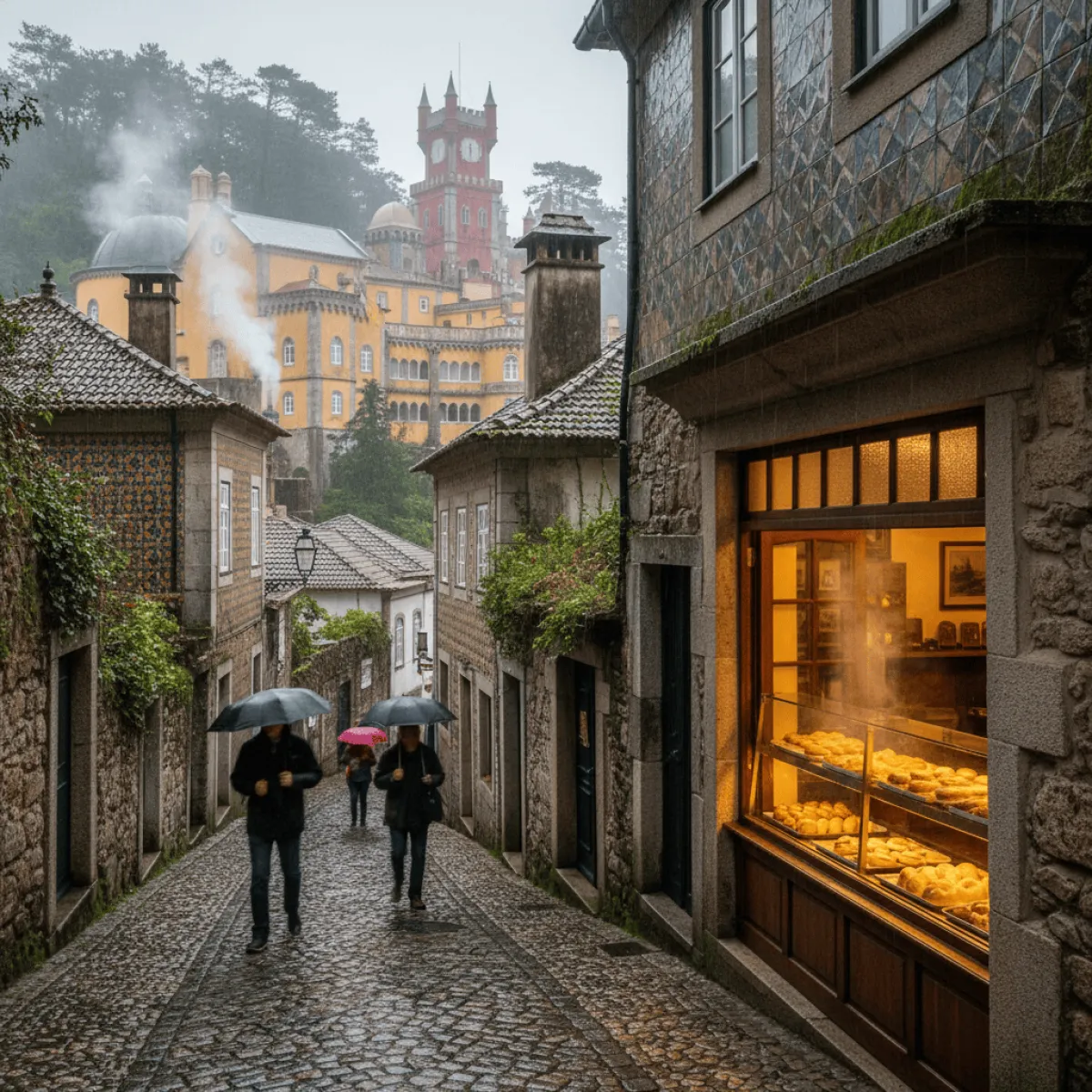
There's a theory whispered between Sintra's local guides that nobody has the nerve to share with the tourists arriving by coach at nine in the morning: Sintra is better in the rain. Not despite the rain. Because of it. When the clouds drop from Cruz Alta and snag on the towers of Pena, when the gardens at Regaleira smell of wet moss and the queue for the Initiation Well shrinks by half, the town finally makes sense. What Byron saw, what Eça wrote about, what the Portuguese kings dragged the entire court here for, was this: a microclimate where it rains while Lisbon, twenty kilometres away, is in full sun.
It is going to rain. Accept it. Buy a cheap umbrella at the first shop on Volta do Duche (five euros, not worth a cent more, will break on day three) and make the strategic decision that changes everything: treat Sintra as an indoor day. Palaces with lit fireplaces, quintas with vaulted ceilings, pastry shops where the windows fog up. This is the itinerary.
The mistake everyone makes
The mistake is starting with Pena. Not because Pena is bad, it's one of the most photogenically deranged buildings in Europe, but because everyone does it first, and in the rain, in the fog, you can see three metres ahead and the cable car queue fills with people in transparent plastic capes arguing in six languages. Flip the order. Start low, in the town, and only climb at the end of the afternoon, when the coaches have already left.
The first stop on a properly wet day is the Palácio Nacional de Sintra, the one with the two white chimney cones you've seen on every postcard. It's the oldest, the most intimate, and crucially the most indoors. The Swan Room, the Magpie Room, the kitchen with two monumental chimneys through which you can see the grey sky, all of it without catching a drop. Admission is around 13 euros, opens at nine thirty, and on a rainy Thursday morning you can almost have it to yourself for the first hour. Anyone who thinks palaces are all alike should look at the Coats of Arms Room and we can discuss it after.
Quintas with history, walls staying dry
Quinta da Regaleira is the unavoidable stop, with one warning: the Initiation Well is outdoors and in the rain it becomes slippery in a way that justifies lawsuits. Climb it slowly, grip the handrail, and then escape inside the main palace. The underground chapels, tunnels, the crypt, this is all interior. You'll come out dripping but finally understanding why the esoterics of the early twentieth century chose Sintra to build their masonic fever dreams.
If you have time, and the rain gets worse, consider Monserrate. It's about three kilometres outside town, far less visited, and the Moorish-Victorian palace has enough covered corridors to spend two hours without seeing sky. The gardens, designed by William Stockdale with plants brought from half the world, gain the density of an English film when the fog rolls in. To understand Sintra beyond the Instagram shots, our Sintra neighborhood guide maps out what exists past Volta do Duche.
The geography of pastry
Now we reach the point that, on its own, justifies visiting Sintra in the rain: the pastry shops. There's an entire economy in Sintra built around two convent sweets, the queijada and the travesseiro, and cold wet weather is the ideal climatic state for understanding them.
Start at Piriquita, on Rua das Padarias. It's a cliché, I know, and there's always a queue out the door, but there's a reason for that. The travesseiros are made on site, puff pastry filled with almond cream, and come out of the oven hot several times a day. Eat one standing at the counter, with a small galão, and you'll understand why the recipe has been kept since 1862. A travesseiro runs about 1.40 euros. Don't buy the box of six, that's for taking to Lisbon. Eat them there, hot, while the rain hammers the other side of the glass.
Sapa, on Volta do Duche, makes the best queijadas. Period. The ones at Piriquita are good, the ones at Casa do Preto too, but Sapa's have a fresh cheese texture the others lost as they scaled up. A queijada costs about 1 euro. Eat three. It's raining, nobody's watching, and tomorrow you'll be back in Lisbon eating salad.
For a complete itinerary covering the historic shops, from the lesser-touristed to the legendary, read our Sintra pastry tour. It includes stops most visitors never find, hidden on the streets climbing toward the castle. If conventual pastry genuinely interests you, it makes sense to compare with our guide to Easter sweets in Mafra, which lives off the same monastic tradition but with different recipes.
Lunch with a fireplace
At one in the afternoon, with wet feet and dark shoelaces, you need a warm table. Sintra has two kinds of restaurants: those that live off the coaches and serve frozen bacalhau à brás for 18 euros, and the others. The others exist, but they require effort.
Look for neighborhood tascas on the streets climbing toward Santa Maria, away from the historic centre. Order the prato do dia, usually chalked on a slate, and never trust a menu translated into four languages with photographs. If you see alheira com grelos, order it. If you see leitão à Bairrada at a restaurant that is not actually in Bairrada, run. A decent lunch with house wine runs 15 to 20 euros per person. If you're paying more and you're not at a known chef's restaurant, you're paying for the view.
The local wine deserves attention. Sintra has its own appellation, Colares, one of the few vineyards in the world planted in sand, by the sea, with ungrafted vines that survived phylloxera. A bottle of Colares ramisco or malvasia at a Sintra restaurant might make you reconsider everything you thought about Portuguese wine. Whatever it costs, order a glass.
Palace afternoon, with a trick
Now, with a full stomach and the rain easing to drizzle, climb up to Pena. But do it backwards: take the 434 bus (around five and a half euros, circular route) and get off at the Moorish Castle, not at Pena. Walk the 500 metres up through the Pena gardens, included in the ticket (16 euros full, 10 euros gardens only), which in the rain are absolutely deserted. The camellias and tree ferns, with fog drifting between the branches, are one of the strangest, most beautiful landscapes you'll see in Portugal. Arrive at the palace at four thirty. The groups have either left or are filing out to catch the last coach. You'll have the pink terrace almost to yourself.
Pena's interiors are, contrary to what most people expect, surprisingly small and domestic. It was the king's weekend house. There are ceilings dripping with paintings, chapels, smoking rooms, kitchens with hanging copper. You can see it in an hour and a half, with time for the rain to come back hard while you're inside.
And if it doesn't rain after all?
It happens. Sintra's microclimate is treacherous in both directions. If the sun decides to appear at the end of the afternoon, you can be at Cabo da Roca in twenty minutes and catch sunset at the westernmost point of continental Europe. Further south, down the coast road, two beaches justify the trip outside swimming season: Praia Grande, with fossilised dinosaur footprints on the cliff face that almost no one notices, and the wilder, more dramatic Praia da Adraga, with rock formations that look like they were drawn by a set designer.
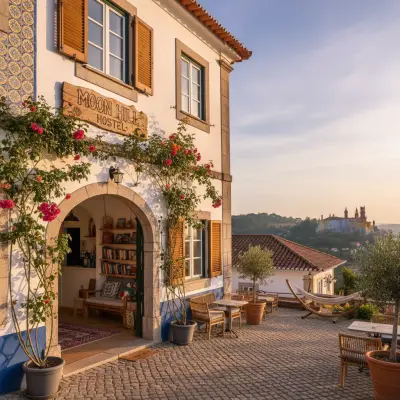
For anyone deciding to stretch this into a weekend instead of a day trip, the Sintra coastal trails take on another dimension between March and May. If the hotel search frightens you, Moon Hill Hostel solves the problem with private rooms at hostel prices, in a nineteenth-century building five minutes from the station. Book ahead, especially if rain is forecast, because everyone has the same idea.
How to get there and what it costs
The train from Lisbon leaves Rossio every fifteen minutes, takes about 40 minutes, and costs 2.40 euros one way. Don't drive. It's a bad decision. You will spend 45 minutes looking for a space and cursing your own existence. Use the daily 434 + 435 bus pass (around 13.50 euros) to circulate between palaces and the centre. Taxis to Cabo da Roca run 25 to 30 euros.
Did you bring a raincoat, hat, and waterproof shoes? Good. Spare socks in your backpack? Even better. Sintra in the rain is not comfortable, but it is what makes Sintra Sintra. People who visit only in sunshine see a pretty town. People who visit in the rain finally understand why this place, half an hour from Lisbon, has a culture so different from the capital. To grasp that contrast, it's worth reading our essay on local culture in Lisbon: you'll notice that Sintra exists apart, in its own weather and its own mythology.
Take the seven o'clock train back to Lisbon, with your coat smelling of rain and two travesseiros wrapped in greaseproof paper in your bag. Eat them on the way. They're cold by now, but still better than anything you'll eat for the rest of the week.