Rainy Day Sintra: A Family Survival Plan That Works
There are fossilised dinosaur trackways on the southern cliff at Praia Grande, and nothing sells a rainy day to a child faster. Between warm travesseiros at Piriquita, Regaleira's underground tunnels and the furious Atlantic at Adraga, rain is when Sintra works best for families.
Sintra manufactures its own weather. The serra, a granite ridge standing between Lisbon and the Atlantic, catches every wet front coming off the ocean and wrings it out over the town. You can leave Rossio station under a blue sky and step off the train forty minutes later into fog thick enough to swallow the Moorish Castle whole. If you are travelling with children, this sounds like the day going wrong. It is the opposite. Rain is when Sintra finally behaves.
Here is the uncomfortable truth about Sintra in good weather: it is a queueing exercise with palaces attached. Queues for the bus, queues for tickets, queues for pastries. On a wet Tuesday in November you walk almost straight into the Palácio Nacional, your kids get whole tiled rooms to themselves, and the mist does what it was always meant to do, which is make the palaces look like the fairy-tale sets they were built to be. This is the plan for those days.
Pick the right palace, because there is a wrong one
Start with the Palácio Nacional de Sintra, the one in the town centre with the two white conical chimneys. It is the obvious wet-weather choice and somehow the most underrated: no uphill slog, an entirely indoor visit, and kitchens beneath those chimneys vast enough to have roasted royal banquets whole. Turn the visit into a game: count the painted magpies on the ceiling of the Sala das Pegas, then the swans in the Sala dos Cisnes. It beats any audio guide for the under-tens.
Pena Palace in the mist photographs beautifully, but be honest with yourself: the walk from the ticket gate to the palace is long and exposed, and with small children in proper rain it becomes a forced march. If you insist, check locally whether the park shuttle is running. My advice is to save Pena for a day of passing showers, not steady rain.
Quinta da Regaleira, on the other hand, is genuinely better in drizzle. The Initiation Well spirals down through nine landings, and the underground tunnels linking the well to the grottoes are, by definition, waterproof. The moss glows greener, the stone turns darker, and the whole estate takes on the drama its eccentric millionaire builder clearly intended. One warning: wear shoes with real grip. Regaleira's wet stone has no mercy on smooth soles.
Museums that do not feel like homework
Sintra's museums are small, which with children is a feature, not a flaw. The Museu de História Natural de Sintra, in the historic centre, has enough fossils to hold any dinosaur-phase child hostage for an hour, and an hour is exactly how long their attention lasts. File this museum away, because it sets up the best part of this itinerary, down on the coast.
MU.SA, the town's arts museum, buys you a dry half hour between showers. The NewsMuseum, dedicated to media and journalism, has interactive exhibits that tend to land well with older kids. Check opening days locally before promising anything: in Sintra, a broken promise to a child is expensive.
The pastry defence
There is one unbeatable argument for getting a child to walk through rain in Sintra, and it is called a travesseiro. At Piriquita on Rua das Padarias, a house trading since 1862, the travesseiro arrives warm: puff pastry, egg and almond cream, and powdered sugar that will end up on everyone's coat. Order it warm or do not order it at all. Add a hot chocolate for the kids and a coffee for yourself and you have bought thirty minutes of peace while the rain drums on the awning outside.
For the adults, the queijada is Sintra's serious pastry. The Fábrica das Verdadeiras Queijadas da Sapa on Volta do Duche has been making them since 1756, sold wrapped in paper rolls. My house rule: travesseiros for the children, queijadas with espresso for the parents, then a second round of travesseiros because nobody holds the line.
Watch the storm from the front row
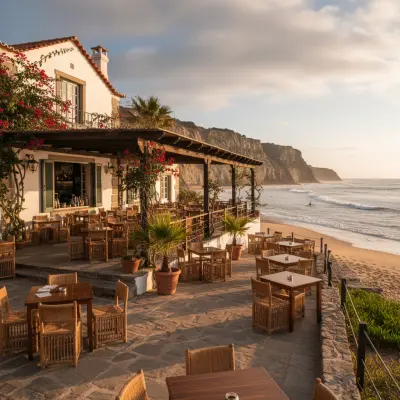
Now for the part of the plan nobody expects: on a rainy day, go to the beach. Not for the sand, obviously, but to watch the Atlantic in a temper, which is a spectacle no screen replaces. Praia Grande is about fifteen minutes by car from the town and holds the card that ties the whole day together: on the cliff face at the southern end of the beach there are real fossilised dinosaur trackways. A child who saw fossils in a museum in the morning and actual footprints in the afternoon does not forget that day.
A little further north, Praia da Adraga is the best storm-watching spot on the Sintra coast: high cliffs, furious sea, and a fish restaurant right by the sand where you can have lunch watching the waves break, though check it is open midweek in winter. The golden rule with children and a winter Atlantic: watch from a distance, stay off the wet sand, and never turn your back on the sea.
If the rain breaks, the clifftop paths between these two beaches are worth every step, with the air rinsed clean and the light low and silver. Between showers it is a completely different walk from the summer version, and a short stretch is enough with kids.
When the adults need rescuing too
A rainy day with children drains any adult's battery. If the budget allows, take turns: one parent keeps the kids, the other disappears for a few hours into the thermal circuit at Penha Longa, up in the serra. We have written about what to expect from a spa day at Penha Longa in detail, but the short version is: indoor pool, silence, and rain falling outside while being no longer your problem. Check the children's policies locally if you want to go as a family.
And if the weather convinces you to stay the night rather than trudge back to Lisbon, Moon Hill Hostel is a sensible base in town: private rooms, common areas where a rainy evening dissolves into board games, and the enormous advantage of waking up in Sintra before the tour buses arrive. Confirm family room availability when you book.
Wet-day logistics
A few practical points that separate a memorable day from a collective meltdown:
- Take the train from Rossio, roughly forty minutes. Parking in Sintra in the rain is a punishment nobody deserves.
- Arrive early. Even on wet days, the Palácio Nacional and Regaleira fill up from mid-morning.
- Forget the umbrella: the serra wind shreds it in minutes. Hooded raincoats for the whole family.
- Shoes with grip. Sintra's wet cobblestones are an involuntary extreme sport.
- Praia Grande and Adraga need a car or taxi; check bus schedules locally before relying on them.
One last piece of advice: do not try to do everything in one day. Rainy Sintra rewards a slow rhythm, one palace in the morning, travesseiros after lunch, an angry ocean before heading home. To understand how the town fits together and plan where to focus next time, our Sintra neighborhood guide does the map-reading for you. And when someone in the back seat complains about the weather, remind them: without this rain, Sintra would be just another town with palaces. The water is what makes the magic.