Coimbra's Republic Houses: Where Praxe Still Lives
About a dozen of them remain, with names like Pra-Kys-Tão and Bota-Abaixo, run as tiny independent republics where dinner is cooked in a shared pot and fado is sung after dessert. An honest guide to the houses where Praxe still pays rent.
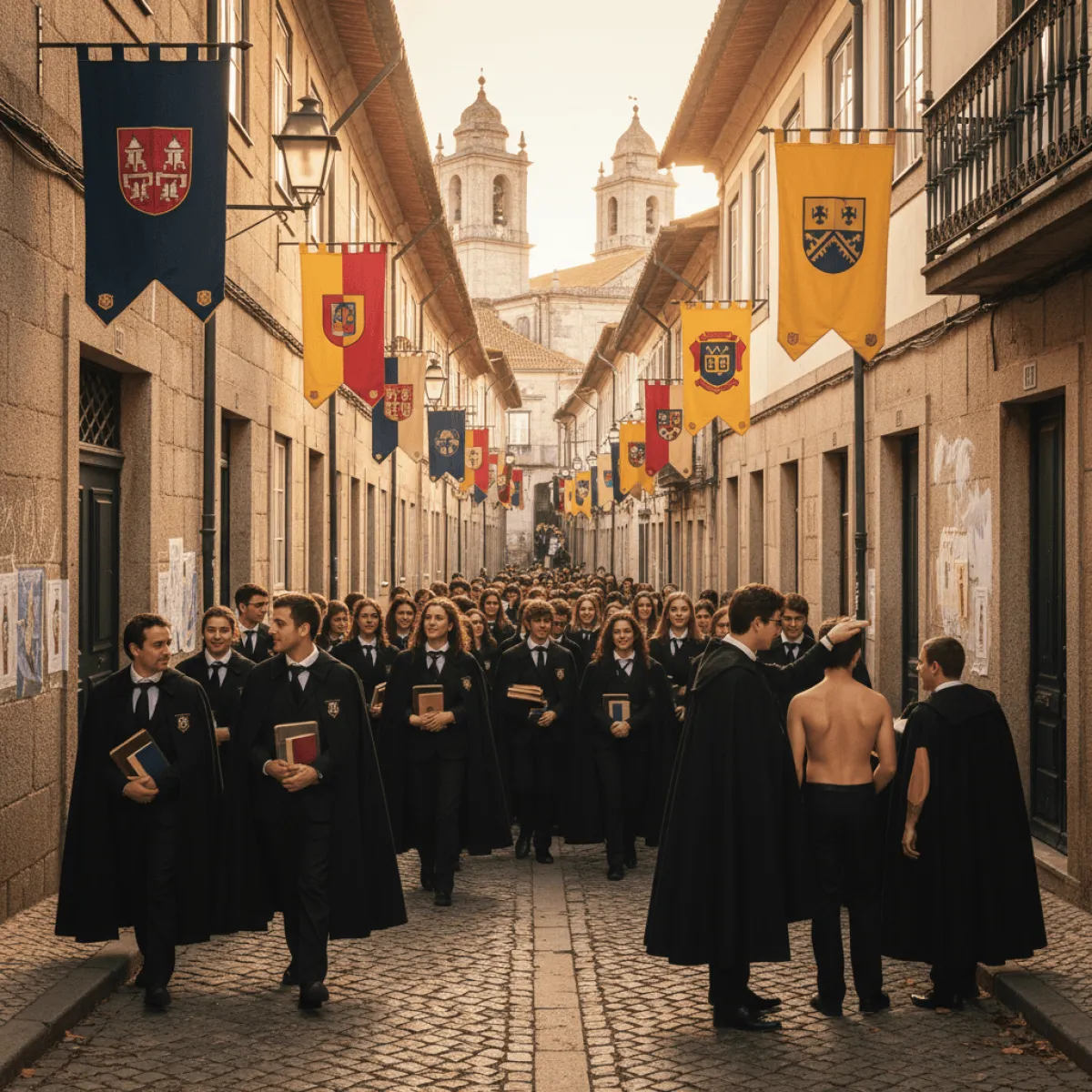
There's a door on Rua dos Combatentes da Grande Guerra that, from the outside, looks like it's about to fall down. The doorbell hasn't worked since, probably, the Salazar dictatorship. You knock with your knuckles and wait. Inside, someone shouts someone else's name, there's the dragged sound of flip-flops on wooden floorboards, and when the door finally opens it's a twenty-year-old boy, barefoot, holding a wooden spoon, asking whether you're staying for dinner or just here to look. This is a República. And it's the last place in Portugal where the nineteenth century still pays rent.
The Repúblicas of Coimbra are not flatshares. They are not republics in the legal sense, nor communes in the hippie sense. They are, strictly speaking, institutions. Student collectives with their own names, coats of arms, minute books, shared cooking pots, and a very particular way of voting on who joins and who leaves, decided around the dinner table, usually after the meal, always behind a closed door. About a dozen are still active. Some are over a hundred years old. All of them live the paradox of being living heritage in a city that would love to package them and sell them to tourists, but can't, because there are still people sleeping inside.
What, exactly, is a República
Start with the practical. A República is a house rented collectively by university students, with written internal rules, elected positions (consul, finance minister, food minister) and an identity that persists across decades, even as residents come and go. In many cases the lease has been passed from generation to generation of students since the 1930s. That's why the rents remain absurdly low and that's why the landlords, whenever they can, try to push them out. There have been evictions. There have been protests in Praça 8 de Maio with hand-painted banners and dog-Latin slogans.
Each República's name is part of the folklore: Pra-Kys-Tão (the oldest, from 1927, up in Alto de Santa Clara), Bota-Abaixo, Rapo-Sá-Ki-Tá, Kuckus, Real República Marias do Loureiro (the only historically female one, now mixed), Palácio da Loucura. The names are almost always a pun or an in-joke that nobody outside understands, and that is precisely the point.
Praxe, seen from inside
Before we go further, one thing not every guide will tell you: Coimbra's Praxe Académica is controversial in Coimbra itself. There are professors who defend it as centuries-old tradition, there are ex-praxistas who renounce it as abusive hierarchy, and there are first-years every September who quit after a week. It is not, and never was, a folk spectacle for visitors. It's a system of socialisation with rules, hierarchies and, yes, occasional excess.
If you want to understand the public, festive side of it, read our honest guide to Queima das Fitas, which covers the big week in May. But the Repúblicas are the private, domestic, daily side of student life in Coimbra. It's where they cook, study, argue about student union politics until four in the morning, and sing Coimbra fado with no audience, no stage, no applause. Just because the body needs to.
Where they are and how to spot them
Most Repúblicas cluster in three areas: the Alta (around the University), Santa Clara (across the Mondego) and the Baixa (Sé Velha, Rua da Sofia, Celas). They are not signposted. There are no plaques. You recognise them by the flags in the windows, the painted coats of arms on the door, and the political graffiti covering the façades, usually in homage to the 25th of April, to Che Guevara, or to some recent fight with the city council.
Pra-Kys-Tão, for example, sits in Alto de Santa Clara, in a three-storey old house with a view of the University. Real República dos Inkas is on Rua dos Combatentes. Bota-Abaixo is in Celas. I won't list them all because I am not a tourist office and because, honestly, the charm is in stumbling on one by accident as you walk.
Can you visit?
Short answer: sometimes. Long answer: it depends.
Some Repúblicas, on specific dates (anniversary parties, Queima dinners, open days during the Latada in October), receive visitors. There are also organised tours run by the Conselho das Repúblicas, usually in May. Outside those days, turning up uninvited is, at best, rude. It is not a museum. It is someone's house. If you know a Coimbra student, ask them to take you to dinner at one. If you don't, walk up to Sé Velha at eleven on a Saturday night in May: you'll probably hear someone singing from an open window, and that is, in itself, a kind of visit.
The República dinner: a ritual
Dinner is the institution within the institution. It happens every day, there's a person of the week who cooks for ten or twelve people on a budget of five euros a head, and there is always, always, soup first. The menu is regional: feijoada à transmontana, duck rice, bacalhau à brás, sopa da pedra, and on Fridays roast chicken. They drink bulk wine bought by the demijohn from the corner shop. They argue about everything: the minister of education, the Champions League final, whether Camilo Castelo Branco was a worse person than Eça de Queirós, and what to do with the cobblestone someone stole from Sé Velha in 1998 that's still sitting in the living room.
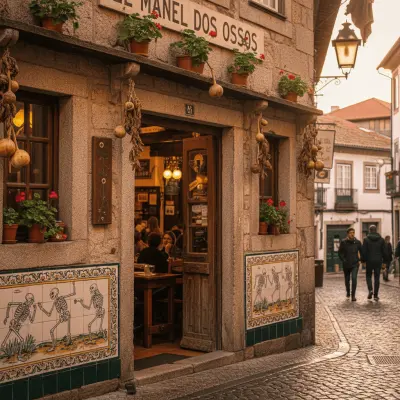
If you want to eat Coimbra student food in a setting that isn't a República but comes close in intensity and price, go to Zé Manel dos Ossos, the tiny tasca with walls covered in poems and napkins written by hand. No reservations, expect a queue, and the wild boar stew is the best in town. Bring cash.
The fado, behind closed doors
Coimbra fado is not Lisbon fado. It is traditionally male, sung by students or former students, played on a Portuguese guitar tuned a tone lower, and the audience does not clap: they cough. Coughing is the respectful way to applaud Coimbra fado, a direct inheritance from the serenades sung beneath the windows of the women in the old Santa Clara convent, where clapping would have been scandalous.
In the Repúblicas, fado is sung after dessert, without warning, usually after someone tells a joke and someone else answers with the first line of a ballad. It's intimate, casual, and absolutely impossible to fake. For the public, ritualised side of Coimbra fado, there's the evening at À Capella, a 14th-century chapel converted into a fado house, where you listen sitting in silence and cough at the end. It's worth doing. It's the formal entry point to the genre, and the acoustics under that vault have no rival in the city.
When to come to Coimbra to understand the Repúblicas
There are three moments in the year when student life spills onto the street and becomes visible to those who don't live there:
- Latada (October): the freshers' festival, with a parade through the centre, baptism in the Mondego, and Repúblicas open to anyone who wants to peek in. The informal, less touristy version of Queima.
- Queima das Fitas (May): the big week, with the Sunday parade, nights at Parque Verde, and monumental serenades on the Sé Velha steps at midnight. Full coverage in the dedicated guide.
- Festa das Repúblicas (variable date): run by the Conselho das Repúblicas, with open days, exhibitions and dinners. Ask at the student union (AAC).
Outside those three windows, Coimbra is a normal university city, with five thousand tourists queuing for the Joanina Library and zero on Rua do Cabido, which is where the real life is.
A half-day itinerary, from the Repúblicas outwards
If you're in Coimbra for a day and want to see the city through this lens, start the morning in the Alta, climb up Couraça dos Apóstolos to the University (paid entry, avoid the basements if you're claustrophobic), and walk down Rua Larga to Praça da República, where the AAC is and where, around lunchtime, you'll see tunas rehearsing at the door. Lunch at Zé Manel or, if the queue is impossible, in any of the tascas on Rua Direita.
In the afternoon, cross the Santa Clara bridge and climb up to the Miradouro do Vale do Inferno, on the other side of the river. It's the best place to grasp the topography of this city: the University on top, the Baixa spilling down to the river, and the Repúblicas scattered like stubborn stains across the hillside. There are no cafés, no tour buses, just a stone bench and silence. Bring a sandwich.
If you have an extra day, consider an escape to Condeixa for the visit to the Passeite olive mill, twenty minutes by car south of town. It's a working mill with a guided tasting, the chemistry of extra virgin olive oil explained with rigour and good humour, and you'll taste a galega that will change the way you understand soup.
The future: precarious, as always
I'm not going to romanticise this. The Repúblicas have been in crisis for thirty years. The rents they pay are incompatible with the current housing market, the inheriting landlords want to sell, and the city council, although publicly supportive, rarely intervenes. Some historic houses have already closed. Others fight in court. Real República Boa Vida, for example, was evicted in 2019 from the house it had occupied since 1957.
There are campaigns, there are alumni associations, there are initiatives to classify the houses as intangible heritage. There is also, of course, widespread indifference. When you come to Coimbra, don't come only for the Joanina Library and the guided cathedral tour. Walk along Rua dos Combatentes, read the graffiti, notice the flags in the windows. If you hear someone singing, stop. Cough, if you know how. And if you know a student, ask to be taken to dinner. It's the only honest way to understand Coimbra.
For those wanting to combine Coimbra with other short trips in the centre of Portugal, the guide to April walks around Caldas da Rainha makes good company, and if your trip overlaps with the 13th of May, it's worth also reading the Fátima pilgrimage guide, an hour away by train.
Coimbra endures. The Repúblicas, with luck, do too.