Visiting Manor Houses in Torre de Moncorvo: Heritage Route Guide
Book at the Interactive Tourism Shop on Rua dos Sapateiros and in two hours a local guide opens the right doors, from the Solar do Barão de Palme to the Mother Church. Twenty-three stops, 14th to 18th century, and stonemason marks you only catch when someone points them out.
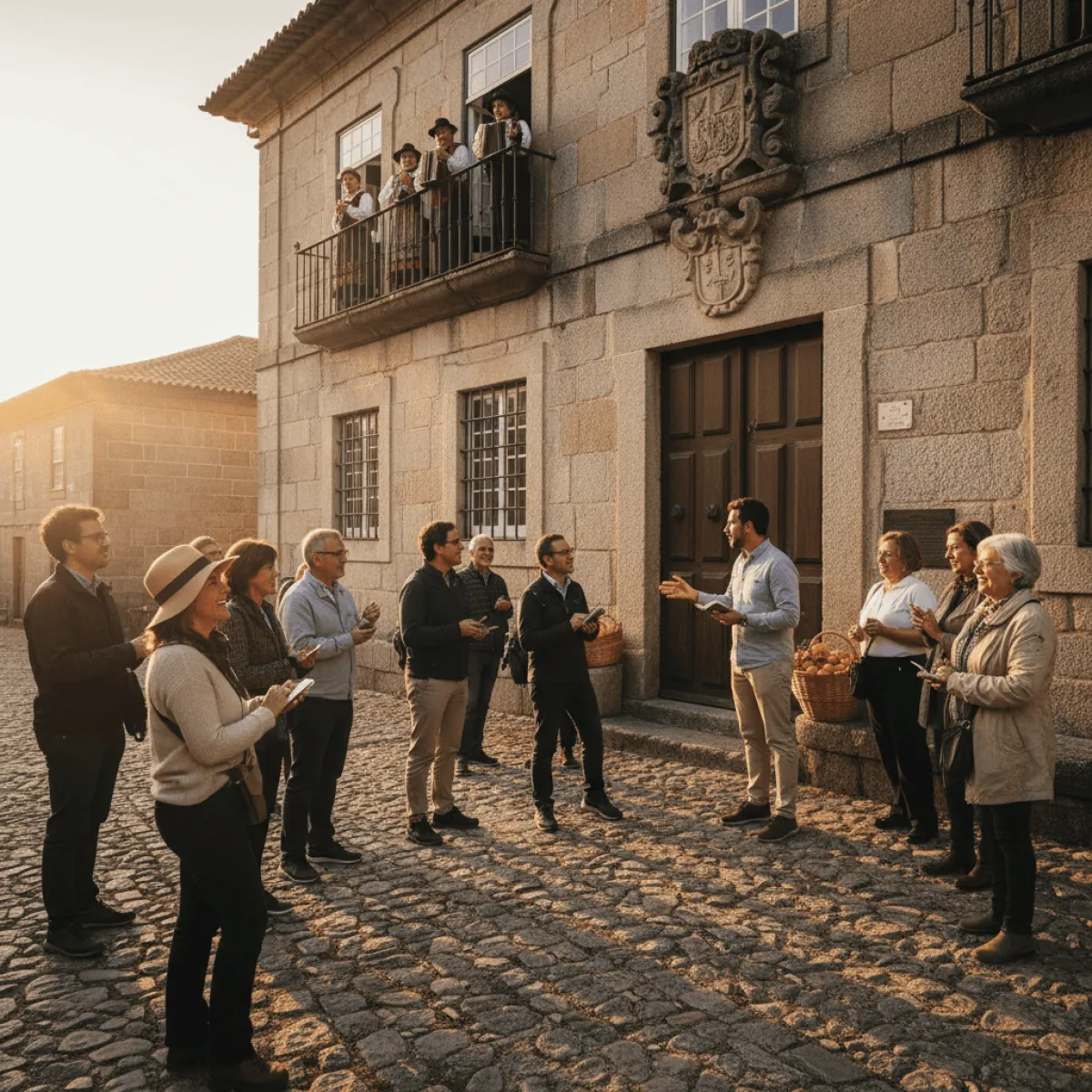
The first thing you notice in Torre de Moncorvo, once you walk up Rua dos Sapateiros and look up, are the doorways. Carved stone frames, weather-worn coats of arms, wrought iron balconies still showing the blacksmith's pattern. There is no single grand palace here. Instead, the entire walled town is built from 17th and 18th century manor houses, and the best thing you can do is the simplest one: book a guided tour at the municipal Interactive Tourism Shop and let a local open the right doors in the right order.
What this tour actually is
The so-called Rota do Património Histórico (Historic Heritage Route) starts at the Loja Interativa de Turismo (LIT), at Rua dos Sapateiros 15, right inside the old town. This is not a private tour operator. It is the tourism arm of the Torre de Moncorvo municipality, and it runs by advance booking only. Call +351 279 252 289 or email turismo@torredemoncorvo.pt to set a time. Without a booking you can still wander on your own, but the only museum that stays open all day is the Iron Museum.
The full route covers 23 points of architectural interest, dating from the 14th to the 18th century. It includes manor houses, churches, chapels and civic buildings. On foot, at a relaxed pace, you should plan around two hours. If you stop at every doorway and ask questions, three.
The manor houses worth your attention
The highlight, for me, is the Solar do Barão de Palme, now the Iron and Moncorvo Region Museum. It is an 18th century building with a sober façade, an outdoor staircase and a covered veranda. The interior has been turned into a museum without gutting the noble floor. The collection tells the story of iron mining in the Reboredo hills, but what most visitors miss is that the house itself is half the visit: the wooden floors creak in exactly the right places, the stair ceiling still has its original plaster moulding, and there is a window on the upper floor where the late afternoon sun lands as a perfect rectangle on the boards.
Next is the Basílica Menor de Nossa Senhora da Assunção, the Mother Church and the largest religious building in Trás-os-Montes. It is not a manor house, but it is part of the route and worth the extra ten minutes. The Renaissance portico on the main façade is more delicate than you expect from such a large interior. The Igreja da Misericórdia de Moncorvo, from the 16th century, has a portal flanked by two medallions of Saint Peter and Saint Paul that reward a closer look. Photographs always flatten the bas-relief.
Along the way you walk past other manor houses that are still lived in. You do not enter those. Do not try. What you can read from the outside is already plenty: the carved arms of the Carvalho e Castro family, the Pimentel, the Sá Vargas. The guides (almost always women from the town, who know the families personally) can tell you who lived where and who still does. That kind of information is in no guidebook.
When to go, and why morning is better
The route runs year round, but Moncorvo summer is no joke. From late morning in July and August the stone radiates heat and the narrow streets feel like an oven. Book the 10:00 slot, or wait for after 17:00. In winter it is the opposite. Mornings can be frosty, and the good light does not reach the streets until after 11:00.
The season most people recommend is February and March, during the almond blossom. The surrounding landscape genuinely earns the trip, and many visitors combine the heritage route with a drive through the orchards. Be warned: the LIT gets a lot of requests in that window, and you should book at least a week in advance. March is particularly busy.
Practical details
- Footwear: the old town is paved in old Portuguese cobblestone, polished by centuries of feet. No heels. Trainers with a firm sole or low walking shoes, yes.
- Clothing: shoulders and knees covered for church entries. A light sweater for the cold interiors, even in summer.
- Duration: about two hours for the main loop. Plan three if you want all 23 points.
- Accessibility: the historic center has steep streets and steps. It is not a wheelchair-friendly route.
- Languages: tours are in Portuguese; English is generally available, but confirm when you book.
- Price: confirm directly with the Loja Interativa de Turismo. Municipal museum fees are modest.
Where to eat and stay afterwards
After the route, the reward is the table. Stay central and look for traditional cooking. I have written about where inland cooking still holds on, and it remains accurate. If you sleep over, there are turismo de habitação houses inside the village itself, in buildings that belong to the same heritage you have just walked through. That changes the whole feeling of the night.
The trick nobody tells you
Here is something I only noticed on the third visit, and still consider the best detail of the whole route: ask the guide to point out the stonemason marks on the cut stone of the manor houses. These are small geometric marks, crosses, arrows, letters, carved by the medieval and early modern masons to sign their work. They are in plain sight, on door jambs and corner stones, but you only see them once someone tells you where to look. After that, you stop walking through a pretty old town and start walking through a collective signature, with the name and the hand of whoever cut each block.
How to get there
Torre de Moncorvo sits in the Douro Superior, about 100 km from Porto via the A4 and A24. By car it is straightforward. Public transport is harder: there are Rede Expressos buses from Porto and Lisbon, but frequency is low. The Linha do Douro train ends at Pocinho station, around 17 km from the village center, and from there you need a taxi or pre-arranged transfer.
Park in the lower town, near the Largo do Município, and walk up. The walk up is part of the experience. Driving the narrow streets of the old town is a stress exercise you can spare yourself.