Torre de Moncorvo: Almond Blossoms and a Spring Road Trip
Between mid-February and March, thousands of almond trees blanket the hillsides around Torre de Moncorvo in white and pink. This guide maps out the best secondary roads, the villages worth stopping in, and what to eat while driving through the Upper Douro at its finest.
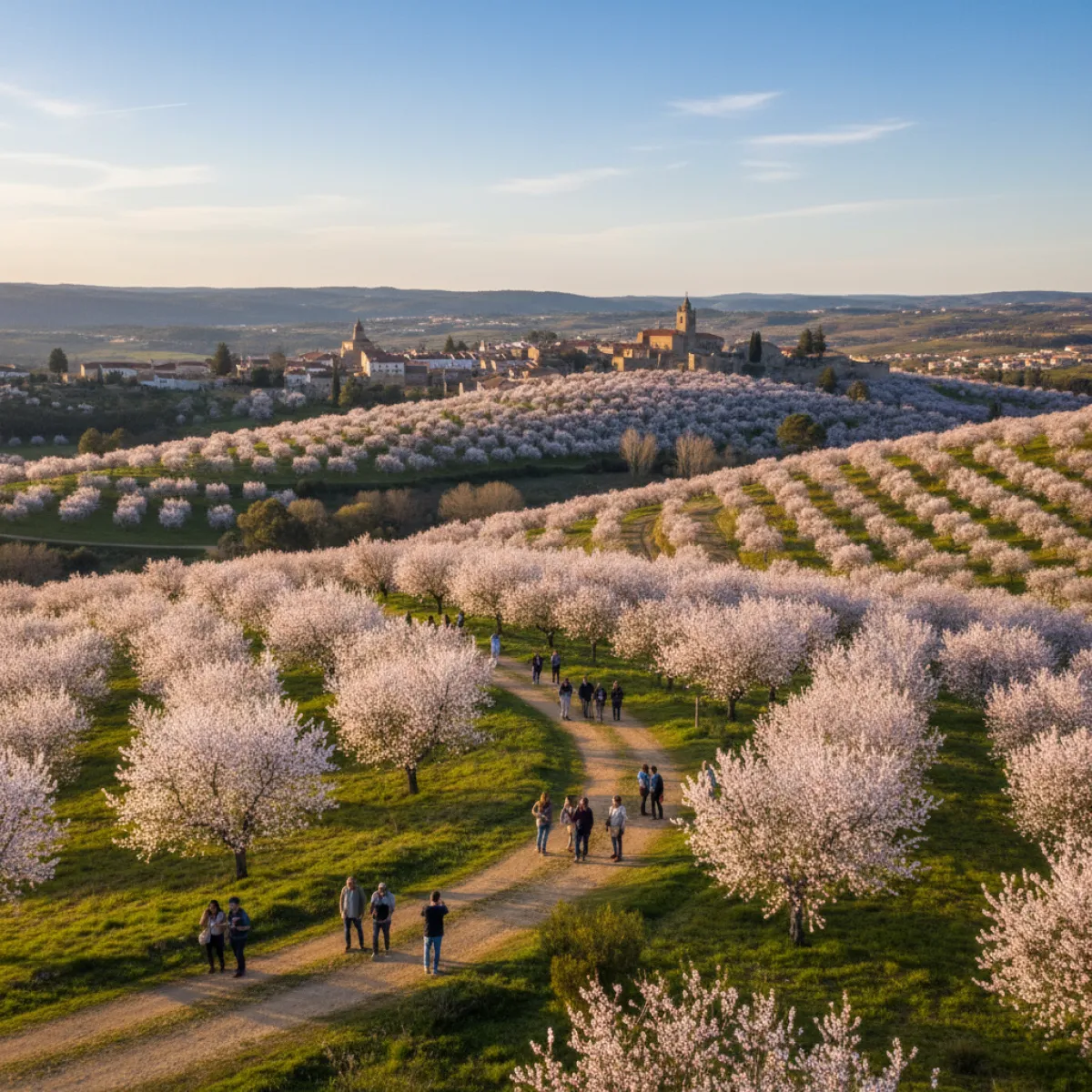
There's a window, three weeks, maybe four, when the municipality of Torre de Moncorvo transforms into something that looks like it was engineered for social media but has existed for centuries. The almond trees bloom. And when I say bloom, I don't mean a handful of decorative trees in a town square. I mean entire hillsides, thousands of trees, a white-and-pink blanket draped across the Upper Douro valleys as if someone shook out a massive duvet over the landscape.
It happens between mid-February and mid-March, depending on the winter. A colder year can push it into late March. The unpredictability is part of the charm, and part of the logistical headache.
Why Torre de Moncorvo
Moncorvo is not an obvious destination. It sits nearly three hours from Porto by motorway, in a corner of Trás-os-Montes that most Portuguese people only know by name. But that distance is exactly what preserved what the coast has lost: a direct relationship with the land, agricultural cycles that still set the rhythm of daily life, and food that doesn't need tricks because the raw ingredients are exceptional.
The town itself has a compact and genuine historic centre. The Igreja Matriz, one of the largest parish churches in Portugal, deserves a slow visit, the gilded altarpiece is remarkable, and you'll usually have the place to yourself, which in a church of this scale is a rare luxury. Rua do Relógio and the surrounding lanes have granite houses with wrought-iron balconies that tell you more about the region's history than any information panel could.
The Almond Blossom Route
Let's get to it. To see the almond blossoms, you can't just show up in Moncorvo and wait for it to happen. The bloom isn't uniform, it varies with altitude and sun exposure. The best strategy is to drive the secondary roads between villages.
The classic route goes from Torre de Moncorvo toward Larinho, passing through Felgar and Carviçais. This road, the N220 and the turn-offs branching from it, cuts through the heart of the almond-growing area. Stop wherever you feel like it. Every bend offers a different view, and the morning light between 8am and 10am is when the blossoms glow brightest against the dark schist soil.
Some essential stops:
- Felgar: A small village with an informal viewpoint (ask locals, it's not signposted) overlooking an entire valley in bloom. The village café serves decent coffee and dry almond biscuits that make the perfect mid-morning snack.
- Larinho: More remote, with fewer visitors. The almond groves here tend to bloom slightly later, which is useful if you arrive at the tail end of the season.
- Carviçais: The largest of the three villages, with more services. The olive oil here, from the Verdeal Transmontana variety, is outstanding, look for small local producers.
If you have time, the route can extend south to Freixo de Espada à Cinta, where there are also notable almond groves and where the heptagonal castle tower is one of the most unusual in Portugal.
What to Eat (And What to Skip)
Transmontana cuisine doesn't do diets and doesn't apologise. In Moncorvo and surroundings, the table is generous and direct.
Almonds, naturally, appear in everything during spring. Amêndoados, almond pastries that vary from bakery to bakery, are the region's emblematic sweet. Some are dry and crumbly, others dense and moist. Try several; every oven has its own recipe. Bolas de carne, another Transmontano classic, are bread rolls stuffed with pork and smoked sausage, baked in a wood-fired oven. They're not elegant, but they're perfect after a morning on mountain roads.
For bigger meals, look for restaurants serving cabrito assado (roast kid), it's the star protein in this region during spring, when the kids are young. Posta de vitela à transmontana (Transmontana-style veal steak) also appears on virtually every menu, and in Trás-os-Montes it's generally done well, using meat from local heritage breeds. Pair it with smashed potatoes and turnip greens.
The wine is from the Upper Douro, fuller-bodied and less polished than wines from further downstream, but with an honest character that matches this food. If you want to go deeper into the wines of the broader Douro region, it's worth reading our guide on the Douro estates in Sabrosa that nobody talks about, another wine area that deserves attention.
When to Go and How Long to Stay
Two days is the minimum to avoid rushing. Three days is ideal, especially if you want to combine it with visits to neighbouring villages or drive down to the Douro river.
The Festa da Amendoeira em Flor (Almond Blossom Festival) usually takes place in February or March, dates vary every year, so check locally or on the municipal council's website before planning. The festival brings music, food stalls, and more people than Moncorvo is used to. If you prefer peace, go a week before or after. The almond trees can't read calendars, they bloom when they feel like it.
The weather in February and March here is fickle. Cold mornings (sometimes with frost), afternoons that can reach 15-18°C in the sun. Bring layers and a windbreaker. Nights are cold, this is deep interior Portugal.
Where to Stay
Moncorvo isn't a town of boutique hotels with spas and infinity pools. The accommodation is straightforward: a few guesthouses, rural houses on the outskirts, and not much else. This is part of the appeal, we're in a Portugal that hasn't been polished for tourists yet. Book ahead during the festival, because demand far outstrips supply.
For those who prefer a base with more accommodation options, Lamego is about an hour away and makes a solid alternative. The city has more tourist infrastructure and is worth visiting in its own right, our guide to river escapes and the luxury of stillness in Lamego gives good ideas for combining both destinations. And if your trip extends beyond almond season, Lamego in winter has an entirely different but equally compelling appeal.
Getting There
A car is non-negotiable. There's no practical way to explore the almond groves on public transport, the secondary roads where the real beauty lies aren't served by buses.
From Porto: about 2h30 via the A4 to Vila Real, then the N2/IP2 to Moncorvo. The final stretch, from Vila Flor to Moncorvo, is on a national road and is scenic in its own right.
From Lisbon: around 4h30. The fastest route is via the A1 to the Aveiro/Viseu junction, then cut northeast. It's not a short drive, but it's worth it if you combine it with two or three days in the region.
From Porto airport: rent a car at the airport and drive straight there. Car rental in Portugal runs roughly €25-40/day for a compact, depending on the season.
What Not to Do
Don't go on a festival Sunday expecting easy parking. Moncorvo is a small town and seasonal events attract thousands. Arrive early.
Don't expect perfect tourist signage to almond blossom viewpoints. This isn't the Algarve. The beauty here is on secondary roads, dirt tracks, places you stumble upon by chance or by tip from someone at the café. Ask locals, they're used to the question and generally take pride in pointing you to their favourite spots.
Don't skip the villages. It's tempting to drive from viewpoint to viewpoint, but the Transmontano villages, with their dovecotes, their threshing floors, their old folks sitting in the sun, are as much a part of the experience as the blossoms. Stop, walk, talk to people. The pace here is different.
The Truth About the Almond Trees
There's a story behind these trees worth knowing. The almond trees aren't in Moncorvo by decorative accident. They were systematically planted over centuries because almonds were, and still are, an important cash crop in northeastern Portugal. The schist soil, dry climate, and cold winters create ideal conditions for almond trees, which need a cold period to bloom properly.
The problem is that the population has aged, young people left for the coast, and many almond groves are now semi-abandoned. The festival and the blossom tourism are actually an attempt to breathe new economic life into an agricultural tradition that was disappearing. When you buy local almonds or almond pastries, you're directly contributing to the survival of this landscape.
That's the beautiful tension of Moncorvo in spring: what looks like a perfect postcard is actually an agricultural landscape fighting for survival. The blossoms are gorgeous, yes. But they're also the first chapter of a harvest that sustains families.
Go. Go before it changes. And bring almonds home.
