Arraiolos Rugs: Visit Ateliers Where Embroidery Still Lives
At the Centro Interpretativo do Tapete de Arraiolos, on the main square, two or three embroiderers are almost always working live, in silence, with the frame on their laps. Entry costs a few euros, and the conversation, if you know how to ask for it, is worth the trip.
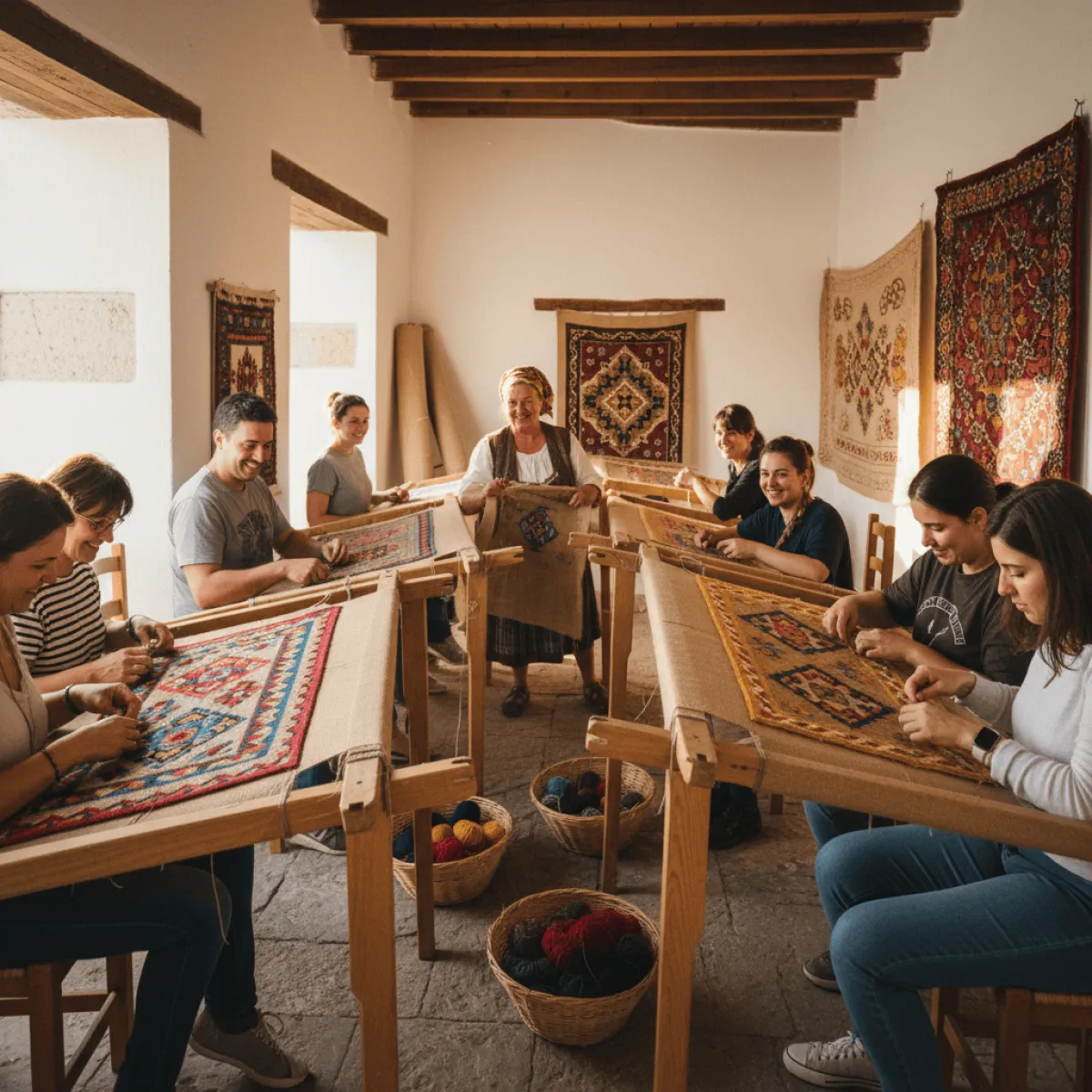
There is a sound you only hear in Arraiolos: the dry click of the needle puncturing taut jute, multiplied by ten or twelve hands working in silence. This is not staged folklore. The embroiderers are sitting with the frame on their laps, the wool skeins lined up by tone, and the long-legged cross stitch, the one stitch that has defined the Arraiolos rug since the 17th century, comes out one by one, in no hurry whatsoever. Spending a day in the village without giving at least one morning to this craft is wasting half the trip.
Start at the Interpretive Center
The right starting point is the Centro Interpretativo do Tapete de Arraiolos, housed in the former Hospital do Espírito Santo, at Praça do Município no. 19. This is a municipal institution, not a shop, and that matters: nobody here is trying to sell you anything. The permanent exhibit walks you through the full chain, from shearing the wool, to the dye baths, to the jute base, to the different stitches, to the Persian motifs that Portuguese embroiderers adapted, to the widows in black who kept the technique alive through the 18th and 19th centuries.
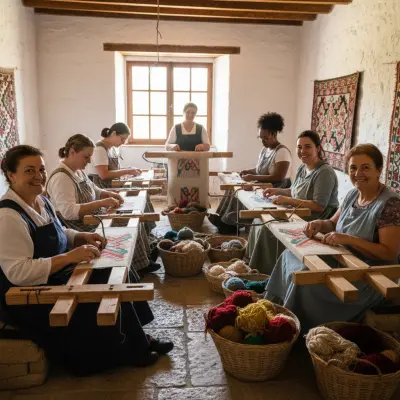
The best part of the visit is not in the display cases. It is in a side room where two or three embroiderers are usually working live. This is not a tourist demonstration with fixed hours: these are local women who come here to embroider, welcome visitors who approach quietly, and answer questions with patience. Ask how long a rug measuring two by three meters takes (the honest answer: months, sometimes more than a year). Ask which stitch is the hardest. You will leave with knowledge no book gives you.
Contact and price
- Address: Praça do Município no. 19, 7040-027 Arraiolos
- Phone: +351 266 490 254
- Email: c.i.tapete@cm-arraiolos.pt
- Website: tapetedearraiolos.pt
- Ticket: entry is symbolic (a few euros). Confirm directly with the provider for current hours and guided group tours.
The village ateliers: what to see next
Step out of the Interpretive Center and Rua Alexandre Herculano along with the main square hold most of the family-run shop-ateliers. They are not all the same. Some sell only finished pieces. Some have an embroiderer working in the front window. Some take custom commissions with personalized motifs (and in that case there is a serious conversation about size, color and delivery, which can easily stretch to a full year). Step into one or two, ask politely whether you may watch them work, and respect the answer when it is no. These women are not extras in a tourism film.
One practical tip: go in the morning, between 10:00 and noon. The daylight through the windows is better for reading the wool tones (essential if you are buying) and the embroiderers tend to be more available to chat before lunch. In the afternoon the village goes quiet and several shops close between 13:00 and 15:00.
Stitching your own: the workshop with Estrela d'Alva
If you want to move from spectator to apprentice, the most structured option is the Arraiolos Rug Workshop by Estrela d'Alva Tours, a licensed operator (RNAAT no. 121/2014) that runs a full day from Lisbon combining Évora in the morning and Arraiolos in the afternoon, with hands-on instruction from a local embroiderer.
- Provider: Estrela d'Alva Tours
- Website: estreladalva.pt
- Price: from €85.50 per person (varies with group size)
- Duration: 8 hours
- Meeting point: hotel pickup in Lisbon at 8:30 AM
- Included: private air-conditioned minivan, English-speaking guide, starter kit (jute, wool, pattern, needle), insurance, water, WiFi onboard
- Not included: lunch and monument entrance fees
The kit is yours to take home. You will not finish a rug in a day, obviously. You will learn the stitch, complete maybe a palm-sized square of embroidery, and begin to understand why it is called the long-legged cross. The embroiderer corrects you, shows you how to manage needle tension (pull too hard and the base warps; pull too softly and the stitch comes loose) and points out the typical beginner mistakes. I left with the humbling certainty that I had not even started to understand it.
The best moment and what tends to surprise
The best moment, for me, was not the workshop or the museum. It was walking into a shop on Rua Alexandre Herculano, watching a woman count stitches under her breath, and learning she had been working on the same rug for seven months. There is no shortcut. There is no machine. There is no other "Arraiolos" made anywhere else that is the same thing, no matter how cheap it looks in a roadside souvenir shop.
To frame the visit, it helps to read our deep dive into Arraiolos carpet artistry, where we explain the history of the stitch and the Persian motifs. And if you are giving the day to the village, there is more than embroidery: the Castelo de Arraiolos, with its rare circular footprint, and the Lóios Convent a kilometer away, both covered in Arraiolos beyond the rug. For everything the quick day trip misses, see what the day trip misses.
Practical tips
- When to go: spring (April to June) and autumn (September, October). Summer afternoons clear 38 °C and the embroiderers stop at midday.
- How to get there: 1h15 by car from Lisbon via the A6, exit Évora-Norte. No direct train.
- Parking: free near Praça do Município. On Mondays (market day) it fills early.
- What to wear: nothing special. Comfortable shoes for the Portuguese cobblestones.
- What to bring: cash. Several smaller shops, including family ateliers, still do not accept cards.
- Reservations: the Interpretive Center accepts walk-ins, but groups of 8 or more should email 48 hours ahead.
- Buying a rug: always ask for the certificate of origin and the stitch count per square decimeter. An uncertified rug may have been made in India or Pakistan.
If you are thinking of staying the night (worth it, to see the village at dinner without the day-tour buses), check our guide on where to stay in Arraiolos.