Arraiolos Beyond the Rug: Castle, Convent and Marble Villages
Almost everyone goes to Arraiolos to buy a rug and leaves by late morning. That's a mistake. There's a circular castle on top of the hill, a convent covered in tiles by Oliveira Bernardes, and thirty minutes east the marble quarries of the Vila Viçosa-Borba-Estremoz triangle. This is the rug-less version.
Everyone goes to Arraiolos for the rug. They buy it, photograph it, take it home rolled up in a canvas bag, and leave by mid-afternoon for Évora. This is a mistake. Not because of the rug itself, which deserves every honour, but because leaving Arraiolos without climbing the circular castle, without peeking inside the Convento dos Lóios, and without driving thirty kilometres east to the marble quarries of Estremoz and Vila Viçosa is to waste one of the most stubbornly distinctive landscapes in central Alentejo.
This is the rug-less version. Or rather: the version where the rug is just an excuse to stay longer.
The castle that shouldn't exist (and yet does)
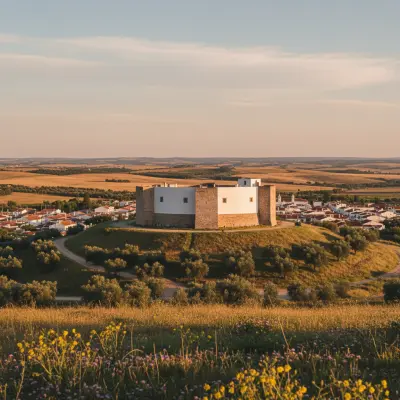
Portugal has castles everywhere, but the one in Arraiolos is an architectural oddity. It's round. Not square with corner towers, not trapezoidal hugging a hilltop: round, like a ring placed on top of a small hill, with the parish church poking up from inside as if left there by accident. Tradition says it was inspired by Moorish models. Historians argue about it. The truth is that no one looks at a circular fourteenth-century floor plan and feels nothing.
Walk up from Largo do Município. It takes ten minutes, maybe fifteen if you stop to photograph, and what you'll find up there is a low wall, a courtyard with olive trees, and a view that justifies the climb on its own: the Alentejo plain opening in every direction, dotted with holm oaks and white smudges that turn out to be houses, sometimes cisterns, sometimes nothing at all. Entry to the Castelo de Arraiolos is, as of this visit, free, but check locally because these things change. Go in the late afternoon, ideally an hour before sunset, when the light turns brick-coloured and the coach tourists have already left for dinner in Évora.
There's no café up there. No gift shop. There's wind, stone, and the distant sound of dogs barking in the gardens below. That's exactly what makes it worth the trip.
The detail no one notices
Inside the walled enclosure, the Igreja do Salvador is easy to overlook because it's under restoration more often than it's open. If you find it open, look up at the seventeenth-century tiles in the choir. If you find it closed, sit on the doorstep. There's a low stone slab to the right where local mothers park their kids for a snack. In Arraiolos, almost everything happens slowly.
The Convento dos Lóios: the other surprise
About a kilometre out of the centre, on the road towards Pavia, sits the Convento dos Lóios de Arraiolos, founded in the sixteenth century by the Canons of Saint John the Evangelist, the same order that occupied the twin convent in Évora now turned into a pousada hotel. There was a pousada here too, for years, and there's now a refurbishment project that has been opening and closing depending on the phase. Even from outside, it's worth the stop: the convent church has a sober facade hiding an interior covered in azulejos by António de Oliveira Bernardes, some of the most spectacular tile work in the country, with hagiographic scenes running from floor to ceiling.
Ask at reception (or at the parish council office, if the church is closed) whether you can visit. On quiet weekdays, someone with a key often turns up within twenty minutes. In August, forget it: either buy an official ticket or stick to the facade.
One piece of advice worth its weight: bring water. There are no fountains along the way and the car park is an exposed gravel patch with no shade. If you're driving, cool the car down before getting back in, because the walk back is a furnace between May and September.
The rug I wasn't going to mention (and now I am)
Fine, let's talk about the rug. Not because it's unavoidable, but because ignoring it would be bad journalism. The Arraiolos rug is Intangible Cultural Heritage and genuinely different from anything else: an oblique cross-stitch on burlap canvas, dyed wool, patterns ranging from Mudéjar geometry to nineteenth-century folkloric scenes. The problem is that half the shops on Largo Lopo de Carvalho sell factory-made knockoffs or, worse, imports.
Simple rule: if the price per square metre looks too good, it is. A genuinely hand-stitched Arraiolos rug, in Portuguese wool with traditional designs, costs hundreds of euros per square metre, not tens. Always ask if you can watch someone stitching. The real workshops show you. The others change the subject.
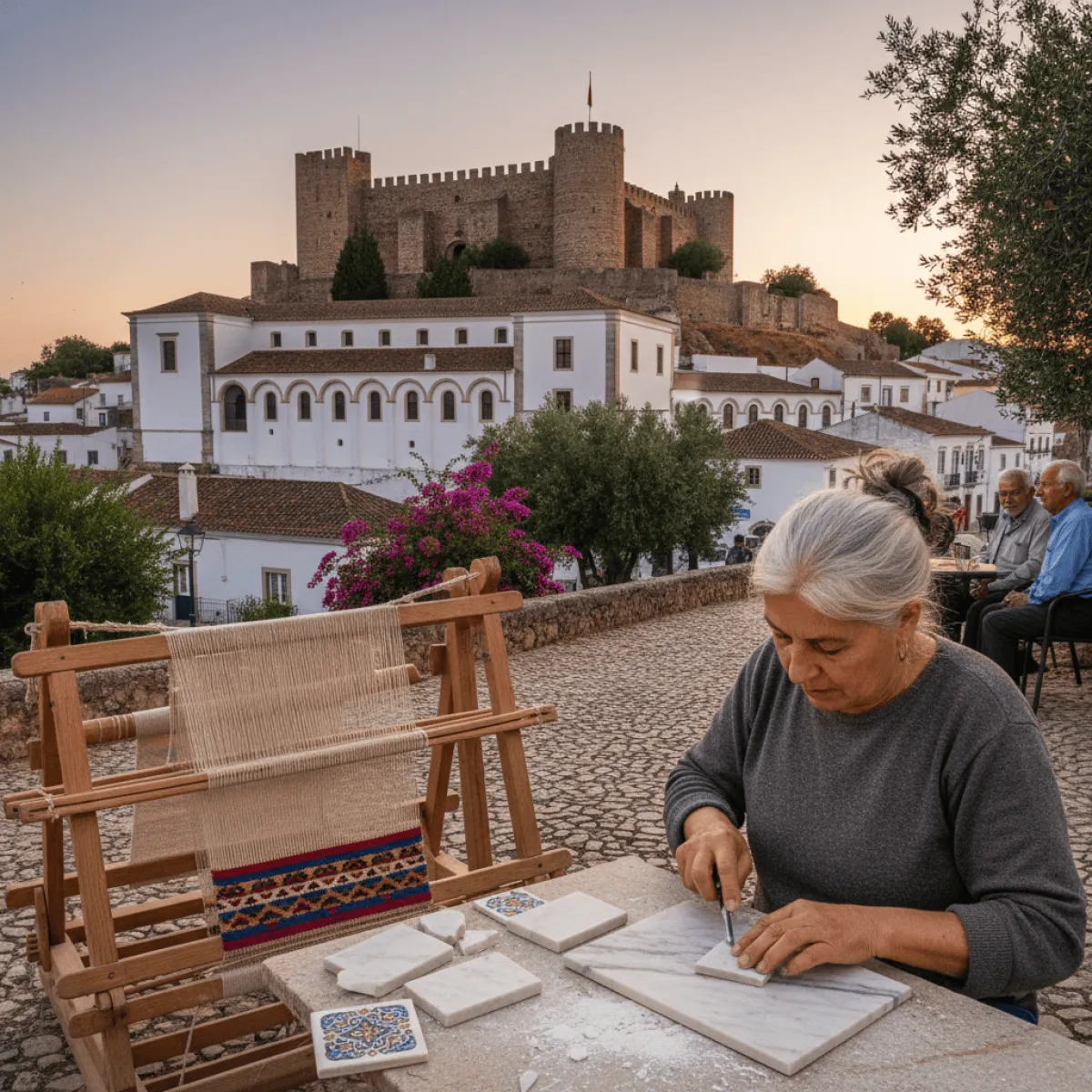
If you really want to understand what you're buying, do one of the backstage experiences first. The Thread of Time: A Masterclass in Arraiolos Rug Weaving is the immersive version, with several hours learning to handle the needle, read a pattern, and understand why a jumper made from Mértola mountain wool yields a different rug from one made of industrial wool. The shorter, more direct option is the Arraiolos Rug Workshop with Local Artisans, where you sit with women who've been doing this for forty years and who will tell you, without diplomacy, whether your first cross-stitch is straight or crooked. You'll leave with a small embroidered square made by your own hand. That's worth more than any souvenir.
Where to eat (and what to order)
Arraiolos is not a culinary capital. It's a small town with half a dozen taverns that survive on local trade and passing tourism. Two solid pieces of advice.
First: at lunch, order migas alentejanas. Not the refined Évora version with fish fillets and garnishes, but the tavern version, with fried pork on top and the fat soaking into the bread. It's the most Alentejan thing you can put in your mouth in Arraiolos. Drink it with the house red. Don't ask too many questions about the appellation; in this part of the country, the unbottled house wine is often better than the labelled stuff.
Second: at dinner, if it's hunting season, order hare stew or braised partridge. Out of season, go for bacalhau dourado, one of the less heroic but more comforting versions of salt cod, and pair it with a glass of Pêra-Manca red if the wallet can take it (or a Cartuxa, if you prefer the middle ground).
For dessert: encharcada and sericaia. Sericaia ideally with Elvas plums in syrup, which is the proper way. If you see sericaia served without the plum on the side, change pastry shops.
Beyond Arraiolos: the marble villages
This is where many people lose patience and head back to Évora. Don't. Thirty minutes east begins the marble triangle: Vila Viçosa, Borba and Estremoz. It's one of the most surreal industrial landscapes on the Iberian Peninsula: huge open-pit quarries where white, pink and yellow marble is cut into blocks the size of shipping containers. There are official viewpoints, but the best move is to drive slowly along the N4 between Borba and Vila Viçosa and stop wherever the view hits hardest.
Vila Viçosa is home to the Paço Ducal dos Braganças, the seat of the last Portuguese kings before the republic was proclaimed in 1910. The tour is guided, takes about an hour and a half, and shows you the bedroom where King Carlos slept the night before he was assassinated in Lisbon in 1908. The history is all there, made tangible in silverware, portraits and fading wallpaper. Check hours and prices locally; they've shifted in recent years.
Borba is less ceremonial, more wine. Drive the Wine Route, stop at two wineries, taste without buying if you don't feel like it, and move on. The taverns in the centre of Borba serve petiscos for a few euros and the atmosphere is genuine, not staged.
Estremoz, on a Sunday morning, hosts its market on Rossio Marquês de Pombal square. You'll find painted clay figurines (the famous bonecos de Estremoz), aged Évora cheese, smoked sausages, fresh vegetables and an alarming number of people haggling over the price of dried beans. It's one of the best-preserved rural markets in Portugal. Get there before ten.
Where to sleep: stay or move on?
Honestly: for one night, sleep in Évora, which has more options and better dinners. For two nights or more, it's worth booking an agritourism on the outskirts of Arraiolos or near Évoramonte. There are half a dozen rural hotels at reasonable rates outside July and August. In August, double everything and book months in advance, or sleep further north entirely.
If you're willing to expand the radius, consider heading further north into the Portalegre district, where the Serra de São Mamede mountains change everything. Temperatures drop, the landscape turns greener, and the food picks up Beira influences. For a serious itinerary, it's worth crossing this trip with our weekend in Portalegre without the tourist traps, or if you want neighbourhood-level detail, the walking guide to Portalegre's best neighbourhoods. And for lunch and dinner, trust where Portalegre's locals actually eat rather than the hotel's first recommendation.
How to get there and get around
From Lisbon, it's roughly 130 kilometres via the A6, exiting at Vendas Novas or Montemor-o-Novo and then taking the N4 or N370. Allow about an hour and forty. From Évora, twenty minutes. From Faro, in the Algarve, almost three hours, which means that if you're doing Algarve-to-Alentejo in a single day, you'll arrive in Arraiolos after three in the afternoon, which is to say: too late for a properly-seen castle. Plan better.
Without a car, it's hard. There are Rede Expressos coaches connecting Lisbon to Arraiolos, but with limited frequencies and schedules that don't talk well with the rest of central Alentejo. For the marble triangle, forget public transport: either rent a car in Évora or hire a private transfer.
When to go
Avoid July and August if you can. Not because of the tourists, who are few, but because of the heat, which regularly tops 40 degrees Celsius in the shade, and in Arraiolos shade is a privilege. May and June are ideal: the plain still green, the storks on top of the convent chimneys, the days long. October is the other good window, with the harvest done, the taverns opening new wine, and the light falling on the castle at almost Italian angles.
Winter is cold but beautiful. January and February are months of fireplaces in taverns, dogfish soup, and absolute silence in the streets after nine at night. If you like empty villages, this is the best time.
What to take home (if not a rug)
If you've decided the rug is for next time, there are smart alternatives. An Arraiolos-stitched cushion cover by the same artisans runs between 60 and 150 euros and fits in carry-on luggage. Skeins of virgin wool, for those who knit, are sold in some workshops. Estremoz figurines, in hand-painted clay, are UNESCO Intangible Heritage and range from 15 euros to several hundred depending on the ceramicist. Aged Évora cheese, Elvas plums in syrup, honey from the Serra de São Mamede: everything vacuum-sealed, everything boardable.
And if you do bring home a rug, make it a small one. A bedside runner, 60 by 90 centimetres, made by an artisan you actually met and whose name you remember. It will last fifty years. The price will be serious but it's one of the few tourist purchases that still make sense in this era of plastic souvenirs made elsewhere.
Arraiolos doesn't hand itself over in two hours. Give it a full day. Two, if you can. Save the castle for late afternoon, have migas for lunch, get a little lost in the white streets, and leave with the feeling that the rug was, in the end, the least interesting thing that happened.