Arraiolos: Where to Stay and Which Zone to Pick
Arraiolos offers three distinct ways to stay: in the walkable historic centre, in a 16th-century convent with cloisters and a pool, or in a rural farmstead lost in the plains. Each gives you a different Alentejo. Here's how to choose.
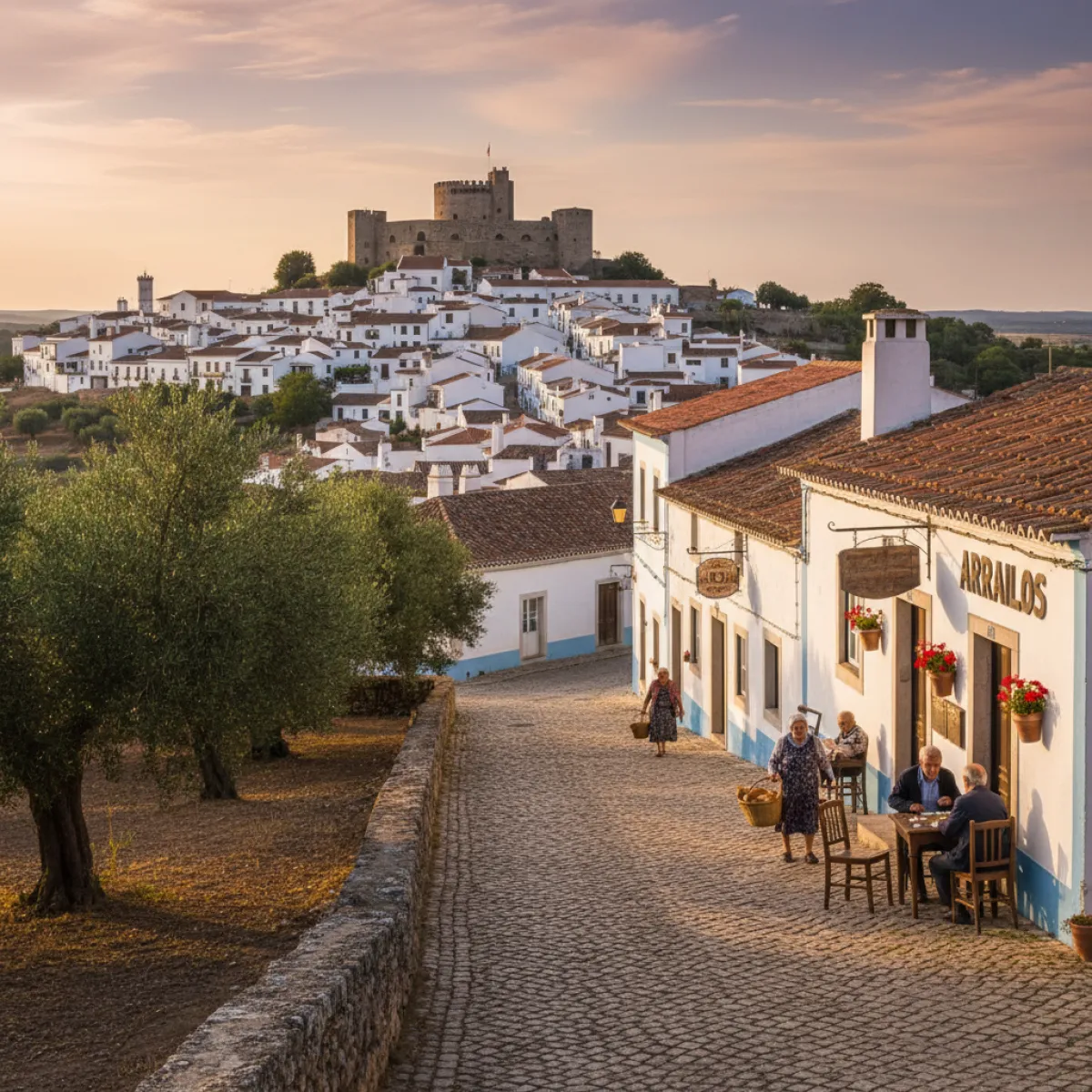
Arraiolos is a small town. So small that you can walk the entire historic centre, pass the castle, and loop back to the square for coffee in under twenty minutes. That's precisely why your choice of where to stay matters more than you'd think. In a big city, a hotel is just a bed. In a place like Arraiolos, your accommodation shapes the whole experience.
There are essentially three ways to sleep in Arraiolos: in the historic centre, steps from the whitewashed streets and rug shops; in the former convent turned pousada, just outside town; or in a rural Alentejo farmstead scattered across the plains. Each gives you a different version of the Alentejo. None is wrong, but you should know what you're signing up for.
In the historic centre: everything on foot
If you want to wake up and walk downstairs in your slippers to buy bread, the centre is your spot. The town orbits Praça do Município, where you'll find the Town Hall and the Arraiolos Rug Interpretation Centre. This is where life happens, though "life" in an Alentejo town means that by 3pm you can hear the wind.
The reference point in the centre is Casa do Plátano, a 17th-century manor house converted into a boutique hotel with around half a dozen rooms. It's not a hotel in the corporate sense. It's more like staying with a wealthy great-aunt who has impeccable taste: spacious rooms, antique furniture that actually works, and a breakfast spread with homemade jams, regional cheeses, and cakes that clearly didn't come from a factory. The garden pool sorts out July afternoons, when the Alentejo decides that 40°C is a reasonable temperature. Rooms start around 90-100 euros per night in low season, but check directly for current rates.
The advantage of staying in the centre is obvious: everything is walkable. Travessa Torta, where the rug workshops and shops cluster, is a two-minute stroll. If you want to truly understand what Arraiolos rugs are about, book an Arraiolos rug workshop with local artisans, where you sit with women who've been doing this for decades and learn just how much patience each rug demands. It's not a superficial tourist demo. It's the real thing.
At night, the centre has one or two restaurants and not much else. Don't come expecting options. If you're in Arraiolos, you're here for the quiet, the plains, and the slow pace. If you want nightlife, get in the car and drive to Évora, forty minutes away.
The Pousada do Convento: luxury with a monastic twist
About a kilometre from the centre, the Pousada Convento de Arraiolos occupies a 16th-century Lóios convent with cloisters, azulejo tiles, and the kind of silence that only former religious houses can deliver. It's been converted into a pousada with 32 rooms, an outdoor pool overlooking the Alentejo plains, and an indoor pool for those who'd rather avoid the sun.
It is, without question, the most comfortable accommodation in the area. Rooms start from around 85-100 euros in quieter months but climb easily to 200 euros in August or during holiday weekends. Breakfast is included and generous. The pousada restaurant serves Alentejo cooking with polished presentation, which is a polite way of saying you'll pay a bit more than at a local tasca but without the rustic charm.
My honest take: the Pousada is handsome and well maintained, but it works better as an isolated retreat than as a base for exploring the town. It's not far, a kilometre is nothing by car. But at night, on foot, it's a walk along a road with no pavement and questionable lighting. If you stay here, plan on driving everywhere.
The real selling point is the building itself. Walking through the cloisters in the late afternoon, with that golden Alentejo light pouring through the arches, is genuinely beautiful. If you care about conventual architecture or simply want a place where your phone feels less urgent, it's a solid choice.
A note on the Pousada's location
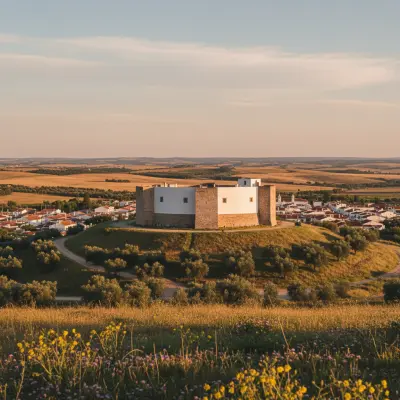
The Pousada sits in a valley, which means you don't get the view of Castelo de Arraiolos you might have expected. That circular castle, by the way, should be your first stop. The climb is short, the view is complete: 360 degrees of plains, cork oaks, and olive trees as far as you can see. Go early morning or late afternoon. At noon, in full sun, it's not a walk, it's penance.
The rural montes: for those who want real plains
And then there's the third option, the most Alentejo of them all: a monte. In Alentejo vocabulary, a "monte" is a rural property, typically a whitewashed house lost among hectares of land, cork oaks, and silence. Around Arraiolos, several have been converted into rural tourism, with pools, comfortable rooms, and the kind of isolation that can be either therapeutic or claustrophobic, depending on your relationship with quiet.
Monte da Lapa, a few kilometres from town, is a reliable option. There's also Monte do Cortiço, with a private pool and garden, better suited for families or groups who want the whole house to themselves. Don't expect 24-hour reception or room service. Expect keys in the door, instructions by text message, and nobody around. For many people, that's exactly the point.
Prices for montes vary widely. You can find rooms from 60-70 euros per night or whole houses for 150-200 euros, especially off-season. The best ones have a pool (essential from June through September), an equipped kitchen (because restaurant options in the area are limited), and enough grounds to wander without leaving the property.
If you choose a monte, my advice is: bring food. Stop at a supermarket in Évora or Arraiolos, pick up Nisa cheese, presunto ham, Alentejo bread, olive oil, olives, and a bottle of Alentejo red. Dinner sorts itself out on a wooden board on the terrace, watching the sun go down over the plains. You don't need more.
The practical question: with or without a car?
Without a car, Arraiolos is tough. There are buses from Évora, but the service is sparse and impractical. If you stay in the centre, you can manage on foot for a day or two. But if you're at the Pousada or a monte, a car is non-negotiable. There's no alternative.
From Lisbon, it's about 110 kilometres via the A6 motorway and then a national road. An hour and a half without traffic. From Évora, thirty minutes. Arraiolos works well as a base for exploring central Alentejo, or as a one-to-two-day stop on a broader itinerary.
If you're planning a wider trip through inland Alentejo, it's worth considering a stop in Portalegre, further north. Our guide to a real weekend in Portalegre gives you an itinerary free of tourist traps, and if you want to explore on foot, the guide to Portalegre's neighbourhoods worth the walk is a good starting point.
So which one should you pick?
If you're travelling as a couple and want culture, rugs, and walks: the historic centre. Casa do Plátano is the safe bet, and having restaurants and shops at your doorstep is worth a lot when the heat hits and the car feels too far away.
If you want guaranteed comfort and don't mind driving: the Pousada. The building is beautiful, the service is professional, and the outdoor pool with views over the plains is hard to beat.
If you want to truly disconnect and have a car: a monte. No neighbours, no noise, no urgency at all. It's the Alentejo in its purest form.
One thing I'd recommend regardless of where you stay: book The Thread of Time rug weaving masterclass. It's not just watching someone embroider. It's understanding a centuries-old tradition, told by the people who live it. And if you leave wanting to buy a rug, know that a proper handmade Arraiolos rug can cost thousands of euros. The ones you see for 50 euros in the shops are machine-made. Nothing wrong with that, but they're different things.
When to go
Arraiolos is best in spring (March to May) or early autumn (September and October). The Alentejo in summer is brutal: 38 to 42°C for weeks. You can survive if you have a pool, but walking up to the castle or around the centre is limited to early morning or late afternoon.
In March and April, the plains are green, temperatures hover around 20°C, and accommodation prices are lower. It's the best time, no question. If you want to combine with regional food, our guide to where locals eat in Portalegre covers the northern Alentejo food scene.
Arraiolos isn't a town to rush through. It's a place to stay for two days, walk slowly, eat well, and understand why the Alentejo has this strange effect on people: when you're there, you want to leave. When you leave, you want to go back.