Arraiolos Beyond the Rugs: What the Day Trip Misses
Most visits to Arraiolos last ninety minutes: the circular castle, a rug shop window, and the road back to Évora. But between the duck empadas at República da Empada and the medieval dye vats hidden under the museum floor, this Alentejo town holds more than the quick itinerary suggests.
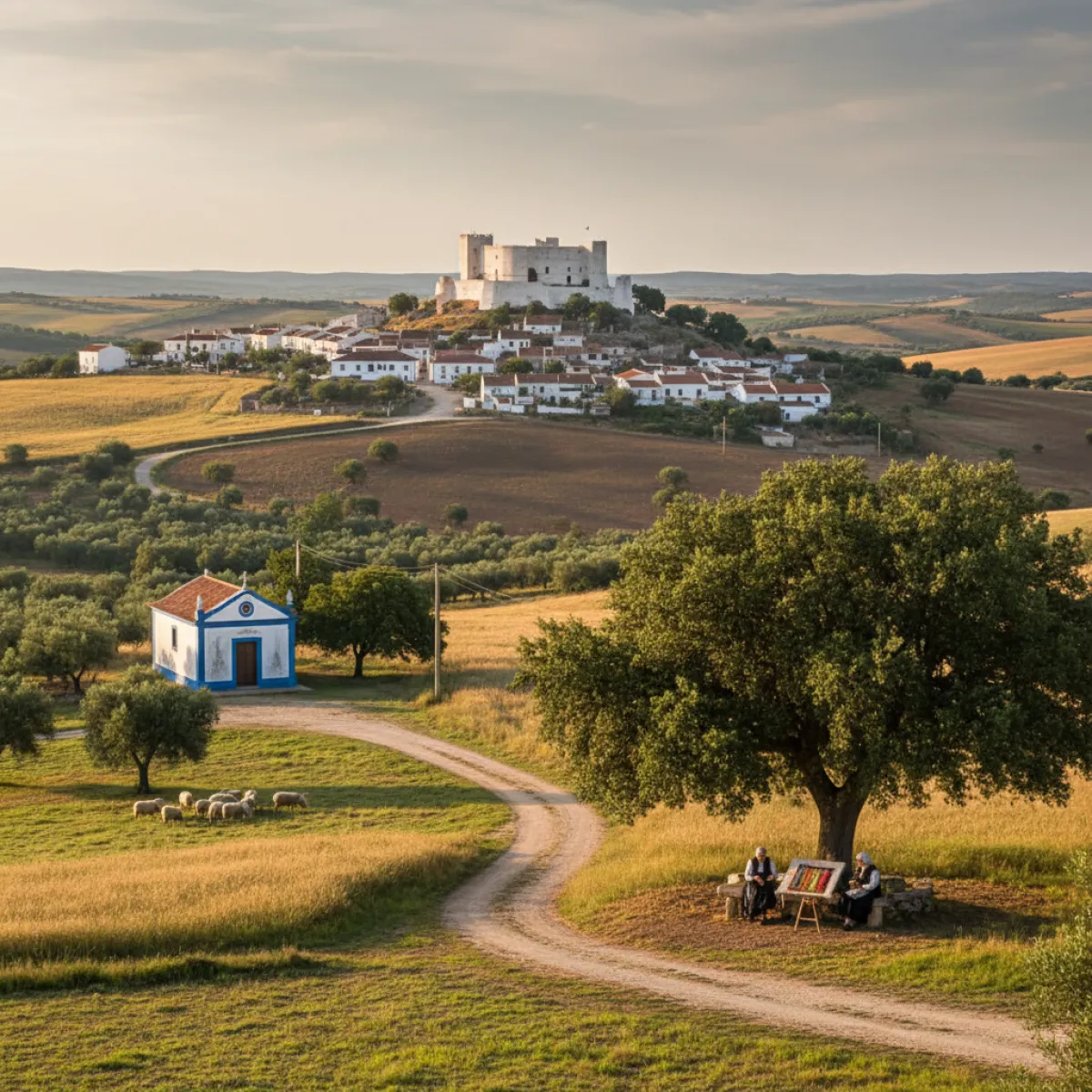
Most visitors to Arraiolos follow the same script: glance at rugs in a shop window, climb to the castle, snap a photo of the Alentejo plains, and drive back to Évora for dinner. It takes about ninety minutes. And it misses the point entirely. Not because Arraiolos is secretly a large town that requires days to explore, but because what makes it worth the detour happens in the gaps between the obvious stops: in conversations with embroiderers, in flavors that don't appear in mainstream guides, and in the streets where, at 8am, the only sound is chairs being dragged across the cobblestones on the Praça do Município.
The castle everyone visits but nobody does properly
Let's start with what everyone does, since almost nobody does it well. The Castelo de Arraiolos is one of the rare circular fortresses in the world, built in the 14th century under King Dinis. Most people hike up, take the panoramic shot, and leave. The mistake is skipping the Igreja do Salvador inside the castle walls. It's a 16th-century church, modest and frequently locked on weekdays, but when it's open, it's worth five minutes of your time. The views from the top are, yes, as good as advertised: the Alentejo plain stretching to the horizon, dotted with cork oaks and olive trees. Go early, before ten, when the light is golden and the heat hasn't kicked in.
The climb is short but steep. You can drive almost to the top if you prefer, but on foot from the town center, it takes less than fifteen minutes and passes whitewashed houses with blue trim that are essentially the Alentejo postcard come to life.
A museum with secrets under the floor
The Centro Interpretativo do Tapete de Arraiolos, on the town's main square, is the kind of museum that tricks you with its modest facade. The collection traces the history of Arraiolos rugs from the 17th century onward, with pieces that once hung in palaces like Queluz and Sintra. But the moment that justifies the visit is right by the entrance, to the right of the ticket desk: a chapel with a glass floor that lets you look down at medieval dye vats uncovered during excavations in 2003. These structures likely date from the 13th century. It's the kind of detail you'll miss if you rush through.
After the museum, the question becomes: do you want to see rugs, or do you want to understand how they're made? If it's the latter, consider booking a masterclass in Arraiolos rug weaving where the process is explained by people who've been doing it for decades. The Arraiolos stitch technique is more complex than it looks, an oblique cross-stitch that distinguishes these rugs from any other European embroidery tradition. This isn't an experience for people who want quick entertainment. It's for those with patience and genuine curiosity.
For something shorter and more hands-on, there's also an Arraiolos rug workshop with local artisans that fits into an afternoon, where you leave with a piece you've started yourself. A good option if you don't want to commit an entire day.
Eating in Arraiolos: forget the generic Alentejo menu
Arraiolos has two food specialties worth seeking out on purpose, and neither is what most travel guides highlight when they talk about Alentejo cuisine.
The first is empadas de Arraiolos. Don't confuse these with the chicken empadas you can buy at any Portuguese bakery. The Arraiolos version is a different thing altogether: thin pastry, generous filling of meat (chicken, duck, sometimes game), seasoned with spices that vary from house to house. República da Empada, in the town center, is the most straightforward place to try them. Order the duck ones if they're available.
The second is pastéis de toucinho, a conventual sweet found only here with this specific recipe: dough of flour, egg yolk, and butter, filled with a mixture of ground pork lard, almonds, egg yolks, sugar, and cinnamon. It sounds heavier than it tastes. Pastelaria O Toucinho is the obvious reference point: pastéis come in individual portions or in a larger pastelão format for sharing or taking away. If you're only going to eat one sweet thing in Arraiolos, make it this.
For a fuller meal, look for local restaurants serving straight-up Alentejo cooking. Migas with pork, açordas, stews. Arraiolos sits 25 km from Évora, which means it shares the same central Alentejo culinary DNA: bread, herbs, and black pork as the foundation of almost everything.
The streets nobody photographs
Arraiolos is small. Small enough to walk the entire center in twenty minutes. But there's a difference between walking through and actually looking. The town has a remarkable collection of whitewashed houses with painted blue and yellow trim that are more photogenic than many better-known historic villages. The 16th-century Pelourinho (pillory) still stands in the square, and the Chafariz dos Almocreves, the public fountain, is one of those urban elements that tells the story of a place better than any information panel.
The Convento dos Lóios, founded in the 16th century, has been restored and converted into the Pousada de Nossa Senhora da Assunção. Even if you're not staying there, the Renaissance cloister and blue-and-white tilework deserve a visit. It sits about a kilometer from the historic center. If your budget allows a night, it's one of the best places to sleep in central Alentejo: the quiet of that building at the end of the afternoon, with the plains all around, is genuinely restorative.
When to go and how to get there
Arraiolos works any time of year, but there are two ideal windows. The first is spring (March to May), when the Alentejo is green and temperatures are mild. The second, for those who want to see the town in festival mode, is June during O Tapete Está na Rua (The Rug is on the Street), when rugs are displayed on streets and facades and the town takes on an energy it lacks the rest of the year.
Summer isn't impossible, but Alentejo heat above 40°C makes the castle climb genuinely unpleasant after 11am. If you come in summer, schedule everything for the morning or late afternoon.
By car, Arraiolos is about 25 minutes from Évora via the N370 and just over an hour from Lisbon. Parking is easy in the town center. Without a car, Rede Expressos buses connect Lisbon to Évora, but getting to Arraiolos itself requires local transport. Check schedules locally, as frequency isn't great.
Worth combining with inland Alentejo
If Arraiolos has whetted your appetite for the Alentejo that sits outside the usual routes, consider extending north. Portalegre, in the Upper Alentejo, has a completely different feel and deserves at least a weekend. We wrote a guide to Portalegre without the tourist traps that gives a solid planning foundation. And if you like exploring on foot, the Portalegre neighborhoods worth walking piece is useful reading before you set off.
Arraiolos doesn't need more than a day, that's true. But the difference between a rushed visit and an attentive one is enormous. It's the difference between saying "I saw the rugs" and understanding why an entire town built its identity around a single type of stitch.