The Geometry of Tradition: A Deep Dive into Arraiolos Carpet Artistry
Discover the technical mastery and secular history behind Arraiolos Rugs, one of Alentejo’s most authentic crafts. A deep dive into stitch geometry, Moorish influence, and where to find the finest textile treasures.
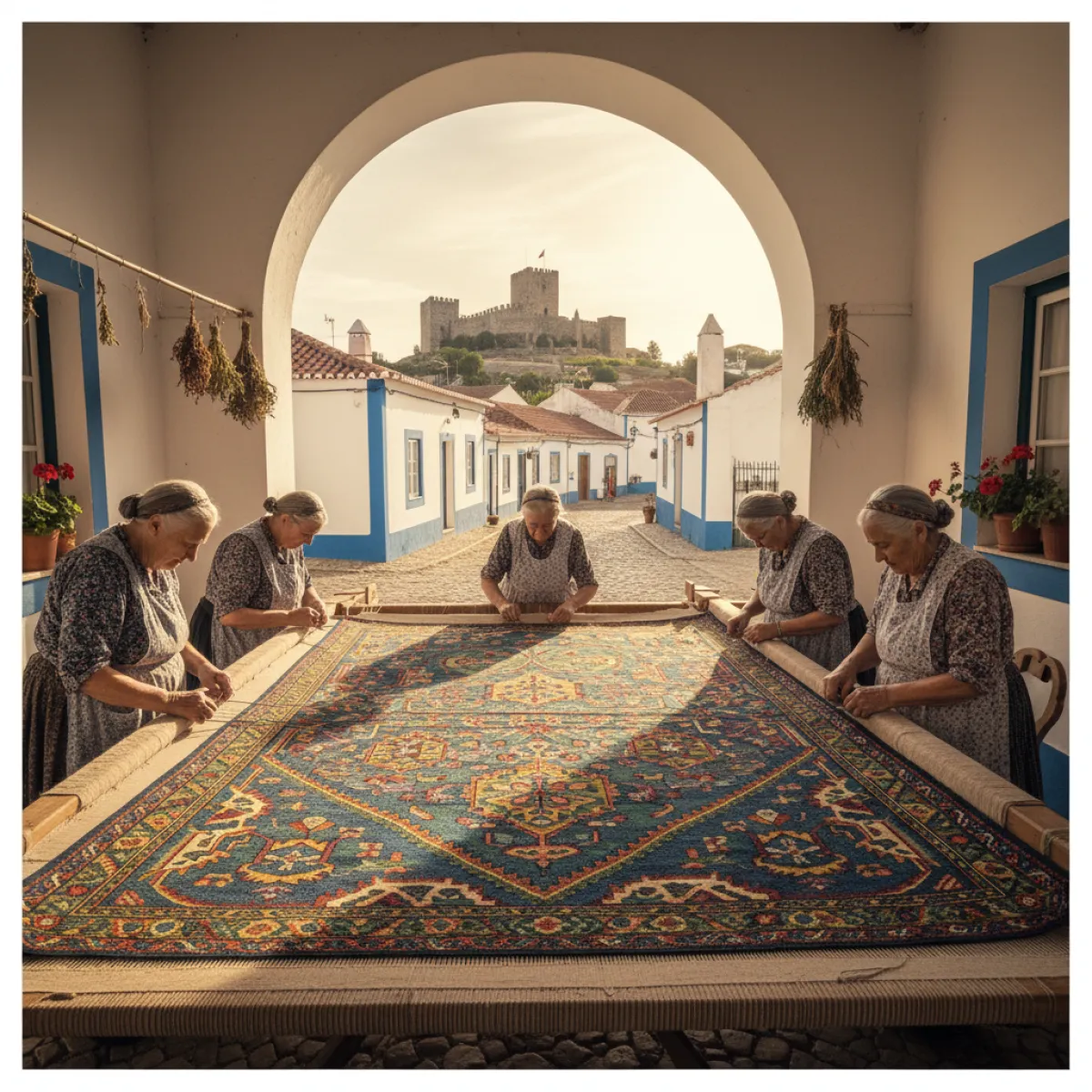
The Geometry of Silence
There is a specific brand of patience that only the Alentejo can cultivate. It is not the resignation of idleness, but rather the rigorous discipline of those who understand that the most beautiful things in the world do not accept haste. In Arraiolos, a town that sits like a white crown upon a hill north of Évora, this patience manifests in wool, hemp, and needle. The Arraiolos Rug is not merely a decorative piece; it is a system of historical coordinates, a textile map that has survived centuries of dynastic and aesthetic shifts. Walking through the narrow streets, where the rhythmic sound of looms and the low murmur of embroiderers at their doorsteps dictate the day's tempo, one realizes they are witnessing one of the rare crafts that has kept its technical integrity untouched since the 15th century.
For the traveler seeking to understand the deep soul of the region, Arraiolos serves as the perfect counterpoint to the classical monumentality of the district capital. If Évora: The Slow Pulse of the Alentejo teaches us about the permanence of stone, Arraiolos speaks of the resilience of fiber. It is an arithmetic of the soul, where each oblique cross-stitch contributes to a visual narrative that fuses Persian, Moorish, and Renaissance influences into a strictly Portuguese dialect.
The Anatomy of the Stitch: Technical Rigour
What distinguishes an authentic Arraiolos rug is its eponymous stitch. Unlike Oriental rugs, which are knots tied to a warp, the Arraiolos is embroidered onto a canvas of jute or linen (the *estopa*). The stitch consists of two needle passes: the first creates the diagonal, the second fixes the structure. This method provides the piece with a density and durability that allow these rugs to pass from generation to generation, acquiring a patina of dignity with use.
Historically, we divide the evolution of these designs into three fundamental periods. The first, clearly of Persian influence, features complex geometric patterns and a sober color palette. The second period, coinciding with the Age of Discovery, introduces elements of exotic flora and fauna, while the third, more Baroque and Rococo, fills the canvases with flowers, bows, and medallions. For those wishing to move beyond passive observation, The Thread of Time: A Masterclass in Arraiolos Rug Weaving offers the rare opportunity to learn directly from the master embroiderers, deciphering the secrets of thread tension and the chromatic choices that define museum-quality pieces.
The Interpretive Centre and the Circular Castle
No visit is complete without a stop at the Centro Interpretativo do Tapete de Arraiolos, housed in the former Hospital do Espírito Santo. The space is a prime example of contemporary museology, balancing historical archives with live demonstrations. However, it is at the Castle of Arraiolos, one of the few circular castles in the world, where one gains the necessary perspective. From the top of the ramparts, the view over the sea of cork oaks and olive trees explains the local craft's color palette: the ochres of the dry earth, the deep greens of the foliage, and the electric blue of the Alentejo sky.
This landscape is the ideal setting for those using Évora as a base. Many travelers follow the evocative suggestions found in Stone and Silence: A Sentimental Guide to Évora, dedicating their mornings to urban exploration and their afternoons to discovering satellite villages. Arraiolos, just a 20-minute drive away, demands this slow-burning time of contemplation.
Practical Guide: Where Tradition Meets the Table
Arraiolos does not live by art alone. Local gastronomy is a pillar of the town's identity. The essential order here is the *Empadas de Arraiolos*, small treasures of shortcrust pastry filled with a chicken stew that melts in the mouth. For a more robust meal, seek out O Chaminé or O Pelourinho, where *Migas com Carne de Porco à Alentejana* (bread crumbs with pork) are served with the honesty expected of this land.
- What to Buy: An authentic rug is an investment. A small piece (80x120cm) can cost between €400 and €800, depending on the stitch density and design complexity. Always look for the municipal seal of authenticity.
- When to Go: Spring (April to June) offers mild temperatures and blooming fields. October is equally compelling for the golden light that bathes the town. Avoid August, when temperatures can soar above 40°C (104°F).
- Logistics: Arraiolos is easily accessible from Évora. If you are planning an efficient circuit, consult One Day in Évora: A Precision Itinerary for the Alentejo Capital to optimize your time in the region.
At the end of the day, when the light hits the whitewashed facades at an oblique angle, one realizes that the geometry of Arraiolos rugs is not just aesthetic; it is the way this community organizes its relationship with time. It is an art of resistance, a silent manifesto against the ephemerality of the modern world, embroidered stitch by stitch, with the certainty of those who know that what is well-made requires, above all, respect for the thread of time.
