Walking Old Viseu: Casa do Adro and Rua Direita
Viseu's old town isn't a city you rush. A walking guide through Rua Direita and Casa do Adro, with mandatory stops at Confeitaria Amaral, Café Hermínio and Armazém do Caffè, plus two workshops that will reshape your day.
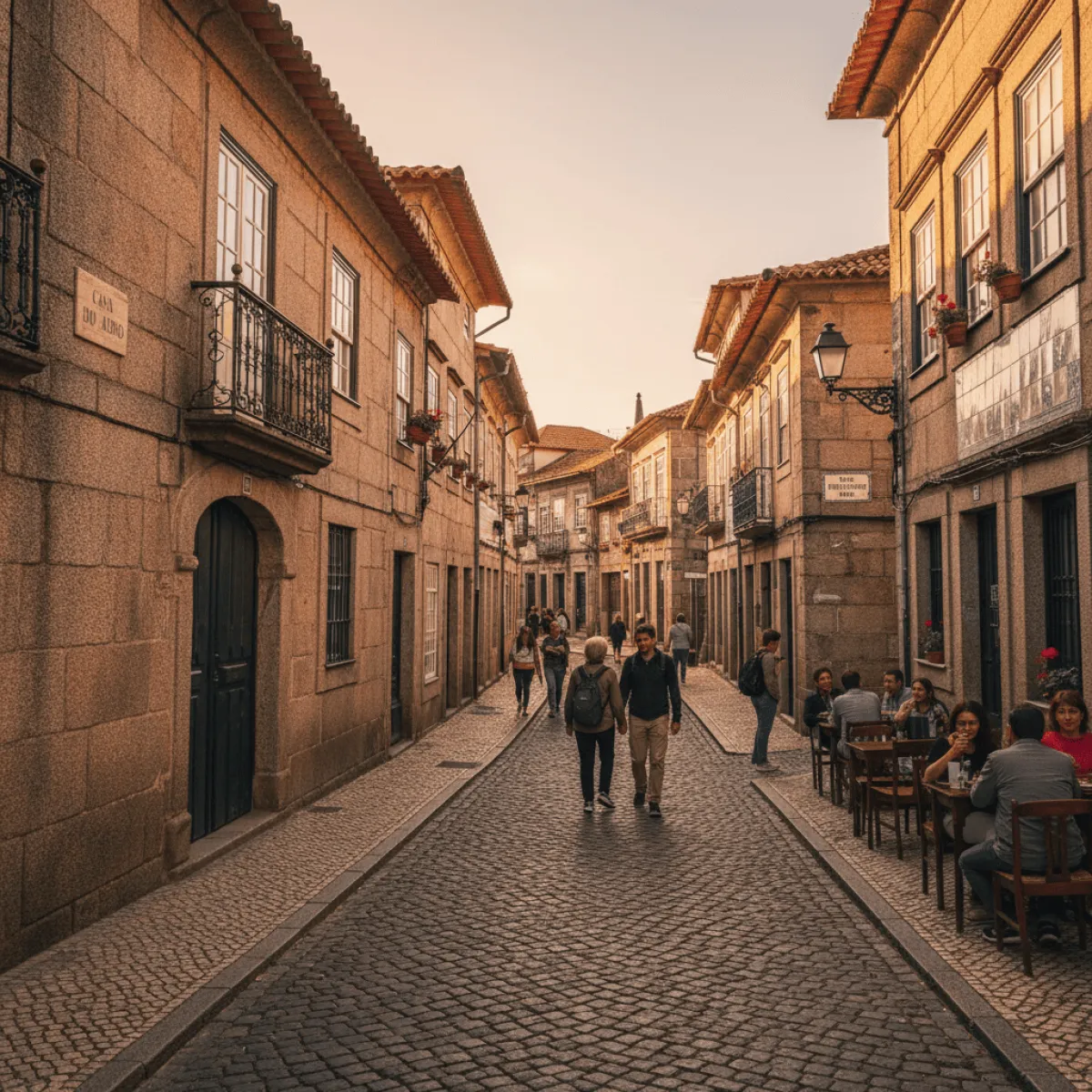
Some cities give themselves away over the first coffee. Viseu doesn't. The old town, wedged between the cathedral and Praça D. Duarte, was built from grey granite quarried in the Caramulo range, and that granite has one peculiar habit: at nine in the morning it is cold as a tombstone, by two in the afternoon it returns the sun with interest, and by sunset it turns honey-coloured. To see this, you have to walk. On foot, no GPS open on your phone, with legs willing to go up and down the same street two or three times.
This guide is for visitors who want to do Viseu the way Viseu wants to be done: slowly, with many stops, and eating well. It focuses on two streets that most people cross without noticing, Rua Direita and the cluster around Casa do Adro, and on three places where you'll probably end up staying longer than planned.
Where to start (and why it's not the cathedral)
Most visitors begin at the cathedral, look at the Renaissance cloister, photograph the facade and head back down. Tactical mistake. The cathedral is always there, and it looks better at five in the afternoon, when the sun rakes across the towers and the square out front is practically empty. In the morning, the light is harsh and the tour buses arrive at ten.
Start earlier. Around eight or eight-thirty. Walk up to Praça D. Duarte from the opposite side, via Rua Augusto Hilário, and let yourself drift. You'll end up at Casa do Adro, a dark granite building with Manueline windows that gives the whole quarter its name. Locals just call it "the old house". There are no visiting hours, it's private, but the outside is enough: stop in the square, lean against the wall, listen. The city is still waking up. A door opens on a first floor, someone shakes out a tablecloth, a dog barks faintly. This doesn't last. Take it in.
The breakfast you cannot skip
The rule for Viseu is simple: never have breakfast at your hotel. The city has three century-old cafés within five hundred metres of each other, and ignoring them for a buffet with lukewarm scrambled eggs is borderline rude.
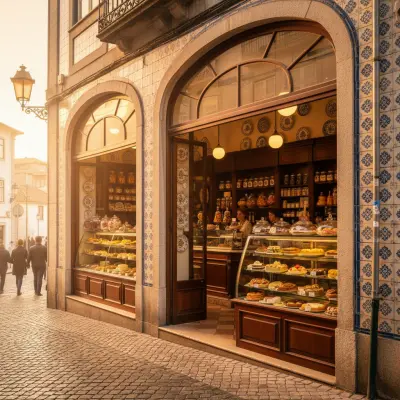
The first serious stop is Confeitaria Amaral. Open since the 1920s, marble counter, curved-glass display cases, and a smell of warm butter that hits you before you turn the corner. Order a castanha de ovos and a galão. The castanhas are house specialty pastries, egg yolk and sugar based, and cost just over a euro each. Don't ask for "the best one", ask for that one. The bakers inside will decide you know what you're doing, and the service shifts gear.
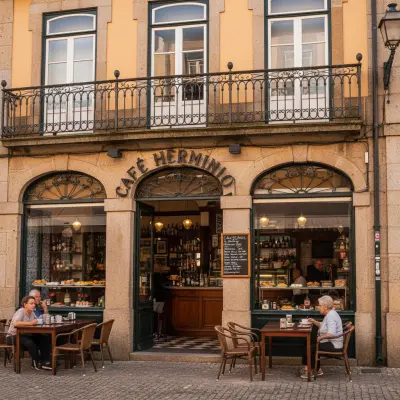
If you prefer somewhere to sit with a newspaper, cross over to Café Hermínio. It's the café of Viseu's pensioners in flat caps and Viseu's lawyers in ties, at the same time. Small tables, antique mirrors, a back shelf with vermouths nobody has ordered in thirty years. Here the espresso comes with a glass of water that nobody asks if you want, and the bread and butter is the strongest argument I know for arriving early.
Walking up Rua Direita, slowly
Rua Direita is the spine of the old town. Narrow, cobbled with irregular stone (mind your heels, I'm serious), and climbing at a gradient that looks gentle until you try it with shopping bags. Buildings are three, four storeys at most, and almost all have a shop on the ground floor.
Practical advice: walk up in the morning, walk down at the end of the afternoon. In the morning you catch shops opening, awnings being unrolled, owners sweeping the doorways. At sunset you catch golden light on stone and bars wheeling out the first outdoor tables.
Along the way, notice three things no guidebook points out:
- The granite door thresholds worn into curves by centuries of feet. Some have a central dip two or three centimetres deep. A small detail, but it is literally the wear of generations of Viseu families.
- The early twentieth-century azulejo panels on residential facades. They aren't protected, they're slowly disappearing, and nobody is keeping an inventory. Look while you can.
- The cast-iron house numbers. Many are original, and the typography changes from street to street, which suggests different local workshops supplied the council at different periods.
I am biased, but there is a way of looking at this street that is worth more than entering the cathedral.
Lunch without inventing anything
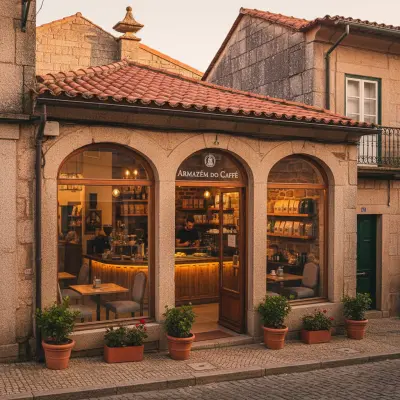
When hunger kicks in, and in Viseu it kicks in around one, head for Armazém do Caffè. Set in a converted warehouse, high ceilings, wooden tables. It's not a tablecloth tasca, more of a contemporary spot with regional cooking. The advantage: decent lunch at reasonable prices in a historic centre where it is easy to fall into tourist traps.
Direct advice: ask for the daily special at the counter before you sit down. In Viseu the prato do dia is still the real thermometer of a kitchen. If it's vitela à lavrador, posta à mirandesa, or a properly made arroz de pato, stay. If it's something odd with cream sauce, walk away. Central Portuguese cooking does not need cream sauce.
To drink, ignore the long wine lists and order a glass of house Dão red. The Dão is the local denomination, the real one, and there are small producers whose by-the-glass wine costs around three euros. Drink that, not the sangria.
Afternoon: workshops, cheese, azulejo
Viseu has two organised experiences worth booking in advance, both of which change the tone of the day completely. The first is the tile painting workshop with master António Cruz. It happens in his atelier in the old town, takes a morning or an afternoon, and you leave with your hand-painted piece. It is not a factory souvenir, it is an object that will exist only in your house. For anyone staying two nights in Viseu, it's worth the investment.
The second, if you have a car or are willing to give up a morning outside the city, is the Serra da Estrela cheese workshop at Casa da Ínsua, in Penalva do Castelo, half an hour east. You learn how wild thistle curdles the milk (yes, plant-based, not animal rennet), taste cheese at three stages of curing, and understand why a proper Serra costs what it costs. I left looking suspiciously at anything sold as "Serra cheese" in a supermarket.
Late afternoon back at the square
Around five, walk back towards Casa do Adro. The light turns. The granite that was grey in the morning becomes the colour of toasted bread. The cathedral tourists have already gone down to their buses, the locals haven't yet left work, and there is a window of about forty minutes when the city belongs to you and half a dozen pigeons.
Sit on some steps, drink water, rest your feet. Don't try to photograph this, it's one of those lights that doesn't transfer to a phone. Just look.
If you have a light appetite at the end of the day, go back to Confeitaria Amaral before it closes and pick up a viseense, a local convent sweet made with egg yolk and almond. At home, with coffee, it beats most restaurant desserts.
Where to sleep, briefly
I will not recommend specific hotels because that's not what this guide is for. But two practical rules: sleep inside the old town, within a five-minute walk of Praça D. Duarte, and don't pay more than a hundred and twenty euros a night for a double unless it's a fair weekend (Feira de São Mateus, in August and September, sends prices through the roof). There are good family-run guesthouses in restored old buildings, and a couple of mid-range hotels in the centre. Ask for windows facing the street, even if you hear cars, because the alternative is an interior courtyard with no light.
When to go
Viseu sits in the inland centre of Portugal, with a continental climate. Cold winters, hot summers. My two favourite windows:
- Late May to mid-June. Long days, mild temperatures, terraces in full swing, before July heat.
- Late September and October. Recent Dão harvest, restaurants rolling out autumn menus, low light that works wonders on granite.
Avoid August if you can. The city fills up with the Feira de São Mateus, a massive popular fair with food stalls and concerts. It entertains plenty of people and has its place, but it is not the right moment to discover the historic centre in peace.
Getting there
Viseu has no train, which seems like an insult to the city but has a long historical (and political) explanation. The practical options are:
- Your own car. A25 motorway from Aveiro, A24 from Vila Real. Paid parking near Rossio, ten minutes on foot from the old town.
- Rede Expressos coach. Daily connections from Lisbon (about three and a half hours) and Porto (about two hours). The simplest way without a car.
Inside the old town, forget taxis and public transport. Everything is walkable, and it isn't large. Wear decent shoes, with soles that grip wet stone if it rains.
Other reading before you travel
If this is your first approach to central Portugal, it helps to understand how the rest of the region works and how we write guides around here. Our honest guide to Coimbra's Queima das Fitas gives you context on the academic tradition that still shapes the centre of the country. If you are thinking of combining Viseu with other stops, the guide to the Fátima pilgrimage on May 13th is useful for travellers in May who want to understand why certain roads become impossible. And for a contrast of rhythm, read our April walks around Caldas da Rainha guide: it's the opposite of Viseu, Atlantic coast, salt air, another Portugal.
Summing up, without bullet points
Viseu is not a photography city. It is a walking city. Everything it has to offer happens between the first espresso at eight in the morning at Confeitaria Amaral and the last glass of Dão red at eleven at night at Armazém do Caffè. In between there are streets, granite, workshops, bakeries, and a square where the light changes every hour.
Don't try to see everything. See less, slowly, twice. That's how you understand an inland Portuguese city. And that's how Viseu, finally, starts to talk.