The Ruins of Miróbriga: A Chronicle of Roman Leisure and Order
Explore the ruins of Miróbriga in Santiago do Cacém, a unique Roman complex featuring Portugal's only preserved hippodrome and monumental thermal baths. An essential guide to leisure and engineering in ancient Lusitania.
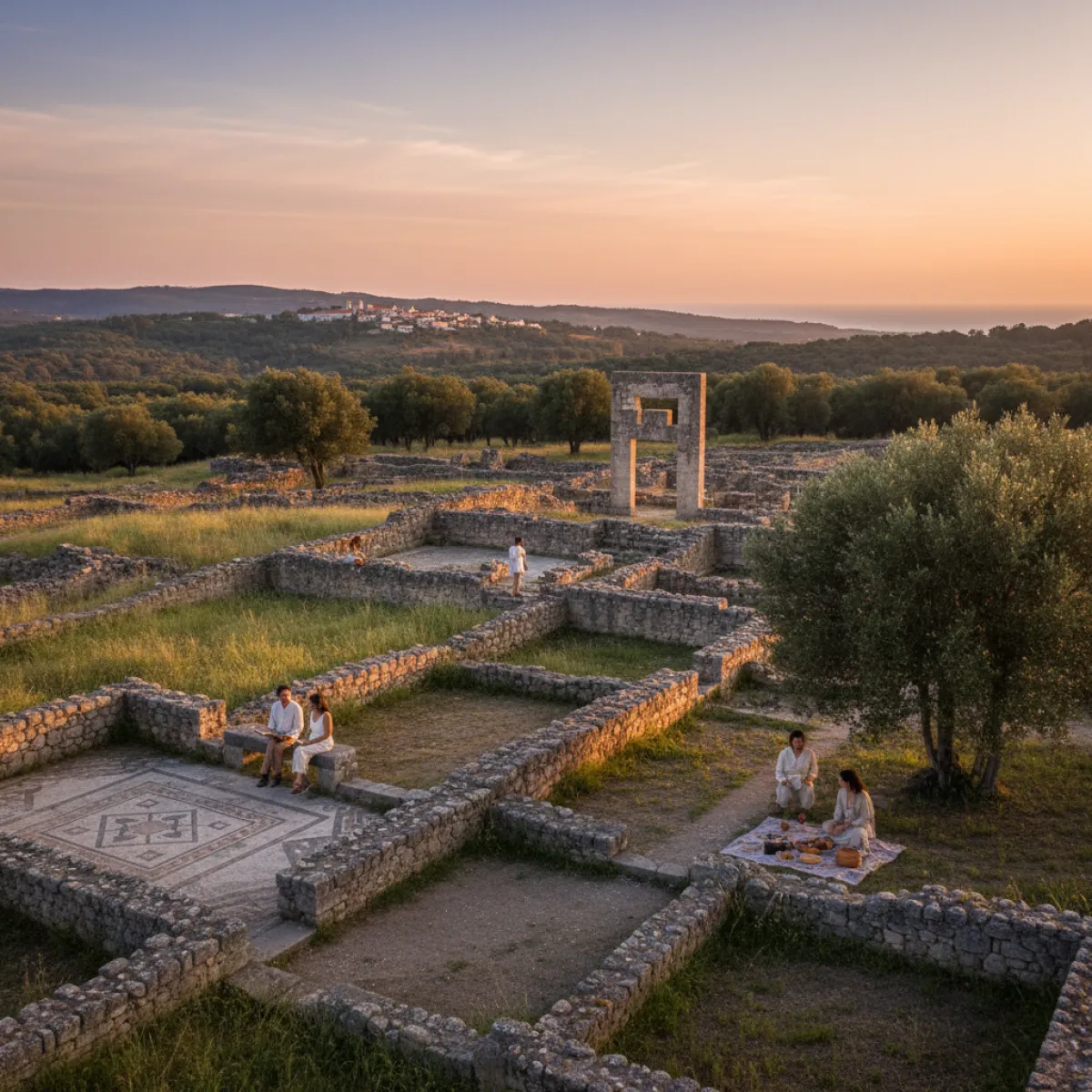
The Geography of Silence in Santiago do Cacém
There is a particular sobriety to the landscape of the Alentejo coast that avoids the tourist exuberance of the Algarve or the melancholic density of the North. Here, the land does not offer itself immediately; it demands a negotiation with the Atlantic wind and a light that, even in winter, possesses an almost surgical clarity. It is within this frame, atop the Chaminé hill, that the ruins of Miróbriga rest. This is not merely an archaeological site, but a manifesto on the persistence of form over chaos. While many seek the Alentejo for stillness, Miróbriga reminds us that this territory was once a vibrant node of trade, rituals, and spectacles.
The Roman city of Miróbriga, located on the outskirts of Santiago do Cacém, challenges the notion that Roman civilization in Portugal was limited to military outposts or agricultural estates. On the contrary, what we find here is the architecture of pleasure and representation. Unlike dense administrative centers, Miróbriga seems to have been designed for the body and the spirit. It is proof that the Pax Romana was sustained as much by the sword as by the exact temperature of the waters in a caldarium.
The Forum and the Authority of Stone
Walking across the limestone slabs of Miróbriga’s forum is to feel the weight of order. The forum, the political and religious heart of the city, stands as a testament to the Roman ability to domesticate topography. Built on a hill, it dominated the view, ensuring that any resident or traveler understood the hierarchy of the empire. The temple dedicated to the Imperial cult, with its elevated podium, was not just a place of prayer but a marker of identity. In a province far from Rome, these stones spoke the Latin of authority.
The preservation of the structures is remarkable, allowing one to glimpse the drainage system and the layout of the tabernae (shops) that surrounded the central square. We can imagine the bustle of merchants selling oil and grain, the sound of sandals on limestone, and the smoke from sacrifices. This rigorous urban organization contrasts with the fluidity of the contemporary Alentejo, where time seems to dilute. For those wishing to deepen this relationship between architecture and the regional soul, the guide Stone and Silence: A Sentimental Guide to Évora offers a complementary perspective on how granite and marble shaped the Alentejan psyche.
The Baths: The Luxury of Water in a Dry Land
The true prodigy of Miróbriga lies in its thermal complex. Divided into the West Baths and East Baths, the set is one of the most complete in the Iberian Peninsula. In a territory where water is a precious and sometimes scarce resource, the existence of a spa of this magnitude was the ultimate expression of sophistication. The hypocaust system, underfloor heating, is still visible, revealing an engineering that prioritized thermal comfort in a climate of extremes.
The baths were not just places for hygiene but the epicenter of social life. Business, politics, and gossip were discussed there while bodies moved from the frigidarium to the caldarium. The transition between rooms, with their varying degrees of humidity and heat, was an almost liturgical ritual. Today, visitors can walk through these spaces and feel the coolness of the stones, a welcome contrast under the merciless midday sun. This valuation of slow time and personal care is something that still resonates in the region, as detailed in Évora: The Slow Pulse of the Alentejo, where patience is elevated to an art form.
The Hippodrome: Where the Alentejo Raced Chariots
If the baths represented introspection and socializing, the Miróbriga Hippodrome was the stage for adrenaline. It is the only example of a Roman circus fully preserved on Portuguese soil. Stretching over 370 meters, this structure was intended for chariot races, the national sport of the empire. The central spina, around which the chariots turned at vertiginous speeds, still marks the axis of the terrain.
The hippodrome’s location, slightly removed from the main urban core, suggests that the competitions drew crowds from across the region. It was mass entertainment in its purest state. Today, the silence that occupies the track is absolute, broken only by the sound of cicadas or the occasional bleating of sheep in neighboring properties. The scale of the hippodrome is monumental and serves to remind us that Miróbriga was not a peripheral village, but a significant destination in Lusitania.
Santiago do Cacém: The Necessary Starting Point
A visit to Miróbriga is inseparable from the town of Santiago do Cacém. The transition between the Roman ruins and the town's medieval structure, crowned by its castle and Mother Church, offers a fascinating visual chronology. Santiago maintains an aristocratic and agricultural dignity, with its whitewashed houses and streets that wind up the hillside. It is the ideal place to base an exploration of the region, allowing for a balance between historical investigation and the fluidity of coastal life.
For those traveling with a strict stopwatch but wishing to capture the essence of the region, the itinerary proposed in One Day in Évora: A Precision Itinerary for the Alentejo Capital can serve as a model for organizing a journey through Santiago, focusing on historical density and local gastronomy. In Santiago, the table is dominated by the flavors of the land and the sea: seafood açorda, migas with pork, and almond and gila sweets that test the endurance of any palate.
Logistics and Pragmatism: The Art of Visiting
Miróbriga requires time. This is not a place for a quick ten-minute stop on the way to the beaches of the Costa Vicentina. Set aside at least two to three hours to walk the perimeter, including the descent to the hippodrome. The visitor center at the entrance is essential for contextualizing the ceramic, glass, and metal pieces found in the excavations, which reveal the details of daily life, from bone needles to coins that circulated throughout the Mediterranean.
The entry fee is symbolic (around 3 euros), but the investment in terms of preparation should focus on footwear and sun protection. The terrain is uneven and the sun exposure is total. The best time to visit is between March and May, when the plain is covered in wildflowers and temperatures allow for a hike without the burden of extreme heat. In the autumn, the golden light over the ruins provides a melancholic atmosphere that favors photography and contemplation.
Conclusion: The Permanence of Form
Miróbriga does not ask us to mourn the past, but to recognize its intelligence. The way houses were built with interior courtyards to keep cool, the sophistication of the water channels, and the grandeur of public spaces are lessons in urbanism that remain relevant. Leaving the site, we look at the landscape of Santiago do Cacém and realize that the Roman order did not disappear; it simply merged with the land, serving as the foundation for everything that came after. In the Alentejo, history is not kept in display cases; it is beneath our feet, waiting for our attention.
