Santana Biosphere: High-Altitude Hiking and the Laurissilva Microclimate
A deep dive into the Santana Biosphere, where the Laurissilva forest and Madeira's highest peaks create a unique microclimate. Explore the technical logistics and elemental beauty of one of Europe's most vertical landscapes.
The Primordial North
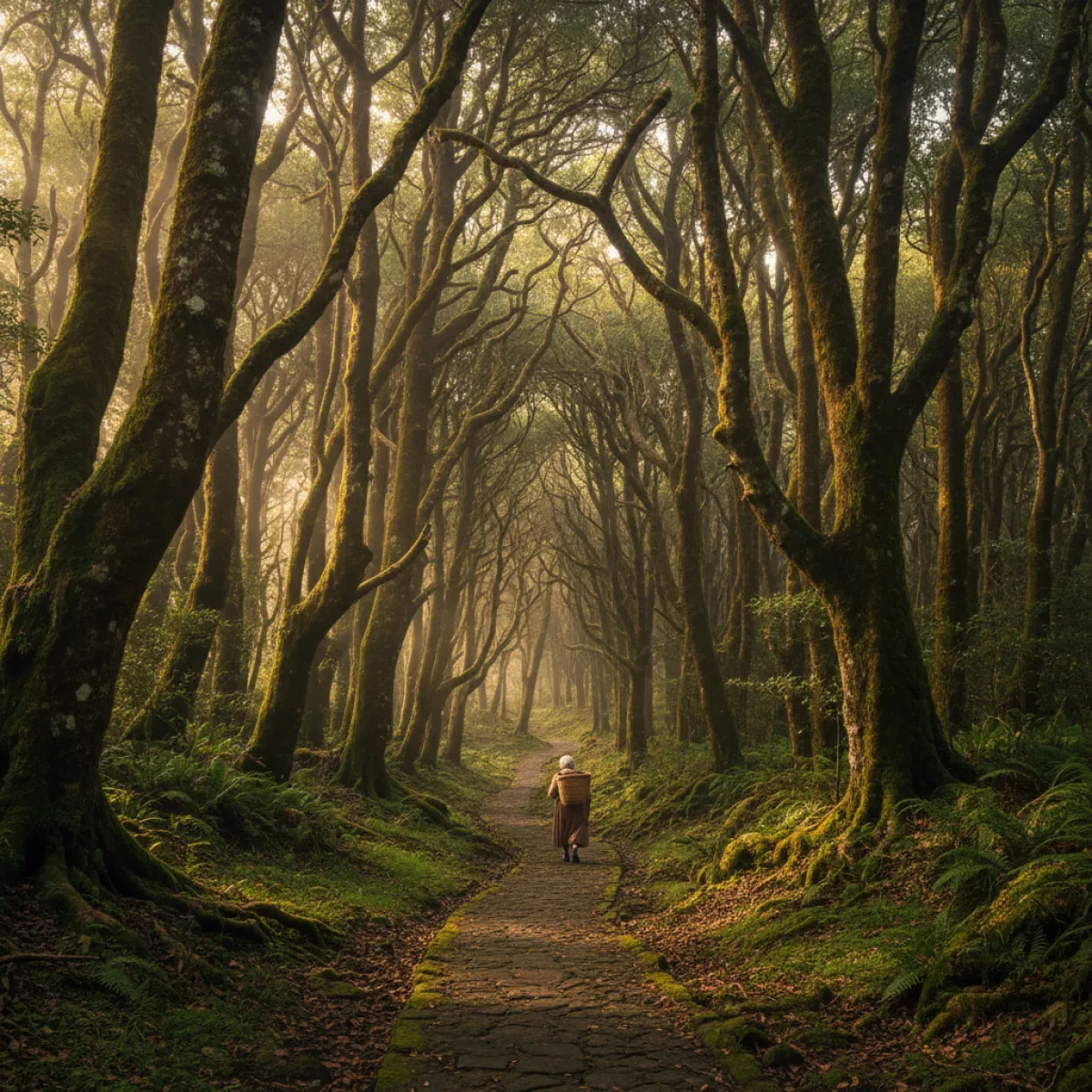
To arrive in Santana is, above all, an exercise in climatic and sensory transition. While the south of the island is bathed in Mediterranean light, almost summer-like throughout the year, the north reveals itself through a wall of basalt and deep green that seems to hold the clouds in a perpetual embrace. Santana is not just a municipality; it is a UNESCO Biosphere Reserve, a title earned in 2011 that protects not only the endemic flora but a way of life shaped by Madeira's most dramatic topography. Here, the scale is vertical. The horizon is interrupted by peaks exceeding 1,800 meters, and the humidity rising from the Atlantic transforms into a dense mist that feeds the Laurissilva forest, a relic of the Tertiary Period that finds its purest sanctuary here.
For the traveler seeking Madeira beyond the conventional circuits of Câmara de Lobos: The Fishing Port That Seduced Churchill, Santana offers a contemplative isolation. It is a territory of silences interrupted only by the sound of water running in the levadas or the occasional cry of the firecrest, the tiny endemic bird that inhabits the laurel canopies. The experience in Santana is defined by the ability to adapt to the microclimate: one moment the sun illuminates the steep slopes, the next, we are submerged in a sea of clouds that erases any trace of modern civilization.
Nature’s Engineering: The Laurissilva Forest
The Laurissilva of Santana is a subtropical rainforest that survived the last glaciations. Walking through it is like entering a living museum. Species such as the Til (Ocotea foetens), the Vinhático (Persea indica), and the Loureiro (Laurus novocanariensis) reach colossal dimensions here, with trunks covered in mosses and lichens that function as biological sponges. This ecosystem is responsible for capturing "occult precipitation", the fog that condenses on leaves and feeds the island's aquifers. Without Santana, Madeira would be a desert.
The best way to understand this dynamic is through the Levada do Caldeirão Verde (PR9). This trail, built in the 18th century to transport water from the mountains to the agricultural fields of the north, is a lesson in engineering and human persistence. The path meanders through tunnels carved into the rock and slopes where the abyss is a constant presence, yet held back by dense vegetation. Upon reaching Caldeirão Verde, the reward is a 100-meter waterfall plunging into a lagoon of icy, crystal-clear water. It is a place of austere beauty, where time seems to have stagnated.
Conquering the Peaks: From Areeiro to Ruivo
For hikers with technical experience and good physical condition, the link between Pico do Areeiro and Pico Ruivo (PR1) is the pinnacle of the Madeiran experience. This is not a casual stroll; it is a high-mountain traverse that demands respect for the elements. The trail, carved into the mountain ridge, offers views over Curral das Freiras and the Santana valleys that are, literally, dizzying. The island's highest point, Pico Ruivo (1862 meters), is often a rock island above an ocean of white clouds, a phenomenon known locally as the "sea of clouds."
The logistics for this hike require careful planning. It is recommended to start at dawn to avoid the cloud cover that usually rises after 11:00 AM. The wind can be biting, even in summer, and temperatures at the top frequently drop below 5°C. Technical layering, plenty of water, and headlamps for the tunnels are essential. Unlike the more controlled environment of São Vicente: A Family Expedition to Madeira’s Untamed Northern Coast, the high trails of Santana are a direct confrontation with the island's volcanic geology.
Architecture and Heritage: Beyond the Postcard
The typical houses of Santana, with their thatched "A-frame" roofs, have become the visual symbol of Madeira. However, beyond the tourist hub in the town center, these structures, known as palheiros, tell a story of subsistence. They were simple dwellings where the ground floor served as the living area and the attic as the dormitory, utilizing the steep roof pitch to shed the north's torrential rains. Today, few locals still live in these houses, but the preservation of the thatching technique is a Biosphere priority.
When visiting Santana, avoid just the quick photo op. Seek out small producers of Sercial wine, the driest and most acidic Madeira wine, which benefits from the cooler northern temperatures. Local gastronomy is robust: Sopa de Trigo (wheat soup), rich and dense, is the ideal fuel for hiking days, as is the regional Picado served in the small eateries of Faial or São Jorge.
Practical Guide for the Traveler
- When to go: May to October offers the most stability for high-altitude trails. However, winter light in Santana is exceptional for photography, if you are willing to brave the rain.
- Logistics: Renting a car with a powerful engine is essential for the steep climbs. For the PR1, consider using a transfer service so you can hike the trail in one direction (Areeiro-Ruivo or vice versa).
- Where to eat: Quinta do Furão offers an unbeatable view of the northern coast and an impressive Madeira wine cellar. For something more authentic, look for the taverns in Santana's center serving freshly made bolo do caco.
- Equipment: Trail shoes with good traction are mandatory. The stones of the levadas can be extremely slippery due to persistent humidity.
Santana represents the untamed side of Madeira. While in places like The New Northern Brutalism: Contemporary Art and Design in São Vicente we see the island embracing modernity and contemporary art, in Santana the focus remains on preserving what is elemental. It is a destination for those who understand that luxury, in the 21st century, is access to silence, fresh mountain air, and a forest that has been breathing for millions of years.
