Câmara de Lobos: The Fishing Port That Seduced Churchill
In the semicircular bay where Churchill set up his easel in 1950, Câmara de Lobos endures as a working fishing port, a poncha temple, and the gateway to the terraced vineyards of Cabo Girão. An unfiltered guide to what to eat, drink, and avoid.
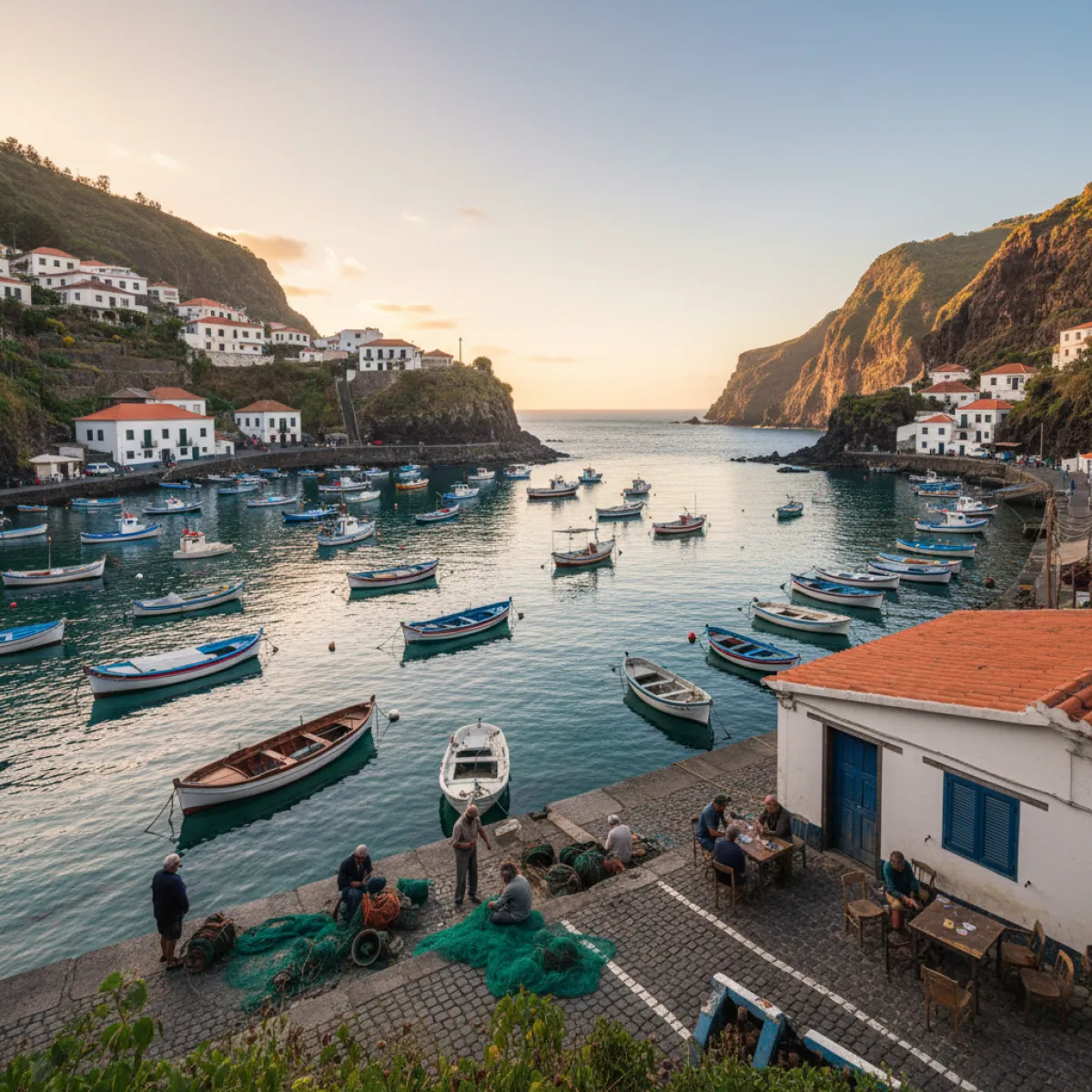
There is a bend in the coastal road west of Funchal where the Atlantic reveals itself with almost theatrical grandeur. The asphalt dips, banana plants thicken on the hillsides, and suddenly there it is, Câmara de Lobos, nestled in a semicircular bay where fishing boats painted in blue, red, and yellow huddle together like pieces of a board game forgotten by time. It was here, in January 1950, that Winston Churchill set up his easel and painted what would become one of his most celebrated works. The British prime minister, rarely generous with praise not directed at himself, declared this one of the most beautiful views in the world.
Churchill was not wrong, but he was not telling the whole story either. Câmara de Lobos is more than a picture postcard. It is a working fishing village, with all the smells, sounds, and contradictions that entails. It is a place where elderly fishermen still mend nets by hand while perched on plastic crates, where black scabbard fish arrives fresh every morning, and where the local bars serve poncha with the same matter-of-factness that a Lisbon café serves espresso.
A Geography of Contrasts
The first thing any visitor should understand about Câmara de Lobos is that it is a village built in layers, literally and metaphorically. The harbour sits at sea level, sheltered by two rocky headlands that create a natural cove. From here, houses climb the hillside in irregular terraces, connected by steep staircases and alleyways so narrow that two neighbours can pass salt from window to window. At the top, Malmsey vineyards stretch in terraces all the way to Cabo Girão, Europe's second-highest sea cliff, with its 580 metres of sheer vertigo above the ocean.
This verticality defines the experience of visiting Câmara de Lobos. Within twenty minutes on foot, you move from the smell of sea salt and grilled fish at the harbour to the earthy aroma of the vineyards, with the Atlantic wind sweeping through everything in between. It is an involuntary cardiovascular workout, but a rewarding one.
The Harbour: Where the Day Begins at Four in the Morning
The heart of Câmara de Lobos beats in its harbour. Not the romanticised harbour of tourist brochures, but the real one, the one that wakes at four in the morning when the black scabbard fishing boats return with their catch. The black scabbard fish (Aphanopus carbo) is Madeira's totemic species: a deep-water creature, coal-black, with enormous eyes and teeth that look like something from a horror film. It is not pretty, but it is extraordinarily delicious.
If you can drag yourself down to the harbour by six in the morning, you will see fishermen unloading their catch directly into polystyrene boxes while seagulls execute aerial manoeuvres of military precision. This is not a show put on for tourists, it is work, pure and honest, and there is something deeply satisfying about watching it unfold.
The best vantage point is the seawall that separates the promenade from the harbour itself. From there, you get a panoramic view of the boats, the bay, and, in the background, the cliffs draped in subtropical vegetation. Churchill painted his famous canvas from roughly this angle, though the commemorative plaque is placed a few metres higher up, next to a statue of the British politician holding a palette in one hand and, naturally, a cigar in the other.
What to Eat at the Harbour
The gastronomy of Câmara de Lobos revolves around black scabbard fish. The most iconic dish is espada com banana, scabbard fillet served with fried Madeiran banana, a combination that sounds odd until you taste it, at which point you realise the banana's sweetness works as the perfect counterpoint to the fish's delicate flesh. Expect to pay between 12 and 18 euros for a generous plate at most harbour-side restaurants.
But the real test of any Câmara de Lobos tavern is not the scabbard, it is the grilled limpets. These small barnacles, served in their shells with garlic butter and lemon, are the ideal starter for any meal. Order them with a glass of the house white wine and you will have one of Madeira's finest appetisers for under 8 euros.
For something more substantial, look for caldeirada, a dense and aromatic fish stew that varies from restaurant to restaurant but in Câmara de Lobos tends to be more generous with tomato and potato than elsewhere on the island. Harbour restaurants typically serve it at lunch, between noon and 2:30 pm, outside that window, you risk finding the kitchen closed.
Poncha: Ritual and Religion
If black scabbard fish is the gastronomic soul of Câmara de Lobos, poncha is its spirit. This simple drink, sugarcane aguardente, honey, and lemon juice, stirred with a wooden stick called a caralhinho, is ubiquitous across Madeira, but it was born here. Câmara de Lobos claims the invention of poncha with the same pride that Naples claims pizza.
The original poncha, known as "de pescador" (fisherman's style), uses only lemon. Variations with passion fruit, orange, or tangerine are more recent inventions that local purists tolerate with the same reluctance a Neapolitan reserves for pineapple on pizza. The correct temperature is room temperature, never chilled, and it is drunk in small glasses, because the alcohol content hovers around 25-30% and the honey's sweetness dangerously masks the potency.
The best advice is to head to one of the taverns on Rua de São João, the main artery climbing from the harbour to the village centre. Here, prices are honest (1.50 to 2.50 euros per glass), portions generous, and the atmosphere unchanged from decades past: middle-aged men arguing about football, a television glowing in the corner, the comforting sound of glasses being set down on marble countertops.
Above the Harbour: Vineyards and Cabo Girão
The second half of any visit to Câmara de Lobos requires climbing. The terraced vineyards covering the hillside above the village produce Malmsey (Malvasia), the sweetest and most prestigious of the four classic Madeira wine grape varieties. The terraces, supported by basalt stone walls built over centuries, are a feat of agricultural engineering as impressive as any cathedral.
The most accessible walking route is the Levada do Norte, which winds through the vineyards with superb views over the bay and the ocean. It is not a demanding hike, perhaps an hour and a half round trip, but the path can be uneven and slippery after rain, so proper footwear is essential. The best time is late afternoon, when the golden light transforms the terraces into steps of gold.
Higher still, Cabo Girão offers one of Madeira's most visceral experiences. The viewpoint, fitted with a transparent glass platform (the skywalk), juts out over the cliff at 580 metres above sea level. The view is spectacular: far below, on the fajã, the platform of land at the base of the cliff, farmers cultivate bananas and vines accessible only by cable car. It is an image that encapsulates Madeira's relationship with its geography: where there is earth, there is cultivation, no matter how impossible the access might seem.
Access to Cabo Girão is free and the car park is spacious. The glass platform is open from 9 am to 9 pm in summer and 9 am to 7 pm in winter. Avoid visiting between 10 am and 1 pm, when tour buses arrive in droves, by late afternoon, you will have the platform almost entirely to yourself.
The Fishermen's Quarter: Unfiltered Authenticity
The most fascinating part of Câmara de Lobos is not at the harbour or at Cabo Girão, it is in the residential neighbourhoods stretching behind the Church of São Sebastião. Here, away from the waterfront terraces, the village reveals its most authentic face: laundry drying on tiny balconies, cats napping on stone staircases, the sound of a television filtering through open windows, children playing football in improvised squares.
These neighbourhoods were for decades the poorest on Madeira. In the 1950s, when Churchill was painting the bay, fishing families lived in conditions of extreme precariousness, no running water, no sewage, with single-room houses for families of eight or ten. The transformation over the past three decades has been remarkable: facades are now painted, streets paved, and flowers spill from every window. But the human scale has been preserved, and that is what makes these neighbourhoods so compelling for those seeking Madeira beyond the resorts.
The best way to explore them is simply to get lost. Climb any staircase, turn any corner, and you will eventually find an improvised viewpoint, a bend in the road where suddenly a vista opens across the harbour and the ocean, worth more than any paid admission.
Practical Information
Getting There
Câmara de Lobos is just 9 kilometres west of Funchal, roughly 15 minutes by car along the regional road 229. Horários do Funchal buses (lines 1, 2, and 4) run the route regularly for 1.95 euros. The scenic alternative is walking along the seaside promenade, a coastal hike of approximately two hours passing Praia Formosa and the Lido bathing complex.
When to Go
Câmara de Lobos works in any season, Madeira's climate is remarkably stable, with temperatures between 16 and 25 degrees Celsius year-round. That said, the best conditions are between April and October, when mornings are clearer and afternoons longer. The Feast of São Pedro on June 29th is the big event on the local calendar: a procession of illuminated boats in the bay, fireworks over the harbour, and poncha flowing in industrial quantities.
How Much to Budget
Câmara de Lobos is significantly cheaper than Funchal. A full lunch for two with wine costs between 25 and 40 euros at most harbour-side restaurants. Poncha rarely exceeds 2.50 euros. Access to all viewpoints is free, including Cabo Girão. Budget between 30 and 50 euros per person for a complete day including lunch, poncha, and transport.
What to Avoid
Steer clear of restaurants with laminated menus in six languages and photographs of every dish, these are tourist traps with inflated prices and unreliable quality. Avoid Cabo Girão at midday, when the light is harsh and the crowds thick. And please, do not order poncha with ice, it is the Madeiran equivalent of asking for ketchup in a Japanese restaurant.
A Final Note
Câmara de Lobos is changing. New restaurants open with English menus and Funchal prices. Holiday apartments multiply in streets that once belonged only to fishermen. The pattern is familiar to anyone who has watched a European coastal village yield to the pressures of tourism-driven gentrification. But for now, the balance holds: the fishermen still head out at four in the morning, the taverns still serve poncha at honest prices, and the view that seduced Churchill remains exactly as he painted it, perhaps with a few more cranes on the horizon, but with the same impossible blue of sea and sky.
Go now, while the authenticity is still real and not a performance.
