São Vicente: A Family Expedition to Madeira’s Untamed Northern Coast
Explore São Vicente, Madeira’s geological heart, through a family-focused guide featuring volcanic caves, contemporary architecture, and the most authentic gastronomy on the island's northern coast.
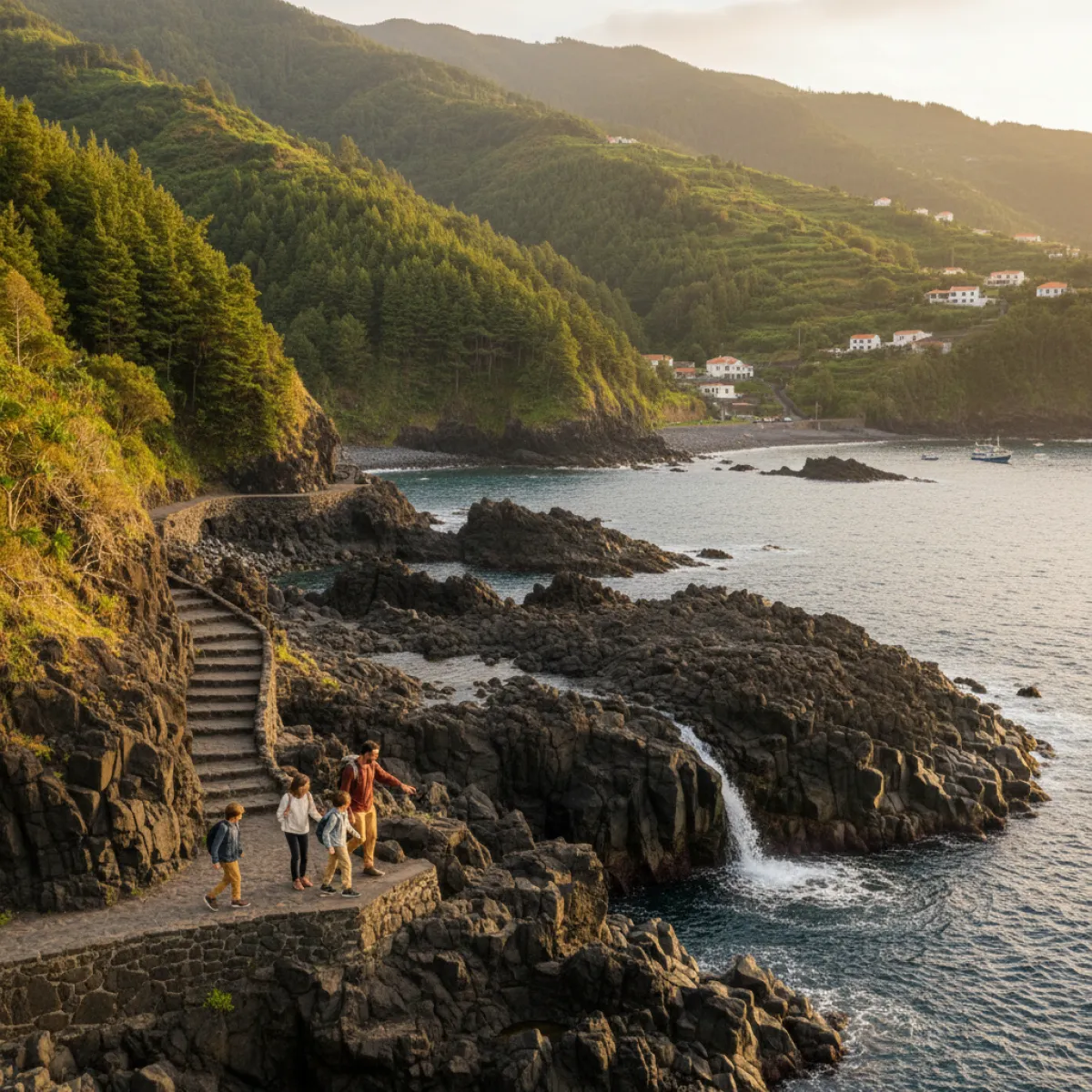
The Geographic Dialectic of the North
Crossing the central mountain range of Madeira towards São Vicente is, for those traveling with children, a masterclass in sensory transition. If the south of the island, personified by the elegance of Funchal or the historical charm of Câmara de Lobos: The Fishing Port That Seduced Churchill, offers a golden luminosity and warmer waters, the north presents itself with a dramatic verticality. São Vicente is the epicenter of this shift, where the deep green of the Laurissilva forest meets the austere gray of volcanic basalt. For a family seeking more than mere resort leisure, this parish offers a practical geology lesson and an immersion into a more authentic Madeira.
The historical isolation of the north, which for centuries depended on precarious paths and the courage of boatmen, has shaped a resilient character that is still palpable today. In São Vicente, the rhythm is dictated by the Atlantic tides and the mist that frequently descends from the peaks. It is a destination to be experienced with hiking boots and light waterproofs in the backpack, ready to explore the secrets the island keeps beneath its surface and on its steep slopes.
Witnessing the Core: Volcanism Center and Caves
The logical starting point for any family itinerary in São Vicente is its Caves. Formed approximately 890,000 years ago during a volcanic eruption, these lava tubes are among the largest of their kind in Portugal. The experience is not merely visual; it is tactile and thermal. Upon entering the tunnels, the temperature drops to a constant 18 degrees Celsius, and the sound of water percolating through the rock creates a hypnotic soundtrack. For children, the sensation of literally walking where lava once flowed is unmatched by any geography textbook.
The Volcanism Center, adjacent to the caves, avoids excessive didactic gimmicks, focusing instead on a clear narrative about the archipelago’s genesis. The elevator simulator that 'transports' visitors to the center of the earth remains a favorite for the younger ones, while the exhibition pavilion offers the scientific clarity needed to understand why Madeira possesses such a rugged orography. Advanced booking is recommended, especially in the summer months, to avoid long waits, as tours are guided and group sizes are limited.
The Lime Route: A Heritage of Labor
For families with older children or those accustomed to walking, the Rota da Cal (Lime Route) is a fascinating pedagogical alternative by the sea. This trail, which lasts approximately an hour and a half, leads visitors to limestone quarries and ancient lime kilns. It is a dive into the island’s industrial archaeology, revealing how this material was crucial for local agriculture and construction. The path is lined with rare specimens of endemic flora, providing a botanical context that often escapes notice in the more curated botanical gardens of Funchal.
Architectural Contrast: The New Northern Brutalism
São Vicente is not defined solely by its natural and geological heritage. In recent years, the village and its surroundings have served as a canvas for architectural interventions that challenge the traditional tranquility of white-washed houses with basalt frames. For parents interested in design and for young people who appreciate contemporary aesthetics, it is worth consulting the guide The New Northern Brutalism: Contemporary Art and Design in São Vicente. This perspective helps in understanding how concrete and straight lines are being integrated into the volcanic landscape, creating a dialogue between the brutality of nature and human intent.
Walking on Water: Levada do Fajã do Rodrigues
Less than a ten-minute drive from the village center lies the Levada do Fajã do Rodrigues. It is one of the most accessible levadas in the north, though it requires flashlights and a bit of an adventurous spirit. The trail is relatively flat, making it ideal for families, but the absolute highlight is the tunnels. Traversing these passages carved into the rock, where the only sound is that of falling water droplets and footsteps on the narrow path, is an experience that defines a Madeiran childhood. The final destination is the 'Madre' of the levada, a hidden waterfall in an amphitheater of greenery that looks like a scene from a period film.
The Art of the Table: The Espetada Ritual
Gastronomy in São Vicente is an extension of its identity: direct, honest, and communal. The mandatory dish is the beef espetada on a laurel skewer. Unlike the tourist versions found elsewhere, here the laurel is essential for imparting a smoky aroma to the meat. The restaurant 'O Lavrador' is a local institution where this ritual is strictly respected. The 'bolo do caco', served hot with garlic butter and parsley, should be ordered as soon as you sit down to occupy the hunger while the brazier does its work.
For dessert or a mid-afternoon snack, look for local bakeries selling 'queijadas de São Vicente'. They are less sweet than their Sintra counterparts, with a more pronounced fresh cheese texture, ideal to accompany an espresso while watching the movement in the main church square.
Logistics and Survival in the North
Traveling to São Vicente with a family requires slightly different logistics than a stay in Funchal. First, a car is indispensable. Although modern tunnels have reduced travel time from the south to a mere 40 minutes, having the freedom to explore the secondary roads that snake along the coast is fundamental. Second, clothing should be in layers. The northern microclimate can shift from radiant sunshine to a fine drizzle (the famous 'chuvisco') in a matter of minutes.
- When to go: Spring and early autumn offer the best balance of mild temperatures and fewer crowds. In winter, the power of the sea is a spectacle in itself, but some levadas may be temporarily closed.
- Budget: São Vicente is significantly more affordable than Funchal. A full lunch for a family of four can range between €60 and €90 in mid-range restaurants.
- What to pack: Footwear with good grip (wet basalt is slippery), flashlights for the levadas, and an extra change of clothes for children who will invariably want to explore the riverbanks.
São Vicente is, ultimately, an invitation to slow down. It is a place where children can see geology in motion and where adults can rediscover a Madeira that resists homogenization. Between the basalt and the laurel, the north waits for those who are in no rush to arrive.
