Walking Santana: Architecture Beyond the Postcard Houses
Santana is far more than thatched houses to photograph. A four-kilometre walk through the historic centre reveals basalt walls, hand-turned chestnut balconies, and traces of water mills that tell the story of a village built against the wind.
Let's get this out of the way: most people visit Santana to photograph the thatched houses and leave. They arrive by bus, queue at the theme park, fire off a dozen shots, and head back to Funchal before lunch. It's a shame, because Santana has an architectural vocabulary that goes far beyond straw-covered A-frames, and the best way to read it is on foot, slowly, paying attention to what's between the buildings, not just inside them.
This route covers roughly four kilometres through the historic centre and its immediate surroundings. You don't need hiking boots or a topographic map, just comfortable shoes and a willingness to look up. Allow three to four hours, including stops for coffee and proper staring.
Starting Point: The Municipal Square
Begin at the Largo do Município, Santana's understated heart. The Câmara Municipal occupies a building that's modest but solid, no ornamental flourishes, just the dark basalt stonework that gives Madeiran civic buildings their particular gravity. Look at the window frames and entrance steps: they're cut from local quarry stone, and the craftsmanship is better than it needs to be.
From here, take in the square. It's small, don't expect a grand plaza, but that's precisely what makes it interesting. Santana was never a seat of power; it was a working village, and its buildings reflect that. Nothing around the square rises above two storeys. The whitewashed façades and wrought-iron balconies show Funchal's influence, but without the pretension.
The Parish Church: Holding the Centre
A few steps from the square sits the Igreja Matriz de Santana, dedicated to Saint Anne. The current building dates from 17th and 18th-century reconstructions, though the worship site is older. What interests me here isn't so much the interior, modest, as befits a rural parish, but the building's relationship to the hillside. The church is set on sloping terrain, and the way the churchyard opens toward the valley is a lesson in vernacular town planning: the church square doubles as a viewpoint.
Notice the bell tower. It's neither tall nor elaborate, but its position on the terrain means it's visible from multiple points around the village, which was exactly the point. In a community scattered across hillsides and footpaths, the bell tower was the original GPS.
The Thatched Houses: What Nobody Tells You
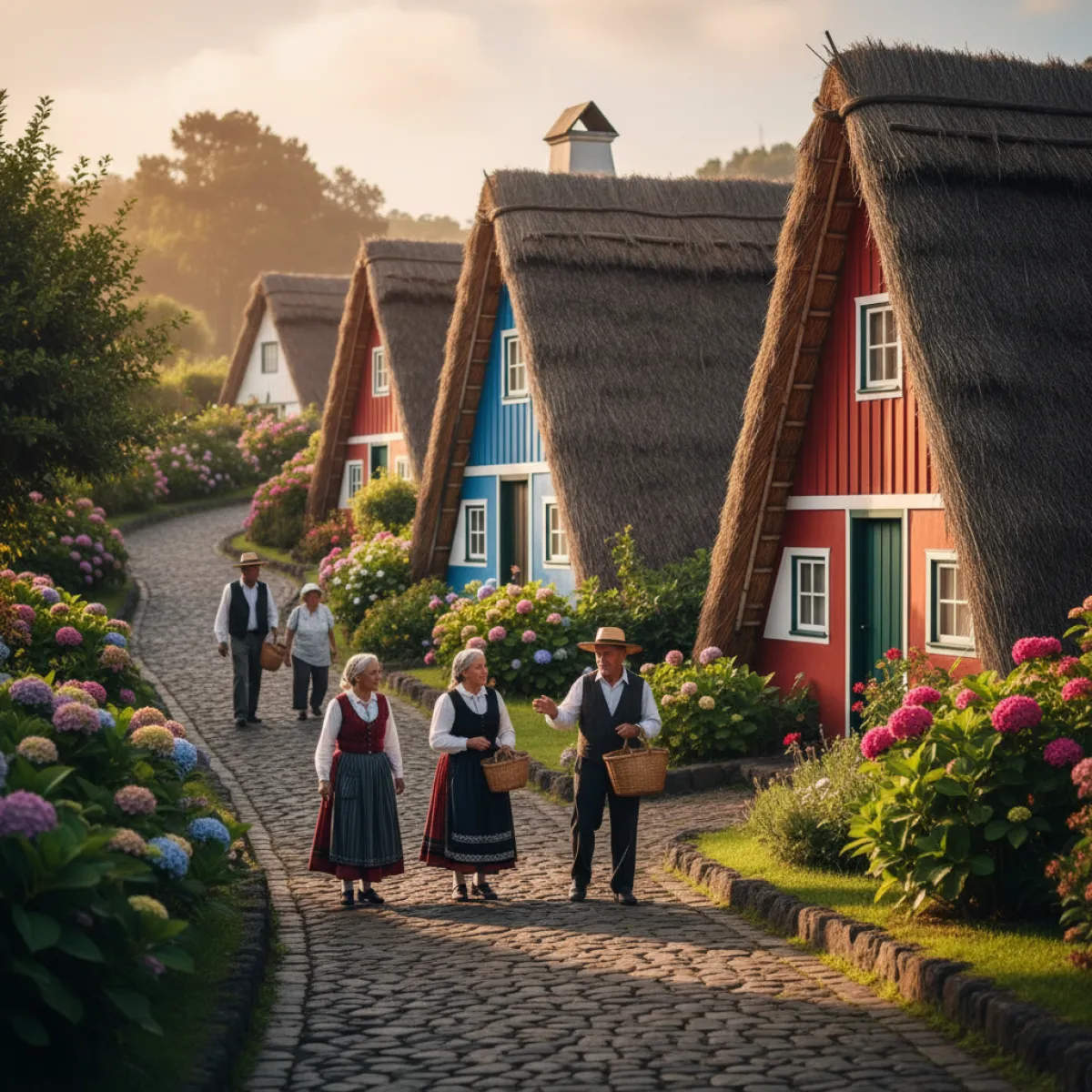
You can't discuss architecture in Santana without addressing the famous casas de colmo, the triangular A-frames with straw roofs that serve as Madeira's postcard image. But I'll be direct: the houses on display at the Parque Temático da Madeira are reconstructions, maintained for tourism. Photogenic, yes. Authentic in the lived-in sense, not quite.
What's genuinely fascinating is the construction logic. The thatched houses are a clever response to Santana's altitude climate: the wheat-straw roof, which sweeps almost to ground level, acts as thermal insulation against the humidity and cold that define this northern part of the island. The triangular timber frame, traditionally built from til and vinhático wood, withstood the winds blowing up from the sea. The door is always small, to conserve heat.
Away from the tourist circuit, a handful of inhabited or reasonably preserved thatched houses still exist scattered across the parish. If you walk along the regional road toward Faial, you may spot more honest examples, without the garish colours of the restored versions. Ask locals; the older residents know where the originals still stand.
The Route: From Village to Quintas
Leaving the centre, the most rewarding path heads north, toward the sea. The road descends gently and the buildings change character: from the compact whitewashed façades of the village to scattered quintas with basalt walls and iron gates. These estates, many from the 19th and early 20th century, tell Santana's economic story: wicker production, subsistence farming, wine.
The walls deserve special attention. Dark Madeiran basalt, laid dry or with lime mortar, is a constant across the island, but in Santana the walls are often taller than elsewhere, shielding agricultural terraces from the northern winds. This isn't decoration, it's survival engineering.
The Detail of the Balconies
If one element defines Santana's domestic architecture, beyond the thatch, it's the balcony. Nearly every traditional house has wooden verandas, often painted in vivid colours, that served as workspaces, food-drying areas, and social hubs. The oldest are made from regional chestnut, with hand-turned balusters. Many have since been replaced with aluminium, a loss, but understandable when you know the cost of maintaining timber in this climate.
The Mill and Threshing Floor Trail
Few visitors know that Santana once had a network of water mills using the ribeiras and levadas to grind grain. Not much remains, most were abandoned after the war, but an attentive walker can still find traces: a stone wall beside a stream, a dry channel, a rusted mechanism. The local parish council has done some signposting work, but we're far from an organised circuit.
The eiras, stone threshing floors where cereals were dried, are another vanishing element. Some have been absorbed into private yards, others turned into car parks. When you find one, notice the quality of the stonework: flat stones fitted with precision, polished by generations of use.
Refuelling: Where to Eat and Rest
Midway through the route, the sensible thing is to stop at one of the tascas or restaurants in the centre. Santana doesn't have Funchal's dining scene, but it has honesty. Look for espetada em pau de louro, beef skewered on laurel sticks, Madeira's most distinctive dish, and bolo do caco with garlic butter. Poncha is mandatory, but pace yourself if you're walking on.
For coffee, a few pastelarias in the centre serve bolo de mel and queijadas, nothing fancy, everything genuine. Prices are notably lower than Funchal: expect 8 to 15 euros for a full lunch with a drink.
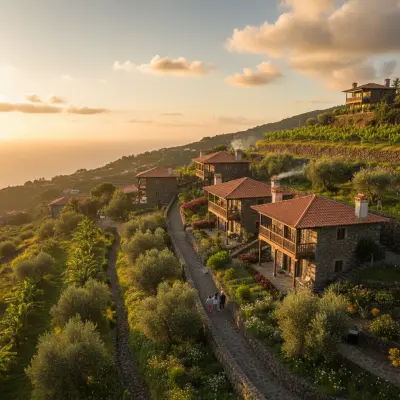
If you're planning to use Santana as a base for exploring this side of the island, Aldeamento Turístico Casas de Campo do Pomar combines the experience of sleeping in traditional-style houses with contemporary comfort, and it's walking distance from the centre.
The Rocha do Navio Viewpoint
The final stage of the architectural walk takes you to the Rocha do Navio cable car, at the northern edge of the municipality. The cable car itself, built to serve farmers cultivating the coastal fajãs, is a remarkable piece of functional engineering. It wasn't designed for tourists; it was built to bring potatoes down and fish up. Today it carries both, but the structure retains that utilitarian honesty which is the best of Madeiran architecture.
From the viewpoint near the upper station, the view over the fajã and the Atlantic is extraordinary. It's also the point where you best understand Santana's relationship with the coast: the village lives with its back to the sea, sheltered by the mountains, yet always dependent on it.
Extending the Day
If the architecture has whetted your appetite for more Santana, the 24 Hours in Santana guide fills in the rest of the day with suggestions beyond the built environment. For those keen to extend into nature, the levada walks near Funchal are a natural next step, several routes pass through areas with stone aqueducts and bridges that extend the architecture lesson into the landscape.
And if this walk has sharpened your eye for handcraft, it's worth exploring Santana's artisan traditions, the wickerwork and embroidery are direct extensions of the same culture that built these houses.
Practical Information
- Duration: 3 to 4 hours, including stops
- Distance: Approximately 4 km (circular route possible)
- Difficulty: Easy, but there's some elevation change, Santana is built on a hillside
- Getting there: Horários do Funchal buses (line 132) connect Funchal to Santana in roughly 1h30. By car, it's 40 minutes via the Via Rápida and ER101
- Best time: Weekday mornings, when the village runs at its normal rhythm without crowds
- What to bring: A waterproof jacket (Santana is the wettest part of Madeira), shoes with grip