Funchal's Levadas in April: The Walks Worth Your Time
Madeira's levadas are over 2,500 km of centuries-old irrigation channels turned hiking trails, and April is the perfect month to walk them. From Caldeirão Verde to the 25 Fontes, this guide maps out the essential routes from Funchal, with practical tips for beating the crowds and catching the island at its greenest.
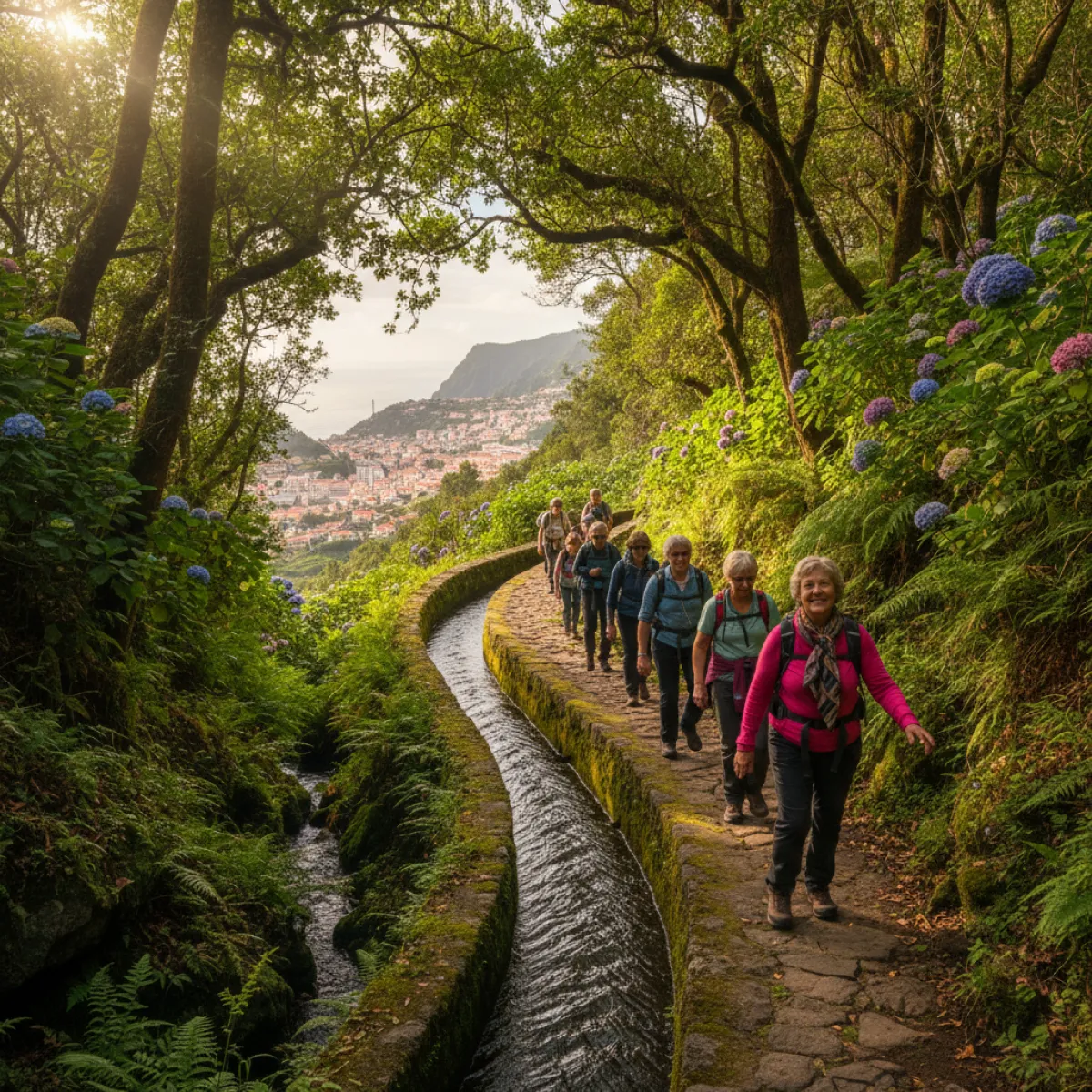
There's a specific look that Madeirans give visitors who announce they're going to "walk the levadas", a mix of pride and patient resignation. Because everyone arrives in Funchal thinking levada walks are gentle canal-side strolls, and then they encounter thick fog at 1,200 metres, basalt steps slick with moisture, and tunnels you navigate by torchlight. April, however, is arguably the best month to do these walks. The heavy winter rains have passed, summer heat hasn't arrived, and the island is in full green explosion, the laurel forest looks like it was freshly repainted overnight.
What levadas actually are
For the uninitiated: levadas are irrigation channels built from the 15th century onwards to carry water from Madeira's wet north to the drier south, where sugarcane was cultivated. There are over 2,500 kilometres of channels across the island, many with maintenance paths that have become hiking trails. The genius is that the channels follow the mountain's contour lines, which means you walk almost entirely on the flat, just enough gradient for the water to flow. This makes levadas accessible to virtually anyone with decent footwear and some respect for the mountain.
Levada do Caldeirão Verde: The non-negotiable one
If I could only do one walk in Madeira, this would be it. Full stop. The trail starts at Queimadas Forest Park, in Santana municipality, about an hour's drive from Funchal. It's roughly 6.5 km one way (13 km return), and the payoff is a waterfall of nearly 100 metres dropping into an emerald-green pool surrounded by vertical rock walls. In April, the waterfall is running heavy, winter has fed it well.
The trail passes through four tunnels (bring a proper torch, not your phone flashlight) and cuts through the laurissilva forest, a UNESCO World Heritage Site. It's one of those experiences where the forest silence is broken only by water running in the levada beside you and, occasionally, the call of a bis-bis, Madeira's endemic chaffinch, which seems to have zero fear of humans.
Practical tip: start early, 8am if possible. Tour buses begin unloading around 10am and the trail, which is narrow in many sections, becomes an uncomfortable single-file queue. Bring water, snacks, and an extra layer, in the tunnels and shaded sections, the temperature drops noticeably.
For the ambitious: Caldeirão do Inferno
From Caldeirão Verde, there's an extension of another 2.8 km to Caldeirão do Inferno, a second, less-visited waterfall. The trail is more demanding, narrow passages, more tunnels, and stretches where you're walking right at the cliff edge. If you've got the nerve to make it here, the solitude and scenery are the reward. Not for anyone with vertigo.
Levada das 25 Fontes and Levada do Risco: Two for one
This is Madeira's other iconic trail, and deservedly so. The starting point is Rabaçal, on the Paul da Serra plateau, the island's central highland. In April, you may encounter fog on the plateau itself, but once you descend to the levada, it usually clears.
The Levada das 25 Fontes is about 4.6 km (one way) and ends at a pool fed by multiple cascades pouring from a moss-covered rock wall. It's cinematic, no exaggeration. The trail intersects with the Levada do Risco, which is worth a 15-minute detour, a vertical waterfall of around 100 metres, less dramatic than Caldeirão Verde but equally beautiful in its setting.
Access to Rabaçal is via a road descending from the plateau. During peak months, private cars are banned and there's a minibus transfer system. In April, depending on the year, you may still be able to drive down yourself, but check locally before going. Parking below is limited.
Vereda dos Balcões: Views without the effort
Not everyone wants to walk 13 km. And you don't have to. The Vereda dos Balcões, near Ribeiro Frio, is a short 1.5 km walk (return) ending at a spectacular viewpoint over the Ribeira da Metade valley and the island's central peaks. On clear days, and April delivers many, you can see Pico do Arieiro and Pico Ruivo simultaneously.
The trail is paved and accessible to everyone, including children. At Ribeiro Frio, there's locally farmed trout worth trying at one of the restaurants, grilled trout with lemon is the safe bet. Ribeiro Frio is also the starting point for the Levada do Furado, a longer trail (11 km) to Portela, if you want a full-day walk.
Logistics: organising your days from Funchal
Most walkers use Funchal as a base, and it makes sense. The city has the island's highest concentration of accommodation and restaurants, and every trailhead is less than ninety minutes by car. My recommendation: rent a car. The Horários do Funchal public buses cover parts of the island, but schedules are limited and many trailheads aren't served. A small car costs from around €25-30/day in April, outside peak season, prices are reasonable.
For a week in Funchal in April, here's how I'd structure it:
- Day 1: Arrival, Funchal, settle in, wander the old town streets, eat well.
- Day 2: Caldeirão Verde (leave Funchal early). Lunch in Santana on the way back.
- Day 3: Rest day in Funchal. Mercado dos Lavradores in the morning, free afternoon. If you want something different, try a surf lesson with Surf Clube da Madeira, yes, there's surf in Madeira, and surprisingly good surf at that.
- Day 4: Levada das 25 Fontes + Risco. Detour via Paul da Serra on the return for sunset on the plateau.
- Day 5: Câmara de Lobos, the fishing port that seduced Churchill, and Cabo Girão, Europe's highest sea cliff with a glass-floor skywalk. Fish lunch in Câmara de Lobos.
- Day 6: North coast, Vereda dos Balcões in the morning, then continue to São Vicente on Madeira's northern coast. The north is the less polished, rawer Madeira, and worth every minute.
- Day 7: Final day in Funchal. Shopping, poncha, farewell.
April and the Flower Festival: perfect timing
One of the great advantages of visiting Madeira in April is catching the Festa da Flor (Flower Festival), which typically falls between late April and early May. Funchal fills with floral carpets, the Sunday parade is genuinely impressive (this isn't one of those events touristified beyond recognition), and the city's gardens, Jardim Botânico, Monte Palace Tropical Garden, are at peak bloom. If your trip coincides, don't miss it. It's one of Portugal's most beautiful festivals, and I say that without hyperbole.
But even outside the Flower Festival, April in Madeira is generous. Daytime temperatures in Funchal hover around 17-21°C, sea temperature sits at 18-19°C (cold but bearable), and the levada trails are green and dotted with wildflowers, orchids, agapanthus, hydrangeas still in bud.
What to wear and what to bring
This seems obvious but I'll say it anyway: hiking boots with grip soles. Not running shoes, not city trainers. Levada paths are often packed earth with exposed roots and wet stone. I've seen people in flip-flops on the Levada das 25 Fontes and it's only a matter of time before someone gets seriously hurt.
Beyond footwear: small backpack, 1.5L of water per person, energy snacks, a waterproof layer (even if the day starts sunny, mountain weather changes in minutes), a headlamp for the tunnels, and sunscreen. The altitude is deceptive, at 1,000 metres in April, the sun burns.
After the trail: eating in Funchal
After a day in the mountains, your body demands proper food. In Funchal, options are plentiful but there are tourist traps, avoid most restaurants on Rua de Santa Maria (the painted doors street), where prices are inflated and quality varies wildly. If you want something with more substance and less scenery-tax, Casal da Penha is a solid choice, Madeiran cooking with well-sourced local produce.
What you should try in Madeira: espetada em pau de louro (beef grilled on a laurel wood skewer, the flavour the wood imparts is unique), bolo do caco with garlic butter, grilled limpets (if you like shellfish), and the inevitable bolo de mel, which, despite the name meaning "honey cake," contains no honey but rather sugarcane molasses. To drink, poncha, the classic version is sugarcane spirit, honey, and lemon juice, but there are passionfruit and orange variants that are equally good.
The north: don't just stay in Funchal
A common mistake is staying glued to Funchal and the south coast. Madeira's north coast is a different island, wilder, greener, less touristed, with a completely different personality. São Vicente, in particular, deserves at least half a day. The volcanic caves, the compact village by the sea, and the road connecting São Vicente to Porto Moniz is one of Europe's most beautiful coastal drives. For those interested in contemporary architecture and culture, have a look at our guide to contemporary art and design in São Vicente.
Many of the best levadas, including the Levada do Rei, near São Jorge, are on this north coast. And the best part: they're far less crowded than those at Rabaçal or Queimadas.
A final note: respect the trail
Levadas are an engineering system with centuries of history that still functions, the water running in those channels feeds agricultural land and supplies communities. Don't litter, don't pull up plants, don't leave the trail for "that photo." Madeira is a fragile ecosystem with endemic species that exist nowhere else on Earth. The laurissilva forest you walk through at Caldeirão Verde is the largest surviving fragment of a type of forest that covered southern Europe millions of years ago. Treat it with the respect it deserves.
And start early. Always early. The mountain in the morning is something else, golden light filtering through the til tree canopy, cool air smelling of damp earth, and the trail all to yourself. That's how you walk Madeira.