Praia da Vitória: Best Viewpoints and When Light Is Right
Azorean light lies: it looks constant, but the real window in Praia da Vitória lasts 40 minutes a day. An honest guide on when to climb the Facho, why to wake up early at Serra do Cume and how to shoot the black basalt of Biscoitos without wasting time chasing sunsets that don't exist.
Here is an uncomfortable truth about photographing Terceira that no tourism brochure will tell you: the light in the Azores lies. It looks constant, it looks soft, it looks always ready. It isn't. At 11am in June, the sun slams down on the white basalt of Praia da Vitória and your photos will come out with the contrast of a bad photocopy. By 2pm, the Atlantic haze drops out of nowhere and swallows the horizon as if someone flipped a switch. The real window is short, and this guide exists to spare you the frustration of walking miles with a camera looking for light that already left.
The 40-minute rule: why you have to wake up early on this island
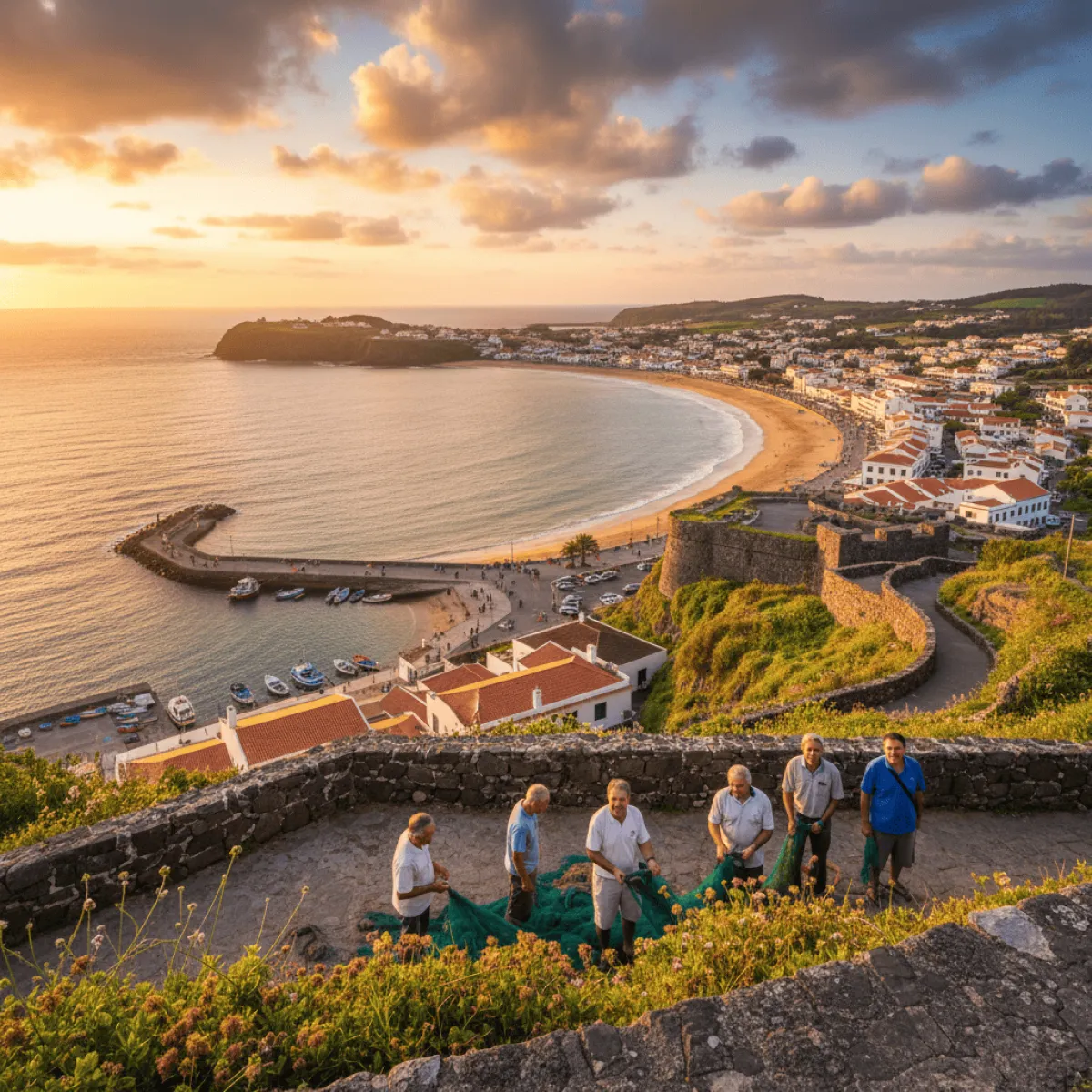
Let's start with the basics. Praia da Vitória has a bay that faces east. For anyone who shoots, that is both a gift and a curse. A gift because sunrise lands directly on the white sand, the dune cordon and the marina, creating that golden hour which here lasts, let's be honest, about 40 minutes before contrast becomes unmanageable. A curse because in late afternoon, when the rest of Portugal is photographing epic sunsets over the Atlantic, you have the sun at your back and a pale sky in front of you.
The solution is simple and unpopular: wake up early. Between 6:15 and 7:30 in summer, or 7:30 and 9:00 in winter, the light coming into the bay is the best you will find in the whole archipelago. Climb up to the Miradouro do Facho, on the southern edge of the bay, with a thermos of coffee in hand and the tripod already mounted, because the first five minutes after the sun crests the ocean cannot be repeated. The city is still asleep, the marina glitters, and the pale pink tones bouncing off the whitewashed houses on Rua de Jesus come out of the camera already edited.
Where to park and how to get up there
The Facho has paved road access and free parking near the top. By car it's eight minutes from the centre. If you don't have a vehicle, you can walk up (about 35 minutes with some incline) or, better, rent an e-bike and make this a layered plan. The e-bike tour through Praia da Vitória is, in my opinion, the smartest way to cover the southern viewpoints of the bay without arriving panting and sweating, which, trust me, does not help keep the camera steady.
Miradouro do Facho: the obligatory postcard, but only at sunrise
Let me be direct. Everyone shoots the Facho at sunset because the name sounds epic and because it's the most signposted viewpoint. It's a mistake. At the end of the day, the sun is behind you and the bay falls into flat shade, no depth. At sunrise, it's another story: the bay opens up in a half-moon, with Monte Brasil in the background (yes, you can see all the way to Angra do Heroísmo on clear days), and the Atlantic front receives light at the perfect vertical angle.
Bring a wide angle (24mm or wider) to capture the whole bay and a telephoto (70-200mm) for details of the commercial port and anchored ships. And bring a jacket, even in August. The wind at the Facho in the morning is not playing.
Serra do Cume: the view that will ruin every other view for you
If there is one single place in all of Terceira that justifies setting your alarm for 5:30am, it's Serra do Cume. Fifteen minutes by car from Praia da Vitória, the view from the lookout shows you the interior of the Terceira caldera: a mosaic of pastures divided by stone walls that, at first light, looks like a Mondrian painting done in green. I have seen photographers cry up there, and I'm not exaggerating.
The magic window
Good light here falls between 6:45 and 8:00 in summer, or just after the dawn clouds lift, usually between 9:00 and 10:00 in winter. The secret is to arrive before the sun and wait. When raking light crosses the valley, the stone walls cast shadows and the patchwork effect explodes in the camera. Bring a polarising filter. The Azorean sky without a polariser is, frankly, a waste of time.
Practical warning: the viewpoint is exposed and the wind crosses the ridge like it's in a hurry. A weighted bag for the tripod is worth its weight. And never, ever fly drones here without checking restrictions. We are close to the Air Base, which brings us to the next point.
Aviation, basalt and the military angle
Praia da Vitória has lived for more than eighty years with the presence of Air Base No. 4 (Lajes, for the locals). It is impossible to photograph the city without, sooner or later, a C-130 or a KC-135 passing low over your frame. And this, against all expectations, is one of the best things that happens here.
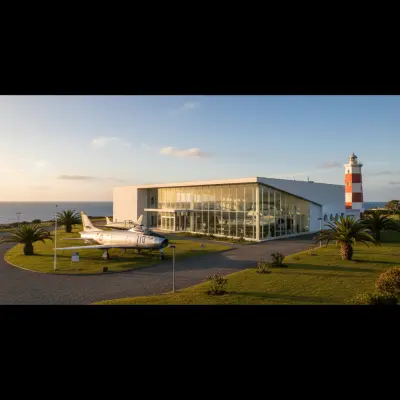
To understand why and how it works, take a photographic break and visit the Air Base No. 4 Museum Centre. It's not a long visit, but it gives you context, and in photography, context is everything. Knowing when training flights pass (usually mid-morning, Tuesday to Thursday) lets you plan compositions of the bay with a military aircraft as a detail. Check locally for hours and visit policy, as both depend on base availability.
Where to shoot aviation without bothering anyone
The Miradouro do Facho works, but the best angle, especially in late afternoon when the Hercules return from mission, is from the road that connects the city to Biscoitos, at one of the high points before dropping down to the north coast. Park safely, stay off the road, and have patience. Sometimes you wait two hours. Sometimes one passes every forty minutes. That's island life.
Biscoitos: the viewpoint nobody recommends
The north coast of Praia da Vitória, around Biscoitos, is technically the most beautiful corner of the municipality. I say technically because tour operators rarely take you there, which is luck for anyone who likes to photograph without elbows pushing. The natural pools of black basalt against the Atlantic blue are a chromatic contrast that even Adobe couldn't invent better.
Ideal light here inverts: sunset in Biscoitos is one of the few places on the east coast where it actually works, because the shoreline twists slightly to the northwest and catches the sun at a lateral angle. Arrive around 6:30pm in summer, 5:00pm in winter, and set up on the rocks (carefully, the basalt is treacherous when wet) overlooking the pools.
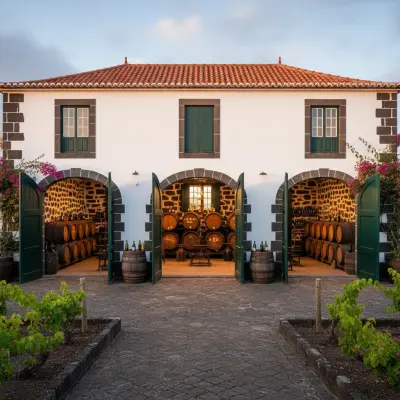
Between shots, take time to visit the Museu do Vinho dos Biscoitos, which tells the improbable story of Verdelho grown on slabs of volcanic rock, and is a few minutes' walk away. For the end of the day, close the loop with a craft beer right there. Brianda, the craft brewery in Biscoitos, is the kind of stop that makes photographic logistics bearable. Reward for the early wake-up.
The historic centre: lateral light and white streets
Back to the centre. Praia da Vitória has the distinction of being the only Azorean city where, in 1980, an earthquake destroyed half the housing stock and everything was rebuilt with architectural discipline. The result: white streets, black basalt door frames, and a visual uniformity that is violent at noon and poetic in late afternoon.
The streets worth walking
Rua de Jesus, Rua da Misericórdia and the area around the Igreja Matriz give you the best play of lateral light between 4pm and 6pm in summer, and between 2pm and 4pm in winter. The rule is simple: stand with your back to the side the light is coming from, and shoot the texture of the whitewashed walls with balcony shadows tracing the asphalt.
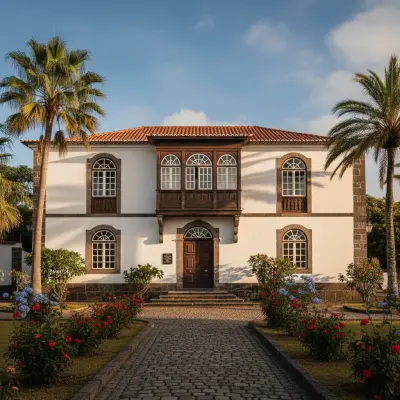
While you're there, it's worth visiting the Casa Museu Vitorino Nemésio, dedicated to one of the greatest Azorean writers. It's not necessarily a photo spot (the interior has rules), but it gives you an hour of literary context that changes how you photograph the island once you walk out. Check locally for opening hours, which vary seasonally.
The cloud question: friend or foe
The Azores have clouds. Lots of them. Different every hour. For an unprepared photographer, this is a nightmare. For someone who gets it, it's the island's biggest asset. A photograph of the Praia da Vitória bay under a flat blue sky is, frankly, dull. With low cumulus slicing the sun in diagonals, it's magazine cover material.
Practical rule: look out to sea in the morning. If there's a line of clouds on the horizon, wait 20 minutes, you'll have dramatic light guaranteed once the sun pierces the layer. If the sky is clear, shoot fast, because the midday haze will flatten everything.
Gear: what to bring and what to leave behind
- Camera with good dynamic range. The sun-shadow contrast in the Azores breaks older sensors. A modern full-frame or a decent mirrorless solves it.
- Small, light tripod. For sunrise at the Facho and for the Serra do Cume. Indispensable.
- Circular polarising filter. Already said it, will say it again. Without it, the Azorean blue washes out.
- Graduated ND filter. Useful at sunrise and for long exposures over the Biscoitos pools.
- Windproof jacket, even in August. The wind cost me the shot of the year in 2023. Don't do what I did.
- Waterproof bags. Humidity here is sneaky. Silica in every pocket, always.
Honest logistics: hotels, meals and how much time you need
To do this properly, count two full days in Praia da Vitória, three if you want to include Serra do Cume twice (worth it, the light is never the same). Decent hotels in town run between 70 and 110 euros in shoulder season, more in peak. There are local guesthouses in the white houses of the historic centre that cost the same and put morning light at your doorstep. Book ahead: July and August fill up.
For meals, avoid the marina restaurants at lunch, which live off cruise passengers and show it on the bill. Climb up to the older zone, find a tasca where they serve alcatra (the traditional Terceira beef stew, cooked in a clay pot), and ask for the local red. Check locally for hours and weekly closing day, which varies.
What if the weather refuses to cooperate?
It will happen. Azorean meteorology is, let's say, creative. When the rain settles in for good, switch plans: do the museum, read, organise the previous day's photos. There's no shame in resting. And if the rain lasts two days, consider a hop by plane to another island. Faial is 35 minutes by air, and I have two guides that can help: 24 hours in Horta to grasp the rhythm of the Faial capital, and the finest rooftops in Horta to keep chasing light, just with a different palette. If you want to drop further south, the gastronomy of Ponta Delgada will feed you well while you wait for the sky to decide.
The summary, in three lines
Sunrise at the Facho. Serra do Cume with wind and patience. End the day with black basalt, sea and beer in Biscoitos. Forget the photogenic sunset you saw on other islands, Praia da Vitória is a morning-light city and the rest is training. Good shooting.