Peso da Régua Cafés: What to Order at Each One
Everyone comes to Peso da Régua for Port wine and almost nobody notices the cafés. Big mistake: here you still order espresso in a small glass cup, still dunk bread in the coffee, and breakfast costs 2.50€.
There is an awkward truth about Peso da Régua: everyone comes here for Port wine and almost nobody notices the cafés. Big mistake. This small town, leaning against the river and crossed by the Douro Line train, has a counter-style café culture that has survived intact while Lisbon converts to third-wave specialty roasts and Porto fills up with bearded baristas. Here you still order an espresso in a small glass cup, you still dunk your bread in the coffee, and there are still old men in flat caps who spend the entire morning at the counter discussing the harvest.
What follows is not an exhaustive inventory. It is a walking route, with strategic stops for breakfast, mid-morning, after lunch, and that last small beer that in Régua is called an imperial and costs, almost everywhere, less than two euros. If you are in a hurry, skip to the section on what to order at each place. If you like context, stay. It is worth it.
Why the cafés and not the wine estates
The Douro estates have full-time PR people and oenologists. The Régua cafés have a woman called Dona Conceição who knows your name by the third coffee. The difference matters. At an estate you pay twenty euros for a tasting and leave knowing more about grape varieties. At a Régua café you pay eighty cents and leave knowing more about the town: who is sick, which baker is best this week, where the last schist wall collapsed, which road is closed because of construction. It is the local information infrastructure, and it still works.
Add to this that breakfast at a Régua pastry shop costs between 2.50€ and 4€. Compare this with what you pay in Gaia for a cappuccino and a slice of industrial cake. There is no contest.
The route, starting on the Avenida
The central axis of Régua is Avenida do Douro, parallel to the river. This is where most of the café life is concentrated, especially between the Cais da Régua (where the tourist boats dock) and the train station. Start early in the morning, ideally before nine, when the boats have not yet arrived and the town belongs to its people.
Pastelaria Avenida: the honest espresso and the warm custard tart
Do not confuse this with chain shops of the same name. The Pastelaria Avenida in Régua is an institution with a long counter, a glass case full of fresh pastries, and a coffee machine that works without rest. Order an espresso and a pastel de nata, but only order the pastel de nata if you arrive before ten thirty, when they still come out of the oven warm. After that, they are the same as anywhere else.
What sets this place apart is the folar and the bolo de arroz. The folar transmontano, dense, with chouriço and presunto baked into the dough, costs around 1.80€ a slice and is essentially a disguised lunch. The bolo de arroz here is small and lightly burned on top, exactly as it should be. Drink it down with a galão if you want to stretch out the visit.
Café Império: for the mid-morning meia de leite
Halfway down the Avenida, with a view of the river, Café Império has outdoor tables and staff used to tourists who order everything in English. Do not worry about it. Sit at any table, order a meia de leite (do not say "café com leite", here it is meia de leite), and a torrada. Régua toast is generally made with sliced sandwich bread, generous butter, and a hot press. It is not gastronomy, it is fuel, and it works.
Practical advice: if you come on weekends between April and October, avoid the tables facing the river between eleven and one. They fill up with cruise groups, they wait forty minutes for a ham and cheese sandwich, and then they complain. Inside, at the counter, service is methodical and fast.
Casa do Pão: the mid-morning stop
This is not strictly a café, it is a bakery, and that is precisely what makes it useful. It has fresh corn broa, it has Serra cheese (cut to order, sold by weight), and it has proper bolas de Berlim with dark yellow cream, the kind that stains the napkin. A bola de Berlim at Casa do Pão and a simple coffee for under 2€ is the breakfast of the railway engineers, and you will still find three or four of them at the counter today.
The lunch pause (and the coffee that follows)
Here we need to detour from the café route because, let us be honest, in Peso da Régua what you eat for lunch matters as much as what you drink afterwards. The choice depends on budget and mood.
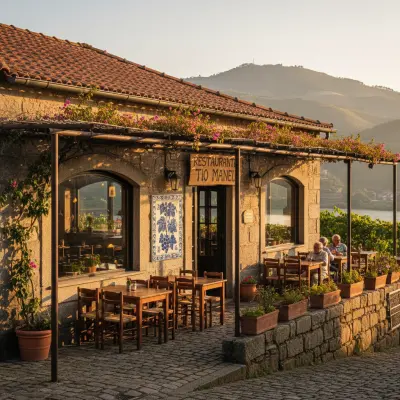
If you want a serious lunch, with house wine and three courses for less than fifteen euros, go to Restaurante Tio Manel. Cooking without frills, bacalhau Tio Manel style when available, posta de vitela on good days. The station café staff eat there and that tells you everything. If you are looking for something more informal, more tavern-style, order a pernil sandwich or a dose of tripas at Tasca da Quinta. It is not for honeymoon couples, it is for people who want to eat well and cheaply. And if the trip is a birthday, or if you have someone visiting you want to impress, book at Castas e Pratos, right next to the station, with more elaborate cooking and a Douro wine list that puts most places to shame.
After lunch, and this is important, the coffee is taken standing at the counter. Sitting down for a post-lunch espresso is a sign of someone who has nothing else to do that day. Régua locals drink it standing, in three gulps, with one and a half sugars.
Afternoon: the cafés no guidebook recommends
Café Central: what survived
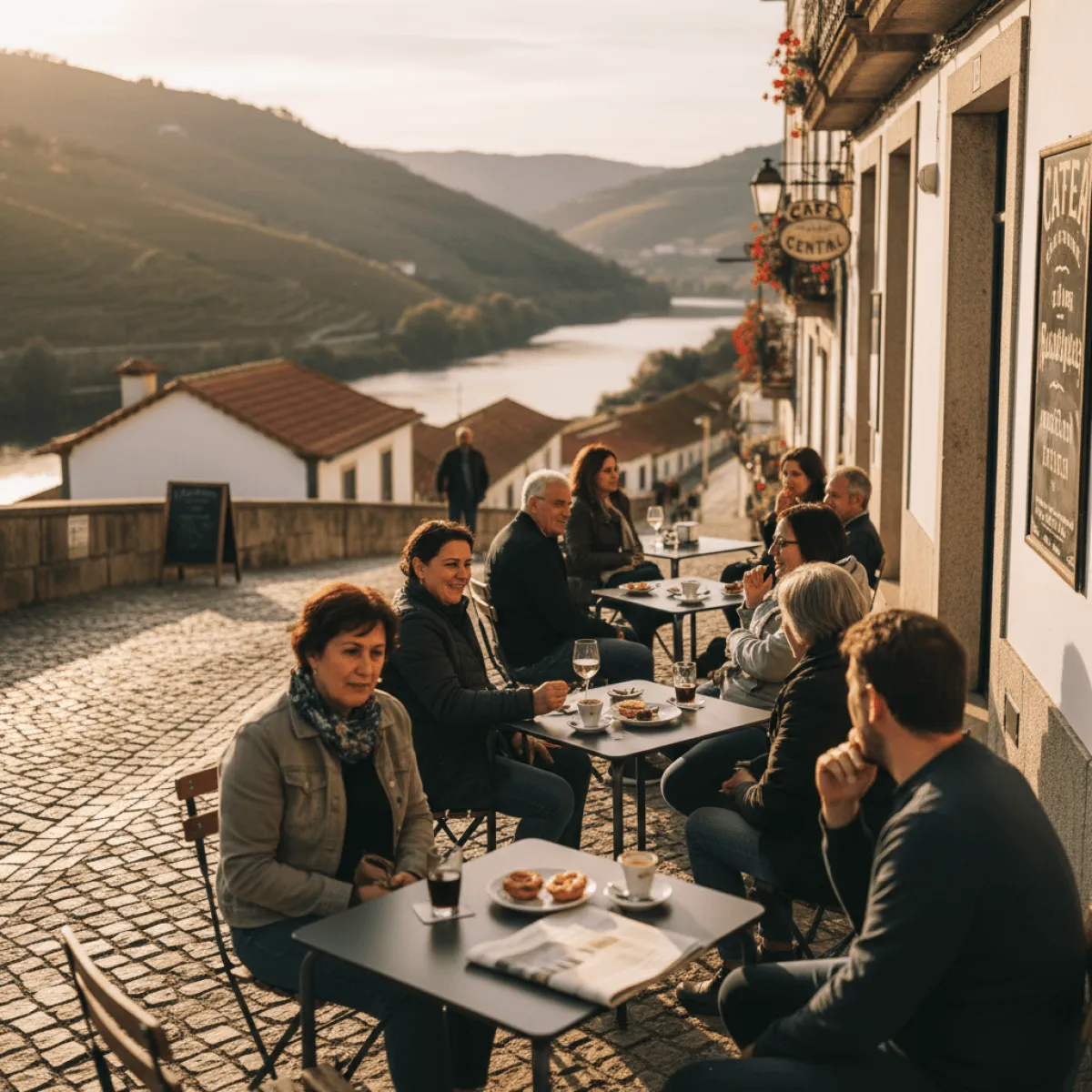
On a street parallel to the Avenida, far from the cruise line queue, sits Café Central. No new sign, no plastic-coated menu card, no card machine on every table. It is where the retirees gather to play sueca card games after three in the afternoon, and where an espresso costs around eighty cents. Order also a small glass of sweet moscatel, if you want to understand why the older people in this town live to ninety.
Unsolicited advice: if you play any card games, be prepared. They will invite you. Accept. It is the best way to learn the human geography of Régua in forty-five minutes.
The kiosk at Jardim do Cais: for good weather
In the Jardim do Cais, next to the Museu do Douro, there is a small kiosk that sells coffees, beers, and ice creams. It has no famous café name, it has no awards, and that is exactly the point. Sit on one of the benches facing the river, order a double coffee, and watch the boats go downstream. It is the cheapest way to do tourism in the Douro: two euros and an hour of landscape.
If you come in May or June, the garden is full of jacarandas in bloom, and there is a light at five in the afternoon that turns everything violet. Worth the detour. If you want to understand what is happening in the vineyards at that time of year, read afterwards about the vineyard budbreak at Quinta do Vallado, which coincides exactly with this jacaranda blooming period.
Late afternoon: the six o'clock imperial
There is a ritual in Régua, and across most of the Douro, called "a imperial das seis". It happens between five thirty and seven, depending on the season. It means walking into any café, ordering an imperial (Super Bock or Sagres, depending on the place), and spending about twenty minutes watching the sun go down over the river. Pair with lupin beans or peanuts. It is not a meal, it is a transition.
The best places for this, in my opinion, are three. Café da Estação, right opposite the railway line, for people who like to watch the train arrive from Pocinho. The terrace at Café Império, if you can get a table, for people who like to watch the river. And, for those willing to walk ten minutes, Café do Cais, by the new boarding pier, quieter, with colder beers and less rush.
Total cost of the operation: between 1.50€ and 2.20€ per beer. If you order a second, they will treat you well. If you order a third, they will remember you next time.
The station café: a category of its own
The Café da Estação at Régua train station deserves its own paragraph. It is not the best café in town. It does not have the best pastel de nata. The service is sometimes brusque. But it is, without doubt, the most cinematic café in Régua. It has tables facing the tracks, an old ticket machine in the corner, and customers who are an impossible mix of lost tourists, railway workers on break, and women coming back from the Lamego market.
Order a coffee and a shrimp rissol. The rissol is industrial, but they fry it on the spot and it comes out crispy. Watch the Régua to Pocinho train arrive, which leaves on the hour and is one of the most beautiful train journeys in Europe for less than fifteen euros. Even if you are not getting on it, watching it leave has something moving about it.
When to come and what to avoid
The best time for the Régua cafés, apparent paradox aside, is outside the high cruise season. From October to April, except for the September harvest period, the town belongs to the reguenses. Prices drop, service is more conversational, and there is time to ask questions. From May to September, especially on weekends, prepare to wait.
If you come in summer and want to escape the groups, there are two strategies. First: drink your coffee very early, before nine, before the boats. Second: take a detour to one of the nearby towns. You can go to Sabrosa, with its lesser-known estates, or even further afield, perhaps timed with the schedule of the Santos Populares in June in the deep Douro. In any of these places, the cafés are smaller, slower, and cheaper.
For those who prefer to combine morning coffee with a more structured plan, consider starting the day with a spring wine tasting, leaving around lunch time, and returning to the cafés in the afternoon for that six o'clock imperial ritual. It works. It has been tested.
How to get here and where to park
Régua has a train station on the Douro Line, with direct connections to Porto (São Bento and Campanhã) in about two hours. It is by far the best way to arrive. By car, you come via the A4 to Vila Real and then the N2, or via the N222 from Porto (more landscape, more time). There are parking lots near the Cais and the station, with low rates, around 0.50€ per hour.
If you come by train, you are literally three minutes on foot from almost all the cafés mentioned. If you come by car, leave it and walk. Régua is small, flat by the river, and life happens within four hundred linear meters.
The summary, for those in a hurry
- Breakfast: Pastelaria Avenida (folar and warm pastel de nata) or Casa do Pão (bola de Berlim and broa).
- Mid-morning: Café Império, meia de leite and torrada, at the counter if you want to be quick.
- After lunch: espresso standing up, at any of the above, three gulps and move on.
- Afternoon: Café Central, for the sueca card games and the moscatel; or Jardim do Cais kiosk for coffee with a view.
- Six o'clock imperial: Café da Estação, Café Império, or Café do Cais.
- Total cost of a full day of coffee and pastries: between 10€ and 15€. No rush, no excess.
And if you still have curiosity left for other stops, there is spring flora scattered across the Upper Douro, especially in Torre de Moncorvo in bloom. But that is another trip, another article, and another coffee.