Montalegre's Friday the 13th: Real Witchcraft or Theatre?
At 1000 metres altitude with 30,000 people storming the castle, Montalegre's Friday the 13th is half documented folklore, half territorial marketing invented in 2002. Here's how to tell the original from the copy, and why the winter edition is worth ten times the summer one.
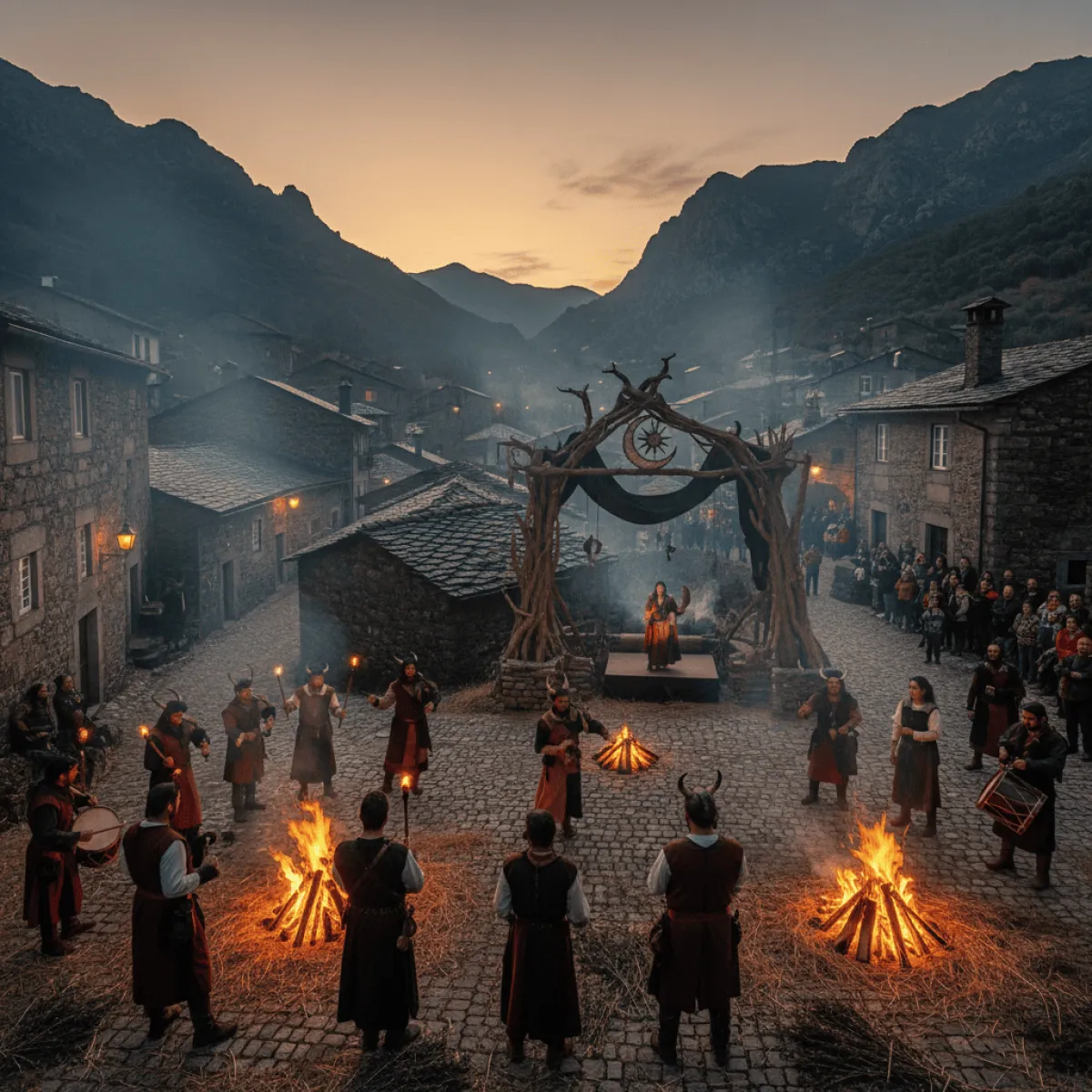
There's something nobody mentions about Friday the 13th in Montalegre: most of the people packing the castle square have never read a single line about the witches of Barroso before booking the trip. They come for the spectacle. They leave arguing about whether what they saw was repurposed folklore for the tourism economy or whether, deep down, some people still believe. The honest answer is both, simultaneously, and that's exactly what makes the night interesting.
I've been three times. First out of journalistic curiosity, second because a friend from Chaves insisted, third because I wanted to see what changed when it rained. Everything changed. When fog drops over the plateau at seven in the evening and the temperature falls to four degrees Celsius, the castle stops looking like a stage set and starts looking like what it actually is: a medieval fortress where, for centuries, real people were tried for sorcery. There are inquisition records. There are names. There are women who were burned alive. That part isn't theatre.
The historical context the town hall doesn't advertise
Montalegre has ten thousand inhabitants across the entire municipality and sits at 1000 metres altitude, pressed against the Spanish border in the far north of Trás-os-Montes. It's one of the most isolated regions of mainland Portugal. Until the 1980s, many villages in the Barroso area didn't have paved roads. That combination, isolation, brutal cold, intense rural Catholicism, created fertile ground for beliefs that elsewhere had already faded.
What the town council sells as a festival is, originally, an intelligent recycling of oral traditions documented by the ethnographer Jorge Lameiras in the 1990s. Werewolves, witches who entered through chimneys, spells to cure cattle: this was winter conversation by the fireplace until thirty years ago. There are audio recordings. There are books. None of it was invented to sell hotel rooms.
What is theatre is the rest: the procession, the choreographed bonfires, the actors in black hoods, the staged black mass in the castle courtyard. All of that was built from 2002 onwards, when the mayor Orlando Alves realised he had a brand on his hands. The first edition drew 500 people. The last one I attended drew around 30,000. It's one of the most successful examples of territorial marketing in inland Portugal, and almost nobody in Lisbon knows it exists.
When to go, and when not to
The festival happens on every Friday the 13th in the calendar, which means there can be one, two, or three per year. Dates vary wildly: some years it's in January, others June, October or November. The rule I learned the hard way: winter editions are infinitely better. In June or August, the square fills with families and children, there are stalls selling cotton candy and sausage rolls, and the atmosphere drifts closer to a midsummer fair than a witches' night.
January, February or November editions have something else entirely. It's properly cold, the rain comes in sideways, the crowd is smaller and more committed. You see people from Porto and Madrid, but also plenty of locals in muddy boots who come because it's tradition. If you have a choice, go in winter. To understand what you're watching, read our companion piece on the Witches' Night Festival, which breaks down the running order and tells you where to stand at which hour.
The programme, decoded
Official programming starts around 6pm with live music in the town square. Ignore that. Show up around 8:30pm, when the procession begins its march from the council building up to the castle. It's the most photogenic moment, but also the most crowded. If you want a good vantage point, climb up to the castle by 7:30pm and stake out a spot along the southern wall. You'll catch the procession arriving and have a view down to the Cávado valley behind.
Midnight is the so-called burning of the witch, which in practice is a brief staged scene with controlled fire. It lasts fifteen minutes. Honestly: see it once, you've seen it. There's no point freezing until two in the morning waiting for an encore that never comes.
Where to sleep, no illusions
Here's the practical problem nobody anticipates: Montalegre has hotel capacity for around 200 people. On Friday the 13th nights, 30,000 show up. The arithmetic is cruel. The two or three hotels in town sell out six months in advance, and prices triple. Booking a week ahead is impossible.
The solution I recommend is staying in Gerês or on the edge of the National Park, about 40 minutes by car. The Hostel Retiro do Gerês is what I use when travelling solo or with a friend: dorm bed at a civilised price, breakfast included, and the location lets you combine the witches' night with a hike in the Gerês mountains the next morning. The owners know about Friday the 13th and are used to guests arriving at two in the morning smelling of bonfire smoke.
If you're driving, leave the car at the Municipal Stadium car park and walk up. Trying to park near the castle on festival night will cost you an hour you won't get back.
What to eat (and what to skip)
This is where I have strong opinions. The square stalls sell hot dogs and fried dough. Ignore them. You're in Trás-os-Montes, the region with arguably the best beef in Portugal, and there are restaurants 200 metres from the castle serving the real thing.
What you actually need to try in Montalegre, festival or no festival:
- Carne Barrosã DOP: the native cattle breed, raised free-range. Order it grilled, rare, with coarse salt. Don't ask for it well done. It's a crime against the cow and against yourself.
- Cabrito assado: kid roasted in a wood-fired oven, the regional Sunday lunch. Some places still use communal village ovens.
- Presunto de Barroso DOP: cured ham produced at altitude, slow-aged, drier and less fatty than the Alentejo version. Order it as a starter with rye bread.
- Feijoca do Barroso: large white beans stewed with chorizo and cabbage. Winter food, perfect after a night at the castle.
- Chouriça doce: sounds odd, tastes better than it sounds. Honey, bread and chorizo cooked together.
What to avoid: anything called a "witch's plate" or "Friday the 13th special menu". That's an inflated tourist menu. Order from the regular carte and pay half the price.
Beyond the festival: the Montalegre that stays
The mistake of visitors who come just for the witches' night is leaving on Saturday morning. Montalegre is worth two or three days, and most of what's best about it has nothing to do with witchcraft.
The medieval castle that serves as the festival's stage is open during the day and offers one of the finest views in northern Portugal. Entry is paid but cheap, around three euros. Climb the keep before ten in the morning, before the tour buses arrive. The full breakdown of what to see in the municipality is in our guide to Montalegre beyond Barroso, which maps out the sites worth driving an extra hour for.
If your visit coincides with dry weather, there's something few visitors realise: the Alto Rabagão reservoir, fifteen minutes from the centre, is one of the best paddling waters in northern Portugal. Kayaking the Alto Rabagão in the morning, with mist still clinging to the shoreline, justifies the trip on its own. Equipment rental is available near the dam, and the water is cold even in July. Bring a fleece.
For photographers, I'd dedicate a morning to the villages of Pitões das Júnias and Tourém, with their communal ovens and thatched roofs. Our winter photography itinerary on the plateau has the right hours for the light and the less obvious viewpoints.
A note on the rest of the Trás-os-Montes plateau
If you're coming from far away, it makes sense to combine Montalegre with other stops in Trás-os-Montes. Mogadouro, on the far side of the Tua river, is one of the most underrated towns in inland Portugal, and our piece on Mogadouro's sunset viewpoints gives you a third-day plan. The logistics aren't trivial, it's two and a half hours by car from Montalegre, but if you've already done 400 kilometres from Lisbon, another 200 won't scare you.
So, is it real or staged?
The question I opened this piece with deserves an honest answer, now that I've given you the context.
The festival as public spectacle is theatre, yes. It was created in 2002, it's choreographed, it has sponsors, and the actors you see in black hoods are neighbours who during the day work at the council or in the restaurants. The fire is controlled, the black mass is staged, and most of the visual iconography is an intelligent collage of generic European pagan elements.
But the stories underneath are real. The witches of Barroso lived in popular imagination for centuries. The Inquisition cases against women accused of sorcery in this region are archived in Lisbon, you can request them. Belief in werewolves, in the evil eye, in folk healing, was current in my grandparents' generation, and there are still those who believe, though fewer and more quietly.
The best way to experience Friday the 13th is therefore with this double consciousness: accept the spectacle as spectacle, while understanding that you're in a place where these stories were once a matter of life and death. When you climb the castle at midnight, look out beyond the wall into the dark of the plateau. Out there, thirty kilometres away, are villages where the lights go out at half past nine and where, fifty years ago, people still told the stories that the council now sells on a poster. It's that tension, between the original and the copy, between belief and representation, that makes the trip worthwhile. And yes, it is worthwhile.