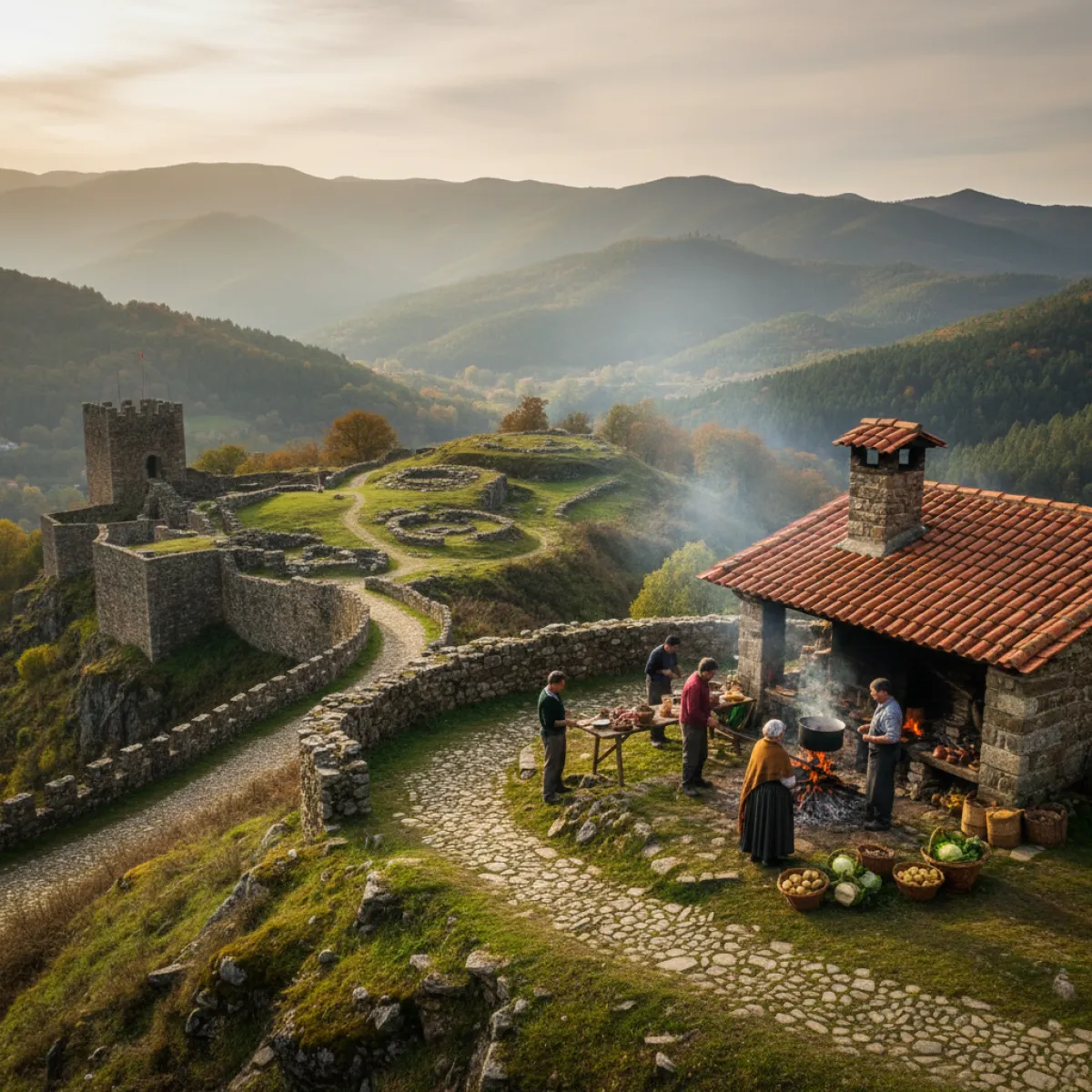
Montalegre Beyond Barroso: Castle, Castro and Mountain Kitchen
Montalegre has a 14th-century castle with views to the Gerês mountains, an Iron Age hillfort that almost nobody visits, and a barrosã steak that justifies the drive. A complete guide to the most underrated town in Trás-os-Montes.
Montalegre sits on a windswept plateau in northern Portugal's Barroso region, roughly ninety minutes northeast of Braga. Most Portuguese know it vaguely, something about cold weather, a Friday the 13th festival, and smoked meats. Most foreign visitors don't know it at all. Both groups are missing out, because Montalegre packs a medieval castle, an Iron Age hillfort, and one of the country's most underrated mountain kitchens into a compact, no-nonsense town that rewards anyone willing to drive the extra hour past the usual suspects.
The Castle: Montalegre's Centre of Gravity
The Castelo de Montalegre isn't Portugal's most dramatic fortress, it doesn't have the scale of Guimarães or the coastal drama of Óbidos. What it does have is a 14th-century keep that functions as the town's reference point, both literally and symbolically. Climb the tower (the entrance fee is modest, check locally for current pricing) and you'll understand immediately why someone built a fortress here. The plateau unfurls in every direction, Serra do Larouco rises to the north, and the Spanish border hovers just beyond the hills.
On a clear day, you can see the Gerês mountains. There's rarely a queue, and the interior is more atmospheric than museum-polished. If you're in Montalegre and skip the castle, you're missing the best free viewpoint in Trás-os-Montes.
Castro de São Vicente: The Other Montalegre
A few kilometres from town, the Castro de São Vicente da Chã is one of northern Portugal's most interesting, and least visited, Iron Age hillforts. We're talking a fortified settlement with visible dwelling structures, defensive walls, and a landscape setting that puts most museums to shame. It's classified as a National Monument, but don't expect an interpretive centre with a gift shop. This is a proper archaeological site: stone, wind, and you.
If you've been exploring the Roman thermal legacy in Chaves, the Castro de São Vicente takes you even further back, from Romanisation to proto-history. The road is decent but don't expect perfect tarmac for the final stretch. Wear proper shoes, and in winter, add a serious layer. It sits above 1,000 metres and the wind up there has opinions.
What makes this castro special isn't just the archaeology, it's the position. Elevated, exposed, with sweeping valley views and a genuine sense of isolation. No ticket booth, no opening hours. You show up, explore, and leave with the quiet realisation that 2,500 years ago, someone stood on the same spot and thought: this is the place.
The Kitchen: Smoked Meats and Then Some
Montalegre is Barrosã territory, home to the indigenous cattle breed that produces some of Portugal's finest beef. The posta barrosã is the signature dish: a thick steak grilled over charcoal, seasoned with coarse salt and not much else, served with smashed potatoes. This is mountain beef from animals that graze at altitude, and you can taste the difference. If you go to Montalegre and don't eat posta barrosã, you haven't been to Montalegre.
But the local kitchen runs deeper than steak. The cozido barrosão is a monumental affair, sausages, pork cuts, chicken, cabbage, potatoes, chickpeas, everything slow-cooked and served in quantities that challenge human anatomy. This isn't diet food. It's winter food, altitude food, food for people who work in the cold. At restaurants in town, order the cozido in advance, many places only prepare it on request or on specific days.
The smoked meats deserve their own paragraph. Alheiras, salpicões, presuntos, in Montalegre, these are made with bísaro pork, another indigenous breed, and smoked with oak wood. If you've already experienced the alheira tradition in Mirandela, you'll find Montalegre's version rougher, less standardised, more directly connected to the farmhouse where it was made. Buy directly from local producers, at the municipal market or at regional fairs, and avoid the plastic-wrapped versions at petrol stations.
To wash it down, there's Vinho dos Mortos, literally, Wine of the Dead. The story goes like this: during the Napoleonic invasions, locals buried their wine to hide it from French soldiers. When they dug it up, the underground fermentation had produced a naturally sparkling wine. Today it's a protected designation and available at several restaurants in the region. It's light, fizzy, and pairs surprisingly well with smoked meats.
Friday the 13th: Worth the Trip?
Montalegre hosts the biggest Friday the 13th celebration on the Iberian Peninsula, a chaotic mix of the esoteric, medieval fairs, live music, and a general carnival atmosphere. The town fills to capacity. Literally. If you happen to land on a Friday the 13th, prepare for crowds, inflated prices, and a parking situation best described as creative. Worth it? If you enjoy popular festivals with a streak of the absurd, absolutely. If you're looking for quiet, authentic Montalegre, come another time.
The best seasons to visit are autumn (October–November, when the colours shift and fresh smoked meats start appearing) and late winter (February–March, when the snow has mostly retreated but the cold still justifies a cozido). Summer is surprisingly pleasant, cool evenings, an unhurried pace, and a welcome contrast to the overheated Algarve.
Getting There and Staying
Montalegre isn't easy to reach, and that's part of the appeal. By car, count on roughly ninety minutes from Braga via the A7 and then the N103. Public transport exists, Rede Expressos runs buses, but schedules are limited and connections infrequent. A car is practically essential, especially if you want to explore the surroundings: the castro, the villages, the plateau landscapes.
Accommodation in town runs to a handful of hotels and rural tourism properties in the surrounding area. Don't expect luxury or endless choice. Book ahead if you're coming for Friday the 13th or the Feira do Fumeiro (January's smoked meat fair), which are the peak periods.
If you're building an itinerary through Portugal's northern interior, Montalegre pairs naturally with Chaves (forty-five minutes away) and with a detour into the Montesinho Natural Park to the northeast. These are territories with different personalities but a shared mountain logic: granite, smoke, distance, and a hospitality that doesn't need a customer-service smile to feel real.
What to Bring Home
Smoked meats, obviously. Salpicão and alheira barrosã are the safe bets. A bottle of Vinho dos Mortos if you can find one, production is limited and it's not available everywhere. And if you have room in the car, Barroso honey, the region is one of Portugal's best beekeeping areas and the heather honey is particularly good.
Montalegre doesn't need slick marketing or influencers filming reels at the castle. It needs visitors with time, curiosity, and appetite. If you've got all three, go. If you've only got two, go anyway, the appetite shows up the moment you smell posta barrosã on the grill.