Mirandela: A Photographer’s Guide to the Tua’s Best Light
Mirandela is a labyrinth of reflections on the Tua River and centuries-old granite. Discover the viewpoints where the Transmontano light transforms the city into a photographer's dream, far from the tourist traps.
The Water Mirror and the Transmontano Obsession
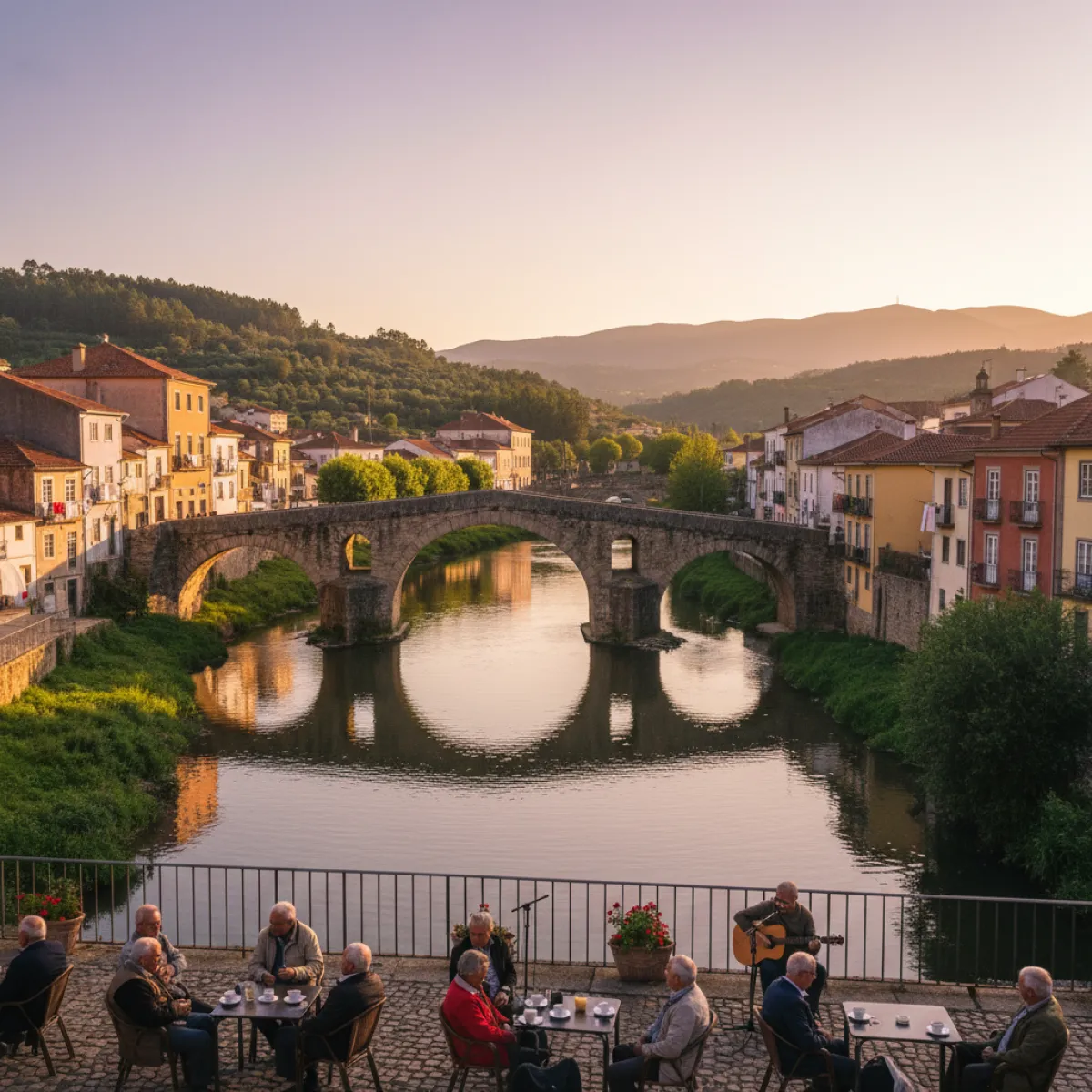
Arriving in Mirandela requires a certain detachment from the conventional tourist expectations that dominate the Portuguese coast. Here, in the heart of Trás-os-Montes, aesthetics aren't served on a silver platter; they are earned by the attentive observer. The Tua River, which cuts through the city with an almost hypnotic serenity, acts as the region's largest natural reflector. If you want the perfect shot, forget midday. Mirandela’s light is unforgiving under a high sun, turning granite and concrete into a contrastless grey mass. The secret lies on the banks, in the morning mist rising from the river and the long shadows that dusk casts over the Old Bridge (Ponte Velha).
Many visitors make the amateur mistake of treating the city as a technical pitstop to grab an alheira sausage and keep driving. To understand the visual composition of this land, you must climb. Mirandela is a city of levels, where 16th-century architecture in the historic center coexists with modernist expansion, all under the watchful gaze of the surrounding mountains. Photography here isn't just about landscape; it’s about the geometry of power and survival in a territory that was never easy.
Miradouro do Paço dos Távoras: The Perspective of Power
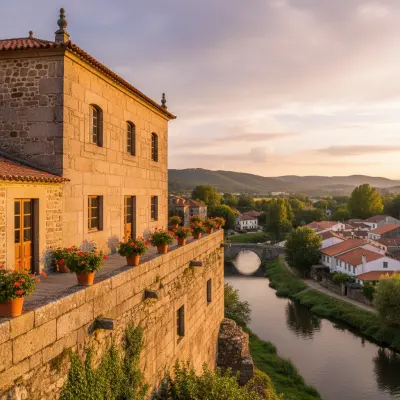
At the top of the hill dominating the old core, the Miradouro do Paço dos Távoras offers what is arguably the most structured view of the city. The building itself, an imposing example of 16th-century manorial architecture, now housing the City Hall, serves as a frame for what stretches out below. From here, the view over the Tua is frontal and absolute. It is the ideal spot for those seeking to capture the city’s symmetry.
When to go: Late afternoon, about an hour before sunset. The light hits the facades of the historic center sideways, highlighting the textures of iron balconies and carved stone. If you’re lucky with the wind, the Tua will be dead still, creating a perfect mirror of the gardens on the left bank. It’s an exercise in patience: wait for the bridge lights to flicker on while the sky still holds a deep blue tone. This is the "blue hour" that separates tourists from serious photographers.
Pro Tip: Don't limit yourself to the panorama. Use a 35mm or 50mm lens to isolate the overlapping clay-tiled roofs heading toward the river. There is an organized disorder in those rooftops that tells the story of Mirandela’s organic growth much better than any wide-angle shot ever could.
Miradouro da Igreja de São Bento: The Vanishing Point
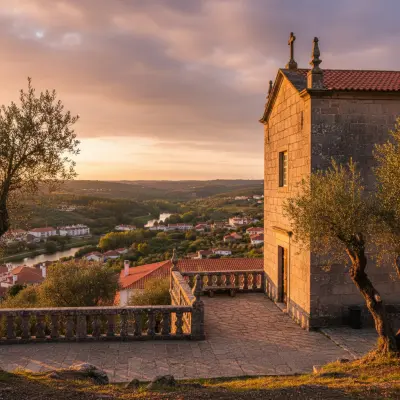
If Paço dos Távoras is about the city, the Miradouro da Igreja de São Bento is about the city’s relationship with the valley. Located at a higher point and slightly further from the riverbed, this viewpoint requires a bit more effort to reach, but the reward is a depth of field you won’t find in the center. From here, Mirandela reveals itself as a green enclave in a territory that, in summer, leans toward ochre and burnt brown.
The Church of São Bento, with its Transmontano sobriety, provides the perfect foreground. The light here is particularly interesting in the early morning. In autumn and winter, the Tua valley is often invaded by fog banks. If you arrive at 7:30 AM, you’ll see only the mountain peaks and the church tower emerging from a white sea. As the sun rises, the mist dissipates, and the city appears, washed and crisp. It’s a dramatic transition that deserves a time-lapse or, at least, a series of long exposures with an ND filter to smooth out any residual movement in the sky.
Miradouro de Franco: The Endless Horizon
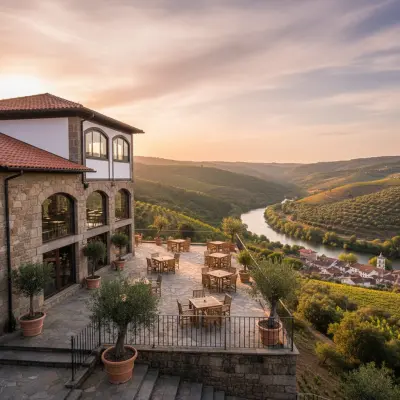
For those not afraid to drive a few extra kilometers, the Miradouro de Franco, located in the parish of Franco and Vila Boa, is the antidote to urban claustrophobia. We are about 15 kilometers from the center, at an altitude that allows us to see the curvature of the earth, or at least the infinite succession of mountain ridges that define the Northeast of Portugal. This is the place for pure landscape photography.
From this vantage point, the human scale disappears. What we see is the force of geology and the persistent mark of agriculture: schist, olive trees, and small patches of vineyard that insist on surviving the steep slopes. It is a place of absolute silence, interrupted only by the wind. To capture the essence of Franco, your gear must change: a wide-angle lens to embrace the horizon and a heavy tripod. The wind here does not forgive shaky hands.
The Right Light: This is a twilight viewpoint. When the sun dips behind the mountains toward Vila Real, the sky ignites in a palette of oranges and purples that seems unreal. It’s the light painters have tried to capture for centuries, manifesting in Franco with a disarming rawness. Don't look for detail; look for the silhouette of the mountains against a sky on fire.
Beyond the Lens: What Really Matters
No one survives on light and the rule of thirds alone. Mirandela is a city felt in the stomach before it’s seen in the viewfinder. After a morning photo session at São Bento, the mandatory stop is a local bakery for rye bread still warm from the oven. The scent of yeast and woodsmoke is the official perfume of the city before 9:00 AM.
As for food, the alheira is the obvious choice, but beware of traps. In the center, dozens of establishments serve industrial versions aimed at bus tours. If you want the real experience, where the fat of the Bísaro pig and the scent of holm oak smoke are felt in every bite, you must read our guide Beyond the Alheira: Mirandela’s Culinary Resilience. We explain where to find the artisanal production that still respects time and tradition, far from the artificial glow of plastic restaurants.
And if your appetite for Trás-os-Montes isn't sated, use Mirandela as your base. The city is strategically positioned. Head north, and you’ll enter the wild territory of Bragança. We highly recommend reading The Silence of Montesinho: A Winter Retreat in the Last Frontier of Portugal to see how the light changes drastically as you climb the mountains. If you prefer something more therapeutic, head west to Chaves. The guide The Roman Legions' Legacy: Exploring the Ancient Thermal Springs of Chaves will provide the historical context needed to photograph the Roman ruins and the bridges over the Tâmega.
Practical Logistics for the Photographer
- Transport: A car is essential for reaching Franco. For the central viewpoints, your legs are the best tool. Be prepared for steep climbs on Portuguese pavement, which can be slippery when damp.
- Parking: In central Mirandela, it’s controlled chaos. Try the lot by the river near the Europe Bridge and walk from there.
- Cost: Shooting is free, but a good coffee and a Pastel de Mirandela (yes, they exist and are delicious almond and squash-based treats) will cost you about €2.50.
- Gear: A circular polarizer to manage reflections on the Tua and a microfiber cloth. The dust from secondary roads in Trás-os-Montes has a special affinity for camera lenses.
Mirandela does not reveal itself to those in a hurry. It is a city that requires you to lower your guard and learn to read the river. When the light sets on the Tua and the silhouettes of the weeping willows project onto the water, you realize that beauty here isn't an ornament, but a condition of existence. Put the camera away for five minutes, order a glass of generous local wine, and just watch. Sometimes, the best photograph is the one you decide not to take.