Grilled Sardines in Évora: The June Truth
Évora sits ninety minutes from the sea and is no sardine town. But in June, with the Santos Populares, the rule breaks: grill smoke fills the neighborhoods beyond the walls. Here's when to come, where to eat and why to skip the central square's tourist menus.
Let's start with a confession no tourist brochure will make for you: Évora is not a sardine town. It sits ninety minutes from the nearest sea, in the dry heart of the Alentejo, where tradition demands black pork, açorda, migas and lamb stew. Show up at Praça do Giraldo expecting Lisbon's smoking grills and you'll leave disappointed eleven months of the year.
Eleven. Because there's one month, June, when the rule breaks. When the Santos Populares arrive, Saint Anthony on the 13th, Saint John on the 24th, Saint Peter on the 29th, the city surrenders to the national ritual. The smell of sardines on the coals, that greasy smoke that clings to your clothes and lingers into the next day, fills the narrow streets inside the walls. And it's then, and only then, that coming to Évora for sardines makes sense.
Why June, and why it matters
The sardine is a seasonal fish, and folk wisdom doesn't lie: you eat it from June to September, when it's fat. Before that it's lean and dry; after that it'll still do but loses its edge. The old rule says a sardine shouldn't catch the rain, meaning the best one is a summer one. In June, with the saints' days landing right at the start of the season, the stars align.
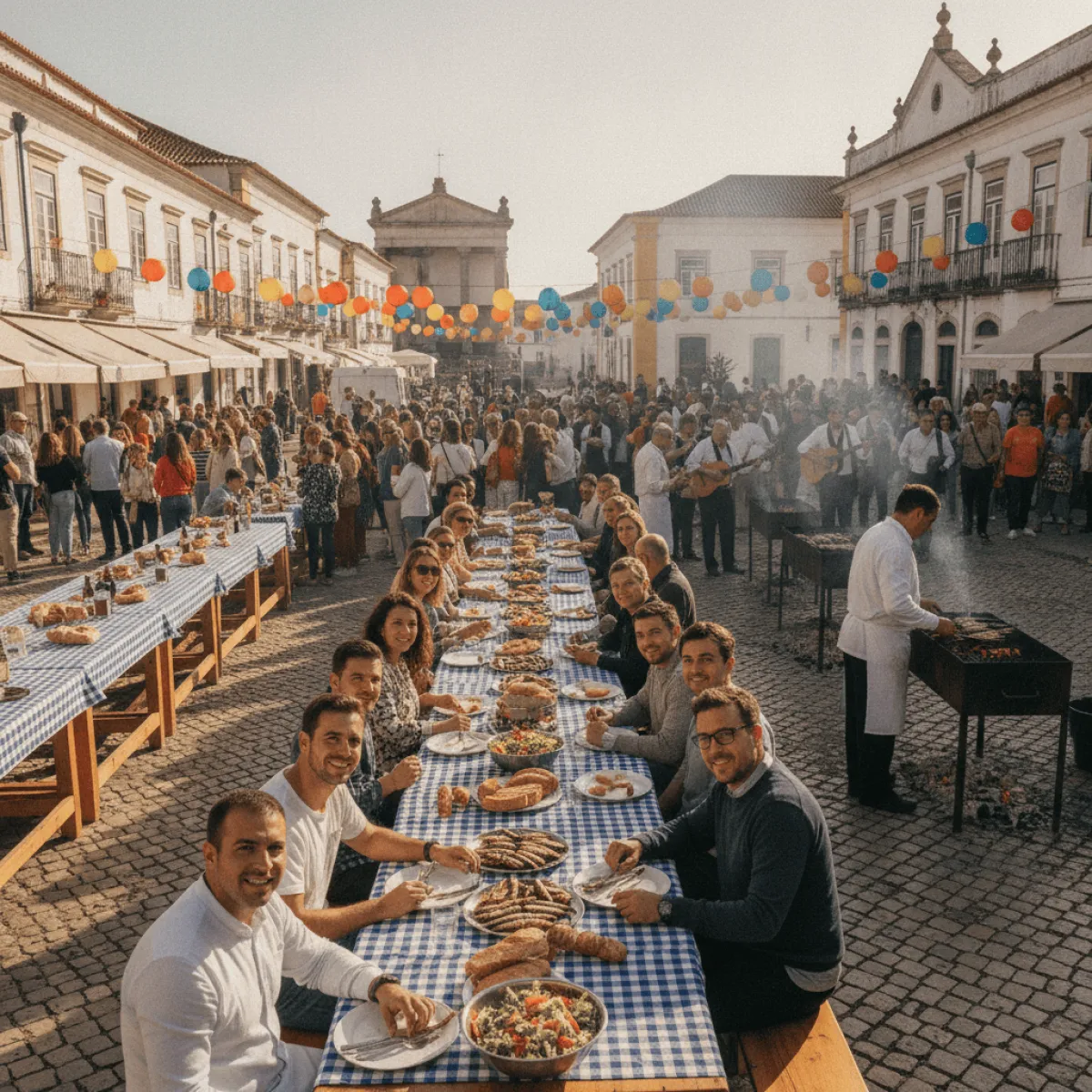
In Évora this means neighborhood street parties, especially out in the Malagueira district and the squares beyond the walls, where local associations set up grills, sell sardines with broa and roasted peppers, and pour wine at prices you won't find on the central square's terraces. Expect a few euros a portion, bread included, with entry usually free. Confirm the dates locally, because each neighborhood has its own weekend and the schedule shifts year to year.
The hurried visitor's mistake is to stay inside the walls, in the zone of awning restaurants and four-language menus. There the sardine, when it exists, is expensive and lukewarm. The trick is to follow the smoke and the noise out of the historic center, where the party belongs to the locals and not the tour buses.
How to eat a sardine properly
There's a method, and anyone who ignores it eats worse. The June sardine comes off the coals, salted on the outside, dripping fat, laid over a thick slice of corn broa. The bread is part of the dish, not a side: it soaks up the juice and the fat that drips down, and by the end it's better than the fish itself. You eat with your fingers. Anyone asking for a knife and fork is doing it all wrong.
Alongside, a roasted pepper with garlic and olive oil, or a plain tomato and onion salad. The wine is young Alentejo red, served cool in a thick glass. Don't go looking for sophistication. The point is the brutal simplicity: fish, salt, fire, bread. In June the sardine is big and fat, and two or three make a lunch. Learn to lift the central bone with your tongue and teeth, no ceremony.
Where, in practice
Being honest about what I know: your best bet is the Santos Populares street parties and the little stalls run by residents' associations beyond the walls during June. Ask at your lodging, ask at the bakery, ask any middle-aged local, they'll tell you where the best grill is that weekend. This is information that lives in people's mouths, not on websites. Resist the temptation to eat a sardine in a tourist-menu restaurant on Praça do Giraldo just because it's convenient. Wait for the festival.
What to do with the rest of the day
Évora doesn't live on sardines, and thank goodness. The city is a World Heritage Site and easily fills two or three unhurried days. I'd build the day around the smoky lunch and leave the mornings for stone and history.
Start early, before the heat, which in June turns serious by noon. A guided walk through Évora's legacy of granite and lime sorts out your mental map of the city in a single morning: the Roman Temple, the Cathedral, the whitewashed lanes, the why of where everything sits. It's done on foot, slowly, and sets you up to get pleasantly lost on your own in the afternoon.
For the days of merciless heat, and there will be some, the Museu Nacional Frei Manuel do Cenáculo is your refuge. It sits beside the Cathedral in a former bishop's palace, with collections running from Roman archaeology to Flemish painting. It's cool, it's quiet, and it's the kind of place to kill the peak hour of heat with a clear conscience. Confirm the opening times locally, since national museums tend to close on Mondays.
If you want to take the Alentejo home rather than just eat it, there's an alternative to souvenir shopping: the wildflower workshop with Catarina Ferreira teaches you to build arrangements from the flora of the Alentejo scrubland. It's the opposite of a sardine, calm, patient, fragrant, and it works as a fine counterweight to a morning of smoke and coals.
The night, after the coals
Évora is a university town, which means the evenings hold more life than the drowsy lunchtime scenery suggests. When the street parties wind down, the action moves. For anyone with energy left after the wine and the sardines, the Praxis Club is where students and the younger crowd stretch the night out. This isn't the Alentejo of the postcards, it's the Alentejo that dances until dawn, and on a festival night it fills.
To sleep without spending a fortune, especially on a saints' weekend when the city packs out, the Old Évora Hostel handles the logistics inside the walls, within walking distance of everything. Book ahead: June is high season in Évora, and the street parties draw people from across the region.
If you come for the fish, stay for the Alentejo
Here's my opinion, and it's firm: use the sardine as an excuse, not a goal. Évora gives you a June pretext to come, but what brings you back is everything else, the acorn-fed black pork, the buttery Évora cheese you eat with a spoon, the wild asparagus migas in season, the sericaia with Elvas plums to finish. The sardine is the party; the everyday Alentejo kitchen is the marriage.
And if a hunger for the deep Alentejo catches you, it's worth driving up to Portalegre, ninety minutes north, on the edge of the Serra de São Mamede. It's a different city, colder, greener, far less touristy. I've got three guides that save you time and money: how to spend a real weekend in Portalegre without the tourist traps, which neighborhoods are actually worth the walk, and, most important for anyone who travels by stomach, where the locals really eat. In Portalegre the mountain cold changes the cooking: more stews, more game, more winter food even in the heat.
The practical summary, no waffle
- When to come for sardines: June, around Saint Anthony (13th), Saint John (24th) and Saint Peter (29th). Outside that, sardines in Évora are rare and rarely worth it.
- Where to eat: neighborhood street parties and association stalls beyond the walls. Follow the smoke, ask the locals. Skip the tourist menus on the central square.
- What to order: grilled sardine over broa, roasted pepper, tomato salad, a glass of Alentejo red. Eat with your fingers.
- What it costs: a few euros a portion at the street parties, bread included. Confirm locally.
- Where to stay: inside the walls, booked well in advance for June.
- How to get there: Évora is about 130 km from Lisbon, just over ninety minutes by car on the A6. There are direct trains and buses.
In the end, Évora's sardine isn't the best in Portugal, and anyone who tells you otherwise is lying. The best are eaten by the sea, in Setúbal, in Portimão, on the coast. But there's something honest about eating grilled fish ninety minutes from the ocean, in a city of plains and stone, simply because it's June and the saints command it. It's exactly the kind of imperfection that makes a trip memorable. Come for the smoke, stay for the clay, the broa and the wine. The Alentejo will thank you.