Covilhã to the Schist Villages: A One-Day Road Trip
Less than 45 minutes from Covilhã, villages like Barroca and Janeiro de Cima offer restored schist houses, river beaches, and the kind of quiet you only find in the valleys of the Beira Interior. A one-day route with stops for river swimming, roast kid goat, and views that need no filter.
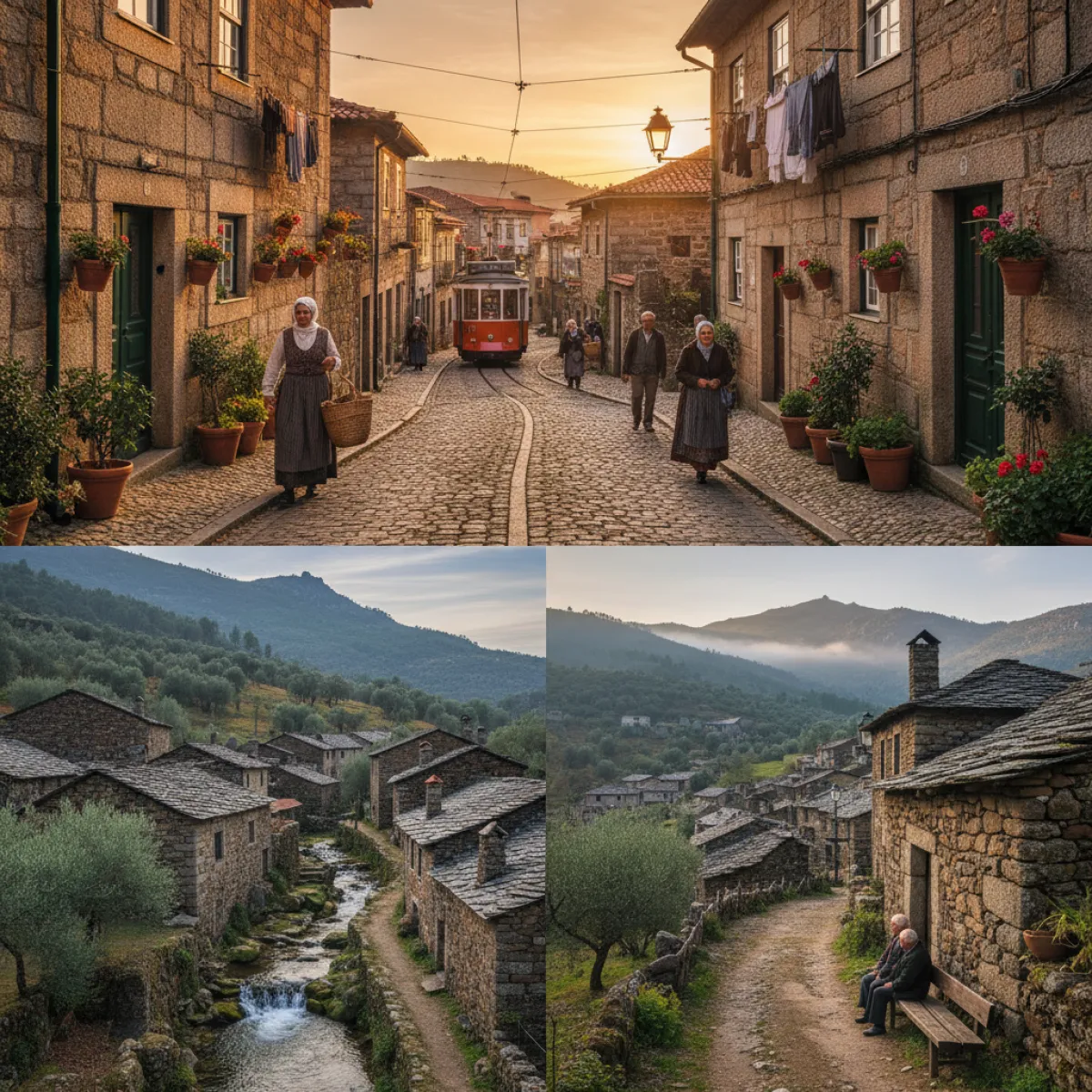
Covilhã is a city that looks up, at the Serra da Estrela, at the hillside where wool was manufactured for centuries, at the murals now covering the concrete walls of its modernist blocks. But to reach the most interesting schist villages nearby, you need to look down. Into the valleys, along the streams, down the narrow secondary roads that wind off the mountain and end in settlements where the houses seem to have grown directly from the rock.
The Aldeias do Xisto (Schist Villages) are a network of 27 traditional settlements in central Portugal, rehabilitated over the past two decades as part of a tourism development programme managed by ADXTUR. Some are too far for a day trip from Covilhã. Others, Barroca, Janeiro de Cima, are less than 45 minutes by car and worth every hairpin turn.
This itinerary leaves Covilhã in the morning and returns by late afternoon, with stops for schist, river, and proper food. No 4x4 required, no hiking boots necessary. Just a car, a towel in summer, and an honest appetite.
Before you leave: coffee in Covilhã
Don't start on an empty stomach. Covilhã has solid neighbourhood bakeries where coffee costs under a euro and the bolas de Berlim are still fried fresh in the morning. The Pelourinho area, in the upper town, is a good starting point, park there and walk downhill until you find an open pastelaria. If you arrived the day before and haven't yet explored the city's industrial and artistic side, it's worth setting aside a morning to discover Covilhã's wool factory heritage and street murals, it gives context to everything you'll see in the surrounding mountains.
First stop: Barroca
Leave Covilhã on the N18 towards Fundão, then cut south. You'll reach Barroca in about 40 minutes. The village belongs to the Fundão municipality and is one of the best-preserved Schist Villages in this area. Dark schist houses line narrow lanes that drop down to the Ribeira da Barroca, and the quiet, real quiet, not postcard quiet, is the kind you feel in your ears.
Barroca isn't big. You can walk through it in half an hour, and that's what makes it efficient for a day itinerary: no time wasted, but the feeling of having time-travelled is genuine. The houses have been restored with respect for the original material, dry schist walls, slate roofs, dark timber balconies. Some operate as holiday rentals (prices vary; check directly on the Aldeias do Xisto website).
What to do here: walk. There's a signposted trail that descends to the stream and follows the water. In summer, the river beach at Barroca is one of the best river swims in the region, cold water, schist banks, natural shade from the trees. Even outside swimming season, the walk down is worth it for the scenery alone.
Practical note
There aren't many services in Barroca. Bring water and a snack. The village has an artisan shop that isn't always open, check hours locally, especially outside summer.
Second stop: Janeiro de Cima
From Barroca, drive to Janeiro de Cima. It's about 20 minutes on narrow but paved roads. Janeiro de Cima is probably the best-known Schist Village in this area, and for good reason: it has an excellent river beach on the Zêzere, an interpretive centre dedicated to linen production, and an atmosphere that stays genuinely calm even in peak months.
The river beach at Janeiro de Cima is different from Barroca, more organised, easier access, and the Zêzere runs wider here. In July and August, there are lifeguards and support facilities. The rest of the year, it's a place to sit on a rock and listen to water.
The linen interpretive centre shows how flax was cultivated and processed in the region, a tradition that nearly disappeared and is being preserved here. The visit is short, 30 to 40 minutes, and gives perspective on what these villages' economies looked like before tourism arrived. If you're in the Fundão area in spring, this is also the ideal base for catching the cherry blossoms in the Serra da Gardunha, a spectacle that lasts only a few weeks and is worth planning your entire trip around.
Lunch: where and what
Janeiro de Cima has a couple of restaurants serving regional food. Roast kid goat and lamb stew are the local standards, heavy, yes, but you're in the Beira Interior, not the Algarve. Expect around €10-15 per person for a full meal with house wine. Lunch hours are typically 12pm to 2:30pm, don't arrive late or you'll be eating sandwiches in the car.
If you prefer a picnic, there are supermarkets in Fundão (15-20 minutes away) where you can assemble a basket of serra cheese, rye bread, cured meats, and fruit. The Zêzere riverbank is a perfect spot to spread your blanket.
Afternoon option: Sobral de São Miguel or a scenic return
If you still have energy and daylight, Sobral de São Miguel is another Schist Village accessible from here, in the Castelo Branco municipality. It's more remote, emptier, and slightly different in character, less restored, more authentic in the sense that you can still see the village functioning as a village, with kitchen gardens and animals. The road adds about 30-40 minutes to your route.
The alternative, if you prefer a relaxed return, is to drive back up to Covilhã via the mountain roads, stopping at viewpoints along the way. The late afternoon light over the schist valleys is, without exaggeration, some of the best you'll see on mainland Portugal. You don't need to be a photographer to pull over and just look.
Practical notes for the full route
- Total distance: Roughly 120-150 km for the Covilhã → Barroca → Janeiro de Cima → Covilhã loop. Add 60 km if you include Sobral de São Miguel.
- Time: A full day, leaving at 9am and returning by 5-6pm. Don't try to rush, the roads are narrow and the villages deserve your time.
- Best season: Spring (April-May) for wildflowers and mild temperatures. Summer for river beaches. Autumn for colours. Winter is possible but the villages are very quiet and some services close.
- Fuel: Fill up in Covilhã or Fundão. There are no petrol stations in the villages.
- GPS: Works, but not always accurately on secondary roads. Have a paper map as backup, or at least offline maps downloaded on your phone.
- Dogs: Yes, you can bring them. River beaches are generally tolerant outside peak season.
If you have more than one day
If you're staying in Covilhã for two or three days, the schist route pairs well with other explorations in the region. The Serra da Estrela is right there, Torre, Manteigas, the glacial valleys, and neighbouring Seia has a surprising modernist architectural legacy that few visitors know about.
And if this mountain-and-schist itinerary awakens a craving for total contrast, there's always the coast. Portugal does this to you: one morning you're swimming in a river between schist boulders, the next day you can be in the Atlantic. For anyone thinking of combining mountains and sea, our March surf guide is a good starting point even if you don't surf, the recommended beaches work for any visitor.
But that's for another day. Today, the schist is enough.
