Surfing Portugal in March: The Best Beaches and Conditions
March offers the ideal combination of consistent swell, empty beaches, and affordable prices for surfing in Portugal. From the powerful waves of Peniche to the versatile beach break at Amado in the Algarve, this guide covers the best spots, necessary equipment, and an itinerary that includes an unexpected stop in the Serra da Estrela.
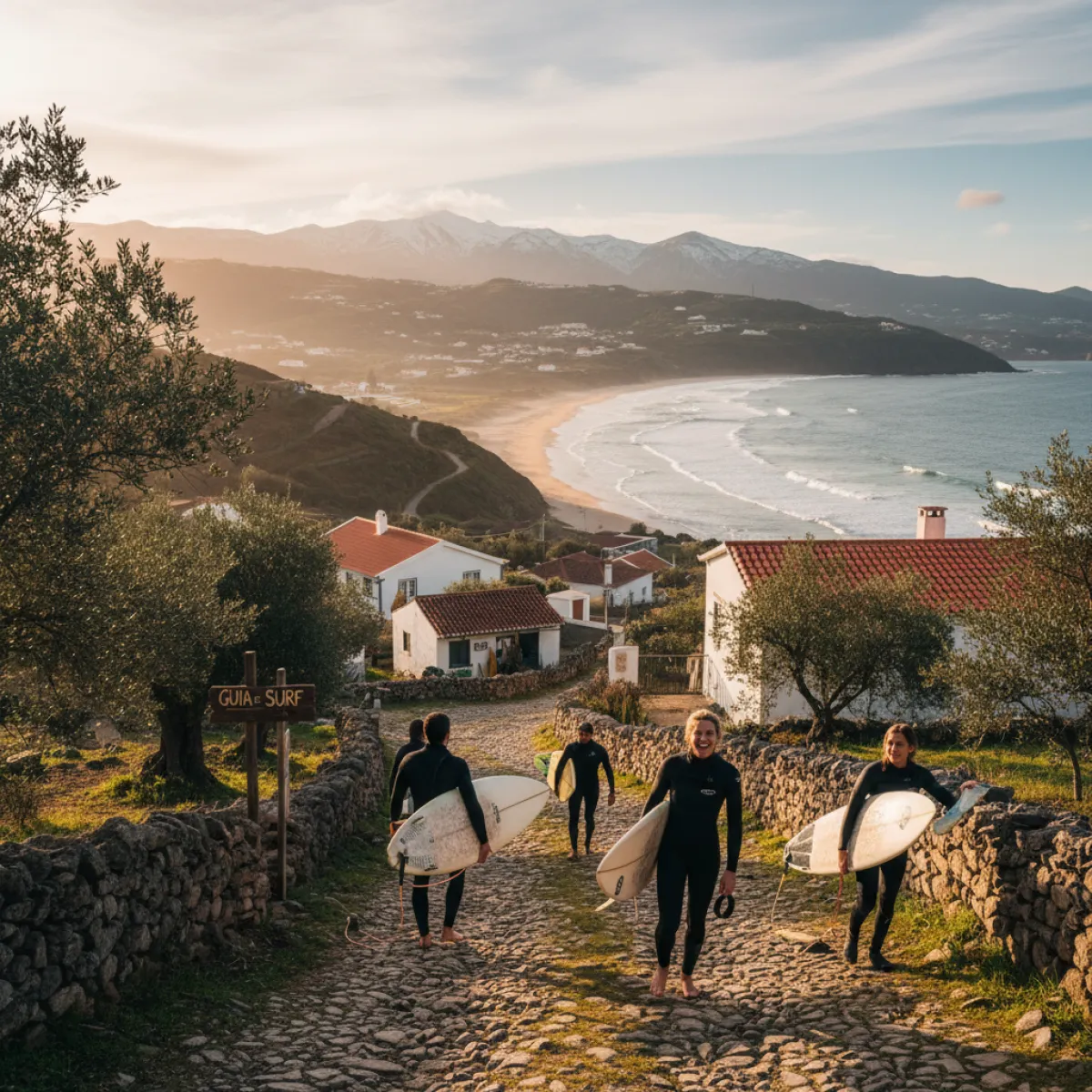
March is, for those who know the Portuguese coastline well, one of the most honest months to surf. Winter is losing its brutality, the northwest swells remain consistent, but they no longer carry that January violence that closes half the spots. The water hovers around 14°C, the air regularly pushes past 15°C, and the beaches are blissfully empty. It is the month when Portugal reveals itself as a surf destination without filters: no summer crowds, no inflated August prices, no need to compete for a spot in the lineup with thirty surfers in new wetsuits.
But this guide is not only about waves. It is about understanding the country from its coast, and, surprisingly, from its interior. Because anyone who surfs Portugal in March and doesn't explore what exists beyond the break line is missing half the trip.
The West Coast: From Peniche to Ericeira
Let's start with the obvious, but with nuance. Peniche is frequently described as Portugal's surf capital, and there are objective reasons for this: its peninsula creates a coastal geometry that guarantees waves in almost every wind and swell condition. In March, the northern side, Baleal and Lagide, works particularly well with the prevailing northwest swells. Supertubos, the most famous beach, tends to be too powerful for most intermediate surfers at this time, but on smaller swell days (1 to 1.5 metres), it offers short, intense barrels that justify the reputation.
What few people mention is that March is the ideal month to surf Molho Leste, the inner beach of Peniche's harbour. When the north wind blows hard and ruins everything on the exposed coast, Molho Leste offers a small but clean wave, sheltered and perfect for late-afternoon longboard sessions. A 4/3mm wetsuit is mandatory, and gloves are not overkill in the early morning hours.
Ericeira, 80 kilometres south, is the only World Surfing Reserve in Europe. Seven world-class waves concentrated within four kilometres of coast. In March, Ribeira d'Ilhas is the star: a long, predictable right-hander that works from 0.5 to 2.5 metres. Coxos, Ericeira's noblest wave, requires pure northwest swell and low tide, conditions that align perhaps six or seven days per month in March. When it happens, it is one of the best waves in Europe, without hyperbole.
Budget for a week in the Peniche or Ericeira area in March: surf hostel accommodation runs 20-30€ per night in a dormitory, 50-70€ for a private room. Surf lessons cost between 35-45€ for group sessions. Board and wetsuit rental per day: 15-25€. A decent meal at a local restaurant, grilled fish, seafood rice, runs between 12 and 18€.
The Algarve: March's Quiet Revelation
The Algarve in March is an entirely different proposition from the Algarve of summer. The western Algarve coast, from Aljezur to Sagres, receives the same Atlantic swells that feed Peniche and Ericeira, but with fewer people and, frequently, air temperatures two to three degrees warmer. The water is marginally warmer too, though the difference is more psychological than real: we are talking about 15°C versus 14°C.
Arrifana is the natural starting point. A semicircular bay that channels the swell and creates a wave of remarkably consistent quality. It works best with west-northwest swell and mid-tide. In March, the north wind that frequently ruins the more exposed spots is mitigated here by the cliffs that shelter the bay. It is an accessible wave for intermediate surfers and generous enough to entertain advanced surfers on bigger days.
Further south, Praia do Tonel in Sagres offers a different experience: a sandy beach facing southwest, which picks up swell that no other spot in the Algarve catches. When the swell rotates west or southwest, which happens with some regularity in March, especially in the second half, Tonel has waves when the rest of the coast is flat. Wind is the deciding factor: Sagres is notoriously windy, and the window of clean surf is often limited to the first three hours of the morning.
Amado, between Aljezur and Sagres, is the region's most versatile spot. Beach break with multiple peaks, it works in practically any condition. This is where most surf schools operate, and in March the instructor-to-student ratio improves dramatically compared to summer. A lesson that in August would be shared with eight people rarely has more than four in March.
The North: For Those Who Don't Fear the Cold
Above Porto, the Portuguese coast transforms. The beaches are wilder, the water colder (12-13°C in March), and the swells arrive with less interference. This is surfing for those who take it seriously, or for those who want an experience radically different from the Algarve.
Praia de Cabedelo in Figueira da Foz offers one of the longest right-handers in mainland Portugal. On days of solid northwest swell and low tide, it is possible to ride waves of 200 metres or more. March is statistically one of the best months for Cabedelo: the swell is consistent, the east wind (offshore) is frequent in the mornings, and there is nobody in the water.
Further north, Espinho has a powerful beach break that works best with medium swell (1-1.5 metres). On bigger days, the current becomes serious and the spot is for experienced surfers only. But on the right days, Espinho offers fast lefts and rights with a push of water that recalls French spots.
Nazaré deserves a mention, not because it is surfable for most people, it isn't, especially in March, but because it is worth watching. If a big swell coincides with your visit, seeing 15-metre waves at Praia do Norte is an experience that redefines your relationship with the ocean. The Forte de São Miguel Arcanjo offers the best view and is free to enter.
Beyond the Coast: The Interior as Complement
One of the great advantages of surfing Portugal in March is that the country is small enough to combine the coast with the interior in a single trip. And this is where the Serra da Estrela, and Covilhã in particular, enters this conversation in unexpected but logical fashion.
After a week of surfing in Ericeira or Peniche, Covilhã is less than three hours by car. And it offers something no beach can: altitude, silence, and a cultural identity that is reinventing itself in fascinating ways. The city sits on the eastern slope of the Serra da Estrela at around 700 metres of altitude, and in March it is still possible to find snow on the highest points of the mountain range, an almost absurd contrast with the surf mornings left behind.
Covilhã was for centuries Portugal's wool capital. The factories that defined the city went into decline in the late twentieth century, but the industrial heritage survived and is being reinterpreted. Anyone wanting to understand this transformation should explore the guided tour of Covilhã's industrial heritage and mural art, which connects the old wool mills to the contemporary murals now covering the city's walls. It works as the perfect counterpoint to full days spent in the water: instead of gazing at the horizon, you find yourself looking at walls that tell stories.
And if your visit coincides with the end of March, or if you can stretch it into the first days of April, Fundão, twenty minutes from Covilhã, offers one of Portugal's most striking natural spectacles. The guide to seeing cherry blossoms in Fundão is essential reading for anyone planning this extension. The cherry blossom season in the Serra da Gardunha valleys is brief, two to three weeks, typically between late March and mid-April, and transforms the landscape into a white and pink canopy that would rival any Japanese hanami, all proportions considered.
Equipment and Preparation
The wetsuit is the most important decision of the trip. For March in Portugal:
- Algarve: 4/3mm is sufficient. Gloves and boots are optional but recommended for morning sessions.
- Central coast (Peniche, Ericeira, Nazaré): 4/3mm mandatory. 3mm boots make a real difference in comfort. Gloves for sessions before 9am.
- North (Figueira, Espinho): 5/4mm recommended. Boots and gloves essential. Hood for extended sessions.
As for boards, March favours shapes with more volume than usual. Colder water makes muscles less responsive, and the waves tend to be more powerful than in summer. A fish or mid-length (6'8" to 7'6") is a smart choice for most surfers. Shortboards work, naturally, but on smaller days you will wish you had brought something with more float.
Logistics and Getting Around
Portugal has a motorway network that connects Lisbon to the Algarve in under three hours and to Peniche in just over one. Renting a car is almost mandatory for a serious surf trip: March prices run around 20-35€ per day for a compact. Fuel costs around 1.70€ per litre for petrol.
Flights to Lisbon in March are significantly cheaper than in summer. Low-cost carriers operate direct routes from almost every European capital, with prices that frequently fall below 50€ one way if booked a month in advance.
For those wanting to combine coast with interior, the most logical route is: Lisbon → Ericeira (3-4 days) → Peniche (2-3 days) → Covilhã and Serra da Estrela (2-3 days). Alternatively: Lisbon → Algarve (west coast, 4-5 days) → return via Alentejo → Covilhã (2 days). Both itineraries are realistic for ten days to two weeks.
When Exactly in March
The first half of March tends to be more consistent in terms of swell, with the last remnants of winter storms generating regular surf. The second half is often gentler, with longer sunny days and air temperatures that occasionally touch 20°C, especially in the Algarve.
To maximise the probability of good conditions, the first ten days of March are the safest bet. For those who prefer thermal comfort and don't mind sacrificing some swell consistency, the last week of March, already transitioning into April, offers the best balance between waves and weather.
Surf forecasting for Portugal is reliable five to seven days in advance. Using sites like Windguru or Magic Seaweed to plan your week is standard practice, and allows you to adjust the itinerary in real time: if the Algarve is flat but Peniche has swell, three hours of driving solves the problem.
A Final Note
Portugal in March is not about perfect surf every day. There will be rainy mornings, onshore wind afternoons, and at least one day when the ocean is so churned up that the best option is to retreat to a seaside café and order a bica and a pastel de nata. There will also be, almost inevitably, that session, a single session, when everything aligns: the right swell, the right wind, the right tide, and nobody in the water but you. That session justifies the entire trip. March is the month when Portugal offers that possibility with the greatest generosity and the smallest audience.
