Covilhã: Industrial Ghosts and Aerosol Dreams on the Streets
Covilhã has transformed its industrial past into one of Europe's most vibrant urban art museums. Discover how wool factories gave way to murals by Bordalo II and Vhils in a route that challenges both your legs and your senses.
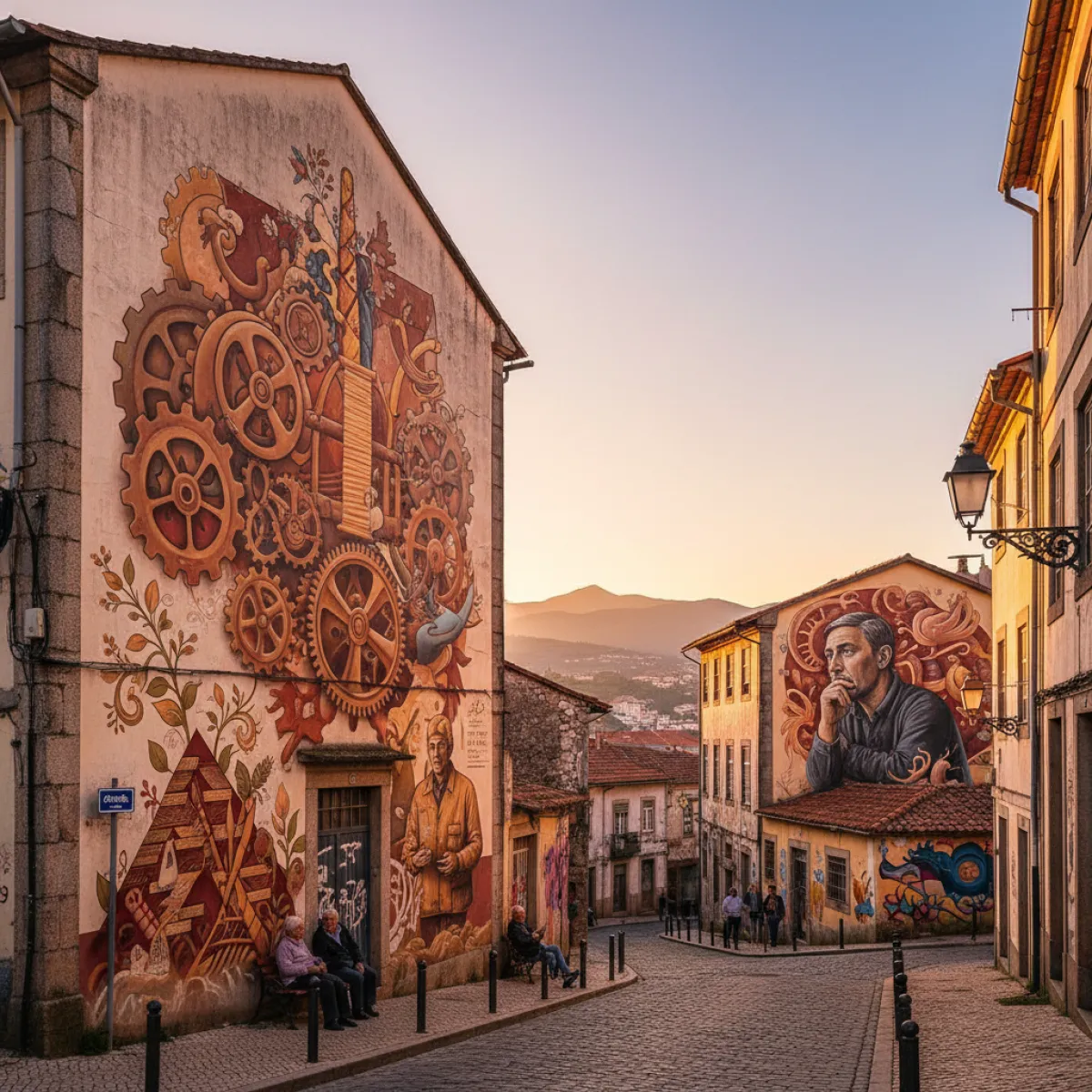
There is something stubbornly defiant about Covilhã. It is a city that insists on climbing the slopes of Serra da Estrela, challenging gravity and the legs of anyone foolish enough to visit on foot. For decades, this was the Portuguese Manchester, a smoky engine of wool production where the clatter of looms set the rhythm of life. Then, silence settled into many of those factories, leaving behind granite carcasses and chimneys pointing at the sky like accusatory fingers.
But Covilhã didn't wallow in industrial mourning. Instead of hiding the scars, it decided to paint them. Today, the city is one of the most impressive open-air urban art museums in Europe, not because it has more walls or more expensive paint, but because art here isn’t cosmetic; it is narrative. Every mural tells a story embedded in the city’s DNA: the wool, the shepherds, the harshness of the mountain, and the resilience of its people.
Rebirth Through WOOL
Everything changed with WOOL, The Covilhã Urban Art Festival. The name is a happy (and obvious) pun on the city's heritage, but the curation is serious business. Forget the hasty tags or generic graffiti you see in the suburbs of Lisbon or London. Here, artists are invited to dive into local history before they even touch a spray can. The result is an open-air gallery that converses with its surroundings.
Walking these streets is both a physical and visual workout. I strongly advise leaving your car in one of the peripheral parking lots or the auto-silo (if you have the nerve for the ramps) and using the public elevators and funiculars, or your own legs, if you want to justify a heavy dinner. The historic center is a labyrinth of narrow streets where GPS goes to die and side mirrors are sacrificed to the gods of granite.
One of the landmarks is, inevitably, the work of Bordalo II. His "Owl" (Coruja), made from trash and industrial waste, stares at the city with huge yellow eyes, perched on a side wall. It’s a critique of consumerism, sure, but here, in the context of Covilhã, it feels more like a guardian of the memories that the waste represents. The texture of the plastic and metal pieces blends oddly well with the roughness of the surrounding stucco.
Not far away, you find the work of Vhils (Alexandre Farto). Instead of adding paint, he removed the wall's surface to reveal the face of a local, sculpting the image through creative destruction. It is a perfect metaphor for the city itself: peeling back the layers of the past to find a new identity. Vhils' technique gains a special dimension here, given that the city itself is made of geological and historical layers.
An Improvised (But Essential) Route
Don't try to see everything in one day, or you'll end up with tendonitis and visual overload. Focus on the main core between Portas do Sol and the University. Rua das Portas do Sol, for instance, is a good starting point. From here, the view over Cova da Beira is disarming, especially in the late afternoon when the light hits the slope and warms the cold tones of the granite.
If you really want to understand what you are looking at, don't just take selfies. I highly recommend taking the Wool and Walls: A Guided Tour of Covilhã's Industrial Heritage and Mural Art. You get details about the old dye houses and working-class life that aren't on the plaques, giving a completely different depth to the murals you see.
Another mandatory stop is the mural by Add Fuel (Diogo Machado). He reinterprets traditional Portuguese tiles with a contemporary twist and, often, subtle humor hidden in the patterns. In Covilhã, his work is based on the patterns of local wool fabrics, creating a fake ceramic "skin" over the building that tricks the eye from a distance. It is a technical and aesthetic tribute to the industry that built the city.
Eat and Drink (Because Art Makes You Hungry)
Covilhã isn't just paint. It is also a land of fork and knife, where food is made to sustain those working in the cold. Don't expect deconstructed gourmet dishes with foam of whatever. Here, you eat for real.
Look for Pastéis de Molho. They aren't a dessert, though the name might fool you. They are a caloric bomb of puff pastry filled with meat, served with a saffron sauce that cures any cold (and perhaps a few hangovers). It is a dish that defies modern dietary logic, and thank god for that. For something more conventional, the restaurant scene in the center has been improving, with some spots modernizing Beira cuisine without losing its essence.
And if you are in town on a cold winter night, which is highly probable, given that winter here seems to last six months, duck into one of the bars near the university. The student population injects a vital energy into the city that prevents it from becoming just a museum. There is a youthful vibe that contrasts deliciously with the old stone walls.
Beyond the City: The Mountain and Neighbors
Covilhã is the gateway to Estrela, but don't ignore what's around it. If your visit coincides with the beginning of spring, you must head down the slope. The Ephemeral Bloom: A Guide to Seeing Cherry Blossoms in Fundão is a chromatic experience opposite to that of Covilhã. While Covilhã is granite-grey and colorful murals, Fundão becomes an ephemeral white and pink mantle. It is worth the 20-minute detour.
For architecture lovers who enjoyed Covilhã's industrial reconversion, the next logical stop is Seia. Check our guide on Modernism in the Mountains: The Architectural Legacy of Cottinelli Telmo in Seia. It is fascinating to see how modernism tried to domesticate the mountain on another side of the range, with straight, functional lines contrasting with the organicity of the landscape.
Now, if the mountain overdose gets too much and you need an open horizon, it might seem counter-intuitive, but March is a curious month to head to the coast. If you are doing a road trip through Portugal, our guide on Surfing Portugal in March: The Best Beaches and Conditions might be the perfect antithesis to the days spent in the mountains. From granite to sea foam, Portugal is this constant contrast.
Final Verdict
Don't go to Covilhã expecting a "Sintra of the Beiras" or a perfectly preserved postcard city. Covilhã is rough, sometimes chaotic, with 80s buildings leaning against 18th-century manors and ruined factories next to design hotels. But it is in this mix, this urban collage, that its charm lies.
Urban art here isn't a band-aid to cover holes; it is a celebration of scars. It is a city that knew how to reinvent itself without selling its soul to the devil of mass tourism. Go for the painted walls, stay for the atmosphere, and leave planning your return, preferably with comfortable shoes and an empty stomach.
