Arraiolos Museums: What's Worth It and What's Not
Arraiolos has exactly one must-see museum: the Carpet Interpretation Centre, with €1 admission and pieces dating back to the 17th century. The rest of the town, from embroidery workshops to the circular castle, is where the culture really lives.

Let's be honest: Arraiolos is not a museum town. It has fewer than four thousand residents and sits in the Alentejo plain about 20 kilometres north of Évora. You won't need a museum pass or a multi-day cultural itinerary. What you will need is an hour or two, comfortable shoes, and the good sense to know which spaces deserve your time and which you can safely skip.
The real question isn't how many museums Arraiolos has. It's what to do with the rest of your day once you've seen the one that actually matters.
The Carpet Interpretation Centre: genuinely worth your time
If you visit one thing in Arraiolos, make it the Centro Interpretativo do Tapete de Arraiolos on Praça Lima e Brito. It's a compact, recently renovated two-storey museum lined with local marble, and it does something rare for a small-town museum: it makes you care about its subject.
Arraiolos carpets have been documented since the 17th century, though their origins likely go further back. The patterns draw from Persian, Mudéjar, and Portuguese folk traditions, and the museum walks you through that evolution with real pieces, from fragile antique rugs to bold contemporary designs. You don't need to be a textile enthusiast to find it interesting. The craftsmanship on display is genuinely impressive, and the museum avoids the dusty-vitrine syndrome that plagues so many regional collections.
Practical details: a guided visit costs just €1 per adult (€0.50 for over 65s). Audio guides are €2. Children under 12 get in free. Open Tuesday to Sunday, 10am to 1pm and 2pm to 6pm. Closed Mondays. For what you get, it's absurdly good value.
My advice: don't stop at the museum. Arraiolos has around 26 workshops and galleries scattered through its streets where you can watch embroiderers at work, choose patterns, and even commission a rug. If you want to go hands-on, an Arraiolos rug workshop with local artisans will give you a much deeper understanding of the famous Arraiolos stitch than any display case. For the seriously curious, there's also a full masterclass in rug weaving that treats the craft as living history.
The Rural Life Interpretation Centre: good, but not essential
The Centro Interpretativo do Mundo Rural is in Vimieiro, about 15 kilometres from Arraiolos centre. It's dedicated to rural Alentejo life from the late 19th century through to the mid-20th: farming tools, traditional dress, reconstructed domestic spaces, the daily rhythms of a world that has largely disappeared.
Is it worth the detour? That depends entirely on your interests and your schedule. If rural ethnography genuinely excites you, it's a well-assembled collection and admission is free. It's open Wednesday to Sunday, 10am to 1pm and 3pm to 6pm (until 7pm in summer), and Tuesday afternoons only.
But if you have just an afternoon or a single day for Arraiolos, I'd skip the 30-kilometre round trip. Stay in the village, explore the workshops, climb the castle, eat a slow lunch. The Rural Life Centre is a worthwhile add-on for anyone spending multiple days in the area or passing through Vimieiro anyway, but it's not the reason to come here.
Things that aren't museums but work like one
Arraiolos has at least two spaces that, without being formal museums, offer a cultural experience every bit as rich.
The Misericórdia Church
Not a museum in any official sense, but the interior of the Igreja da Misericórdia in Arraiolos deserves a stop. The 18th-century tiles lining its walls are exceptional, some of the best examples of Portuguese azulejo work you'll find outside Lisbon or Porto. It's free, it takes ten minutes, maybe fifteen if you look carefully. Check locally for opening times, as they can be irregular.
The Castle
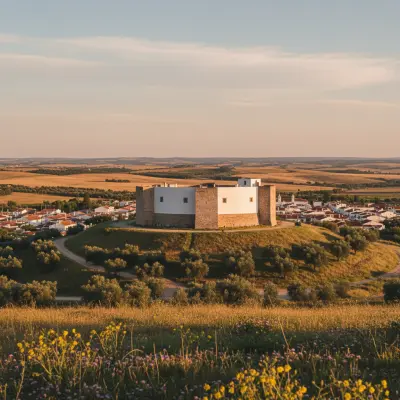
Arraiolos Castle is unlike any other castle in the Alentejo, and the reason is simple: it's circular. Not roughly circular, not "rounded." Fully, distinctly circular, which makes it a genuine rarity in Portugal and the Iberian Peninsula. It sits on top of Monte de São Pedro, and from the walls you get unbroken views of the Alentejo plains in every direction.
Go in the late afternoon. The sunset from up there is worth the climb. Inside the walls, you'll find the remains of the old Igreja do Salvador, with fragments of frescoes that have somehow survived the centuries. It's not a museum, but it's an open-air history lesson.
What you can skip
Let's be direct. Arraiolos doesn't really have bad museums, because it doesn't have enough museums for any of them to be bad. But there are time traps worth avoiding:
- Rug shops posing as "exhibitions": some galleries in town present themselves as cultural spaces but are essentially retail operations. There's nothing wrong with buying a rug, but don't mistake a showroom for a museum experience.
- The Vimieiro detour just for the museum: as I said, the Rural Life Centre is free and interesting, but a 30-kilometre round trip purely to see it doesn't make sense if you're short on time. If you're passing through Vimieiro for other reasons, step in. Otherwise, stay in Arraiolos.
How to plan your day
Here's my ideal Arraiolos programme, assuming you arrive in the morning:
Start at the Carpet Interpretation Centre. Get there at 10am when it opens, before the tour groups show up later. Spend 45 minutes to an hour.
Then walk the village streets. The rug workshops are scattered through the centre, many in private homes with the front door open. Stop, watch, ask questions. The embroiderers of Arraiolos are generally welcoming and proud of their work.
At midday, eat lunch. Alentejo food here is straightforward: açordas (bread soups), stews, black pork. I won't name specific restaurants because the offerings change, but look for places where locals are eating. In a town this small, that's not hard to spot.
In the afternoon, climb to the castle. Bring water, especially in summer, because the Alentejo heat is no joke. The climb isn't long but it's steep. Take your time at the top.
If you still have energy, stop by the Misericórdia Church before it closes.
If you want to go further
Arraiolos works well as a base or a stop on a longer Alentejo itinerary. Évora is half an hour by car and has enough museums to fill several days. But if you want to explore the northern Alentejo, Portalegre has a completely different character. If you're planning that trip, our guide to a real weekend in Portalegre covers what matters without the tourist padding. The city has neighbourhoods that are genuinely worth exploring on foot, and a local food scene that deserves attention, which we cover in our guide to where locals actually eat in Portalegre.
The verdict
Arraiolos has exactly one museum that's essential: the Carpet Interpretation Centre. It's cheap, it's well done, and in under an hour it gives you the context for everything else you'll see in town. The Rural Life Centre in Vimieiro is a bonus if you have time and a car. Everything else, the castle, the church, the workshops, aren't museums but are first-rate cultural experiences.
Don't come to Arraiolos expecting a full-day museum crawl. Come expecting a village you can cover in a few hours, where the culture lives as much in the museum walls as in the hands of the people still embroidering on their doorsteps. And that, in 2026, is rarer than any collection behind glass.