Arcos de Valdevez: A Romanesque Architecture Route Worth the Drive
Arcos de Valdevez has five Romanesque monuments scattered across villages where two cars can barely pass. From Ermelo to Távora, a route for those who prefer 12th-century capitals to tourist queues.
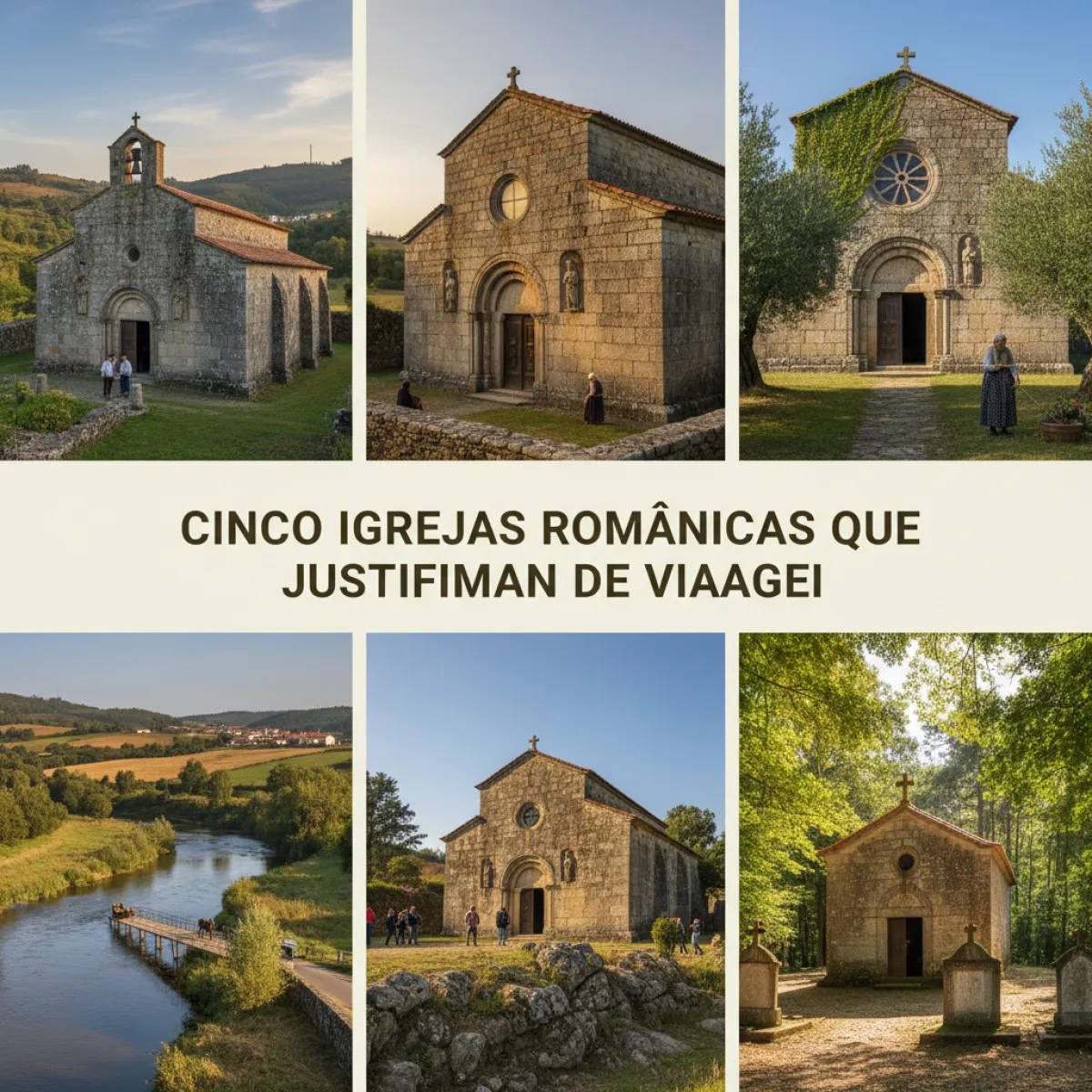
There is a reason Alto Minho's Romanesque heritage doesn't have the fame of Catalonia's Boí Valley or Burgundy's great abbeys. It's not a quality problem. It's an access problem. Arcos de Valdevez sits about 90 minutes north of Porto by motorway, and then you have to navigate narrow roads between granite walls and overhead vines to reach churches that have been standing for eight centuries without anyone bothering to put up a proper information board. That's precisely what makes them worth the trip.
This route connects five Romanesque monuments in the Arcos de Valdevez municipality, plus one essential detour to Ponte da Barca. One full day if you're efficient. Two days if you want to eat properly and sleep in the area.
Ermelo Monastery: what's left of the Cistercians in the Lima valley
Start with the Monastery of Santa Maria de Ermelo, on the right bank of the Lima River. Founded in the early 12th century as a Benedictine house, possibly by order of Queen Teresa (mother of Portugal's first king, Afonso Henriques), it adopted the Cistercian rule in the 13th century, affiliating with the Monastery of Fiães in Melgaço. It was secularized in 1560 by Cardinal Henrique and has been sitting there quietly ever since, classified as a National Monument but without the tourist pressure that usually implies.
What survives is the church and vestiges of the ruined cloister. On the facade, the Romanesque rose window is the most striking element: it was the central nave's light source in the original Cistercian plan. Inside, the triumphal arch and capitals with phytomorphic and geometric motifs are typical of the Minho basin's Romanesque style. The church originally had three naves and a chancel with three quadrangular chapels, but one of the side naves was removed over the centuries. You can still see the triumphal arch of that vanished chapel from the exterior, which gives the visit an almost archaeological dimension.
Ermelo is a tiny village pressed against the steep slope of Outeiro Maior. There is no café by the monastery door, no souvenir shop. Bring water.
Chapel of São João Baptista, Távora Commandery
The second stop is the Chapel of São João Baptista in the parish of Távora Santa Maria. Built in the 12th century, it has an inscription on the axial portal's lintel dated 1190, making it one of the best-documented Romanesque monuments in the municipality. But the story doesn't end with the Romanesque: in 1269, the Knights of Malta established a commandery here. That's why the chapel is also known as the Malta Chapel or the Rhodes Chapel.
The capitals decorated with plant and animal motifs are noteworthy, and the small columns flanking the openings carry representations linked to the Order's patrons. Modifications came in the 14th and 15th centuries, and stone sarcophagi line the southern facade. The whole ensemble makes sense as a reading of centuries compressed into one small building: each layer of occupation left its mark in the stone.
Church of São Bartolomeu, Monte Redondo
The Parish Church of São Bartolomeu in Monte Redondo is another piece of the Ribeira Lima Romanesque cluster. Also 12th century, also with a 1190 inscription on the portal. The parallel with Távora isn't coincidental: there's clearly a logic of simultaneous construction, likely tied to the same impulse of parish and seigneurial organization that shaped the region.
The church is more modest than Ermelo in scale, but the portal's decorative elements deserve close attention. Monte Redondo is one of those scattered rural parishes where two cars can barely pass each other on the road. That's part of the charm.
Miranda Monastery
Miranda Monastery, built between the late 12th and early 13th century, is another Benedictine house that drove the medieval socio-economic expansion of the area. The Romanesque structure of the original church partially survives: the plan was, as at Ermelo, a three-nave church with a chancel of three quadrangular chapels.
The monastery sits in the village of Miranda, a few kilometres from the centre of Arcos de Valdevez. Of the four stops within the municipality on this route, it arguably has the most dramatic landscape setting, wedged between hills and agricultural terraces that haven't changed much since the Middle Ages.
Chapel of Nossa Senhora da Conceição: the transition
In the town centre, the Chapel of Nossa Senhora da Conceição is the oldest religious monument in Arcos de Valdevez. Its architecture marks the transition from Romanesque to Gothic, making it an interesting point of comparison with the purely Romanesque buildings you've just visited. Here you can already notice pointed arches and a verticality absent from the earlier churches. It's a good way to close the circuit in the centre of town, where you can finally sit down and eat something.
Essential detour: São Salvador de Bravães
If you're coming to Arcos de Valdevez for Romanesque architecture, you cannot skip Ponte da Barca, less than 20 minutes by car. The Church of São Salvador de Bravães is, by consensus, one of the finest Romanesque monuments in Portugal. The western portal, with five decorated archivolts, displays a sculptural density that's rare in the country: monkeys, intertwined serpents, eagles, and human figures representing the Virgin and the Angel Gabriel, something unusual in Portuguese Romanesque.
The church dates to the 12th century, founded as a Benedictine monastery by Vasco Nunes. The tympanum and portal capitals are the highlight, but the interior also holds decorative elements from the 15th and 16th centuries. If you have to pick only one Romanesque monument in all of Alto Minho, pick this one.
Eating in Arcos de Valdevez
After a day staring at 12th-century capitals, you'll want to sit down properly. The local cuisine has real identity. The dish to know is cachena beef with arroz de feijão tarreste: cachena is an indigenous breed from Alto Minho, small-bodied with enormous horns, and the meat has a mineral flavour you won't find in other breeds. The bean rice is the canonical accompaniment.
Other dishes on local menus: cabrito mamão da serra (young mountain goat, best in spring), cozido à moda dos Arcos, rojões with papas de sarrabulho, and arroz pica no chão. For dessert, charutos d'ovos are the local convent sweet: wafer pastry rolled around egg cream. You'll find them at Doçaria Central in the town centre.
Minho Verde restaurant, near the Casa das Artes, does solid home cooking. For something more ambitious, Foral de Valdevez at the Luna Arcos Nature Hotel has chef Vasco Pombo working Minho cuisine with more technique. Check hours and prices locally.
Practical information
By car from Porto, count on about 1 hour 15 minutes via the A3 and then A27. Driving is the most practical option, especially since the monuments are scattered across the municipality and there's no public transport between them. If you don't have a car, RenEX runs buses from Porto Campanhã to Arcos de Valdevez twice daily. The journey takes about two hours.
The best time for this route is April through October, when the days are long and the mountain roads are dry. In winter, fog in the Lima valley can be thick, which has its own beauty but complicates driving on the narrower paths.
Building a wider Alto Minho trip
If you're planning a longer trip through the Minho, Arcos de Valdevez pairs well with Ponte de Lima, just 25 minutes away. Beyond the historic centre and medieval bridge, you can try horseback riding along the Lima River, an unexpected way to see the valley.
Barcelos, about an hour south, is another worthwhile stop to combine. If you're travelling with children, our honest family guide to Barcelos will save you time and manage expectations. If you prefer coffee to monuments (or both), we have a café-by-café guide to Barcelos. And if you like museums, check our guide on which Barcelos museums are actually worth your time before walking into all of them.
Alto Minho rewards those with time and patience to get lost. The Romanesque churches of Arcos de Valdevez won't appear in any Instagram top 10, and that's exactly why finding them on your own, on a misty morning above the Lima, is one of the most genuine experiences Portugal has to offer.
