Arcos de Valdevez: Granite, Granaries and Mountain Kid Goat
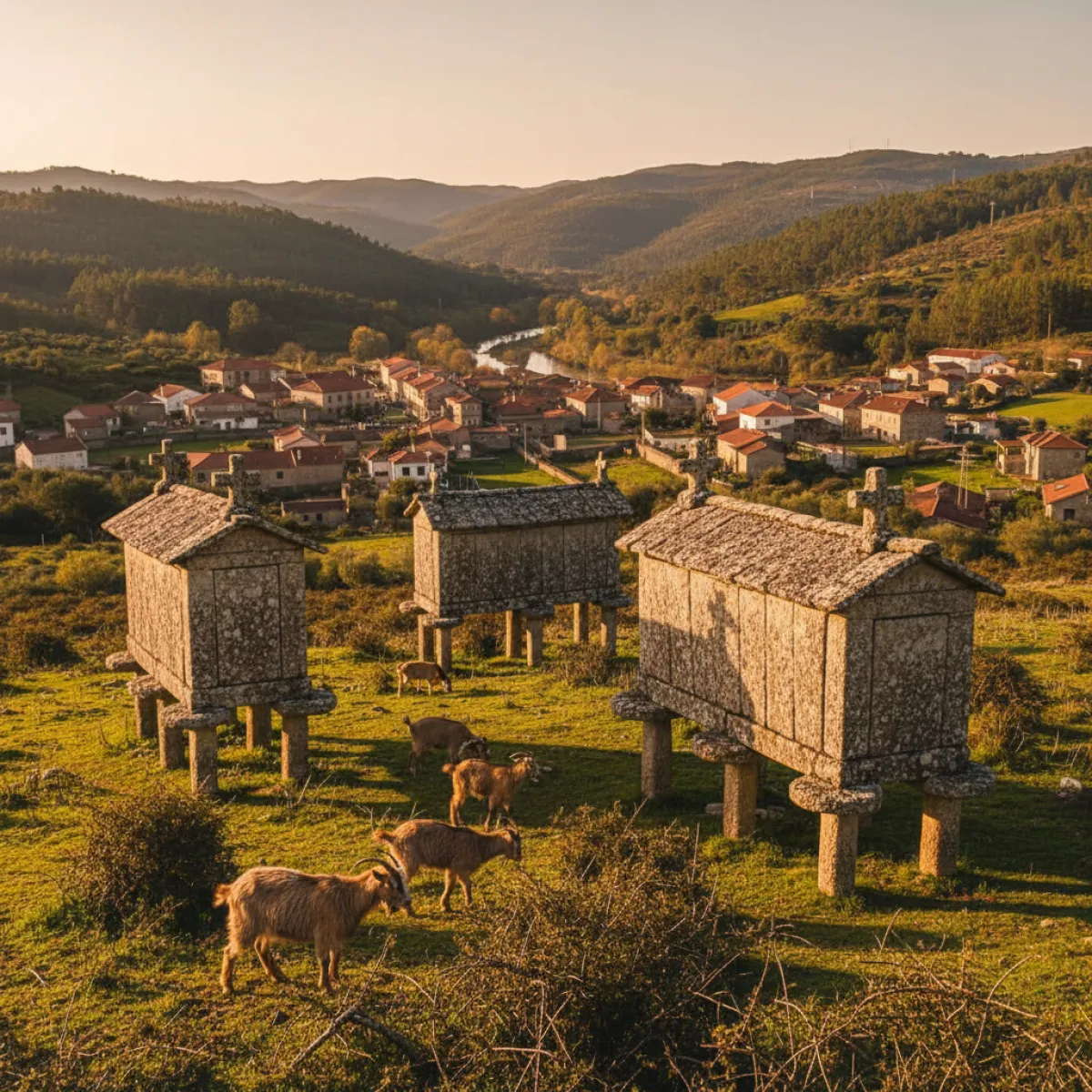
In Soajo, 24 granite espigueiros have stood on a natural rock slab since the 18th century. Arcos de Valdevez is Alto Minho's largest municipality and one of the best places in Portugal to understand how granite shaped the life, architecture, and landscape of the north.
There's something nobody tells you about Arcos de Valdevez: the granite here isn't just building material. It's identity. It's in the walls of houses, the steps of churches, the espigueiros that dot the mountainside, the boundary markers that have divided properties for centuries. If Minho is a region of granite, Arcos de Valdevez is its epicentre, a vast municipality, the largest in Alto Minho, stretching from the fertile valley of the River Vez to the windswept plateaus of the Serra do Soajo and Peneda.
The Historic Centre: Noble Houses and Carved Stone
Start in the centre. The main square of Arcos de Valdevez, along the River Vez, has the quiet feel of a Minho town that hasn't yet been colonised by souvenir shops. The building facades are a catalogue of Minho architecture: dressed granite, wrought-iron balconies, coats of arms worn smooth by time. Walk along the riverbank, there's a pleasant garden and a medieval bridge crossing to the other side.
What makes Arcos different from other Minho towns is the sheer density of noble houses. These were landed families of influence who built their manor houses here between the 16th and 18th centuries. Don't expect an open-air museum, it's subtler than that. A coat of arms here, a Manueline window there, a noble doorway half-hidden in a side street.
Paço de Giela: The Monument Worth a Detour
A few minutes from the centre, on the left bank of the Vez, stands the Paço de Giela, a National Monument since 1910 and one of the most impressive medieval complexes in northern Portugal. What you see today is a 14th-century tower and a 16th-century residential wing, with Manueline windows that, even in partial ruin, retain remarkable elegance. Inside, there's a small museum across three floors covering the archaeology of the municipality, the history of the building itself, and the Battle of Valdevez in 1141, the episode in which Afonso Henriques faced Alfonso VII of León and Castile, a pivotal moment in Portuguese independence.
If you only have time for one thing in central Arcos, make it this. The rest of the town is pleasant, but this is exceptional.
Soajo: The Granaries Everyone Photographs (Rightly So)
Now for the main event. The road from Arcos to Soajo takes about 25 minutes and climbs into the Serra do Soajo, with tight bends and views that improve with every kilometre. Soajo is a small village of narrow streets and granite everywhere, famous for its espigueiros, stone structures used to dry and store maize, raised off the ground to protect the grain from rats and damp.
The Soajo cluster has 24 espigueiros, all in granite, arranged on an enormous natural rock slab. The oldest dates from 1782, with the rest built throughout the 18th and 19th centuries. They've been classified as a Property of Public Interest since 1983, and rightly so, this is one of the most photogenic and well-preserved granary ensembles in all of Minho.
I say "everyone photographs" without irony. It deserves the photographs. But the trick is to go early morning or late afternoon. At noon, especially in summer, the granite slab becomes an oven and the light is harsh. At eight in the morning, with mist lifting from the valley, the espigueiros look like they've been there forever, which, in practical terms, is nearly true.
What Exactly Is an Espigueiro?
For those who've never seen one: imagine a narrow rectangular structure, built entirely of granite, with lateral openings for ventilation, raised on stone feet called "tornarratos" (literally "rat-turners," designed to stop rodents from climbing up), and topped with a cross. They were used to dry and store maize, the crop that, from the 17th century onwards, became the dietary staple of Minho. Each family had their own espigueiro on the communal threshing floor, making this space a centre of village social life.
In Soajo, the threshing floor is the granite slab itself, a natural platform adopted by the community. It's a perfect example of vernacular architecture: no architect, no blueprint, just the accumulated knowledge of generations about how to work stone and solve practical problems with available materials.
Beyond Soajo: More Granite in the Mountains
Soajo isn't the only village in the area with espigueiros, though it's the most famous. If you want to see more, Lindoso, in the neighbouring municipality of Ponte da Barca, has around 60 espigueiros beside its castle, the largest cluster in Minho. The drive from Soajo to Lindoso is short and worth it if you want to compare the two sites.
Within Arcos de Valdevez itself, there are mountain villages worth a stop: Sistelo, for instance, with its green terraces that earned it the nickname "Portuguese Tibet" (exaggerated, yes, but striking). Or the Brandas da Serra, stone-walled shelters used by shepherds during summer months, another example of granite architecture adapted to the needs of people who lived from the land and their livestock.
Eating in Arcos: Kid Goat, Cachena Beef and Arroz Pica no Chão
You don't come to Arcos de Valdevez without eating cabrito. The cabrito mamão da Serra, suckling kid goat reared exclusively on mother's milk in the Soajo and Peneda mountains, has Protected Geographical Indication status, and is prepared roasted in a wood-fired oven with roast potatoes, turnip greens, and baked rice. It's the signature dish of the municipality, and several restaurants serve it well.
Other dishes to know: Carne de Cachena com Arroz de Feijão Tarreste (Cachena is an indigenous cattle breed, small and adapted to mountain life, with flavourful, tender meat), the Cozido à Moda dos Arcos (a local version of the Portuguese stew, with regional cured meats), and Arroz Pica no Chão, a free-range chicken rice dish that's as simple as it is satisfying.
For restaurant recommendations, Restaurante O Barriguinhas is a local reference for stew and kid goat. Restaurante Alto da Prova also comes up frequently for grilled meats and roast cabrito. Check hours and prices locally, restaurants in this region don't always keep their online information current.
To drink, vinho verde from the region. Arcos de Valdevez falls within the Monção and Melgaço sub-region for Alvarinho, but local production leans towards Loureiro and traditional blends. Ask for the house wine, in village restaurants, it's often homemade, served in a clay jug, and it's exactly what the food calls for.
Getting There and How Long to Spend
Arcos de Valdevez is about an hour and a half from Porto via the A3 and A27 motorways. From Viana do Castelo, it's around 45 minutes. A car is essentially mandatory, public transport exists but is limited, especially for reaching mountain villages like Soajo.
For the historic centre and Paço de Giela, half a day is enough. To include Soajo and one of the mountain villages, you'll need a full day. If you want to combine it with hikes in the Peneda-Gerês National Park (Arcos is part of the park), two days is ideal.
And if you're exploring Minho with more time, it's worth combining Arcos de Valdevez with other stops in the region. Ponte de Lima is half an hour away and offers completely different experiences, including horseback riding along the banks of the River Lima, an excellent way to see the valley from a different perspective. Further south, Barcelos deserves at least a morning: we have an honest guide for those visiting with children, and for those who prefer to explore at the pace of a coffee, our Barcelos café guide is a solid starting point. If you have time to spare, the museums in Barcelos hold a few surprises, and a few you can skip without guilt.
What to Bring Home
Mountain honey, cured meats (chouriça, salpicão, presunto), vinho verde, and, if you find it, freshly baked broa de milho (cornbread) from a village bakery. The heather honey from Soajo has a reputation in the region and is sold directly by local producers, often from their doorstep. Don't expect organised artisan shops, here, shopping is more informal and more authentic.
Arcos de Valdevez doesn't need elaborate marketing. The granite speaks for itself, in the espigueiros, the manor houses, the bridges, the walls that have divided fields for centuries. Come and see how people built when stone was infinite and patience was the only precision tool.