Angra do Heroísmo: What Lies Beyond the Postcard Square
Angra do Heroísmo doesn't end at Praça Velha. São Mateus da Calheta's fishing port, Monte Brasil's full circuit, and the backstreets where actual Angrenses live, that's where the city starts making sense. Plus the alcatra at Tasca das Tias, which alone justifies the plane ticket.
Most visitors to Angra do Heroísmo follow the same script: get off the ferry or rental car, walk up to Praça Velha, photograph the Palácio dos Capitães Generais, stroll down Rua da Sé, glance at the bay, and drive off to the Furnas do Enxofre or the Biscoitos natural pools. The city gets reduced to a two-hour stop on an island itinerary. That's a mistake.
Angra doesn't reveal its best self in two hours. The real city lives in the opposite direction from the obvious historic centre, south toward the volcanic peninsula, west toward the fishing villages, in the neighbourhoods where nobody carries a camera.
São Mateus: Terceira's Other Capital
Six kilometres from Angra, São Mateus da Calheta is the most maritime village on the island. It's not a tourist destination, it's where Terceira's fishermen unload their catch in the late afternoon, where the smell of charcoal-grilled fish drifts from tavern doors that have never been listed on a review site.
The Forte Grande de São Mateus, painted yellow and built in the 16th century to protect the harbour, now serves as an exhibition space from May to September. But the real show is the port itself: in the early evening, boats return to the small bay with Monte Brasil as a backdrop, and the dock cats know the schedule better than the fishermen's wives do.
For eating in São Mateus, the Beira Mar serves whatever came in that morning with a simplicity that puts many Angra restaurants to shame. Order the catch of the day, don't try to get creative with the menu. If you'd rather stay in town, O Forno in Angra is a reliable choice for honest, no-fuss meals.
Monte Brasil on Foot: Skip the Main Viewpoint
Everyone climbs Monte Brasil. Almost nobody completes the full circuit. The typical mistake is heading straight for Pico das Cruzinhas, snapping the panoramic shot, which, I'll admit, is spectacular, and walking back the same way. That wastes half of what Monte Brasil has to offer.
The complete loop takes about two hours at an easy pace and cuts through the dense forest covering this extinct submarine volcano. There's a trail that descends to the southern coast, where lava formations drop vertically into the sea. It's there, far from the main viewpoint, that you grasp the real scale of this peninsula, and that you're walking on top of a dead volcano.
The Castelo de São João Baptista, the fortress occupying much of Monte Brasil and still an active military installation, is visible from several points along the trail. You can't access the entire fort, but the open sections make clear just how massive this operation was: for centuries, this was the Atlantic's primary defensive stronghold.
Go early. At 8am, the trail is virtually empty and the light over Angra's bay is the best you'll get all day.
Rua Direita After the Shops Close
Rua Direita was Angra's main artery for centuries, it connected Praça Velha to the old pier. Today, during business hours, it's a fairly unremarkable commercial street: a Mango, a Benetton, shoe shops, stationery stores. Nothing worth a detour.
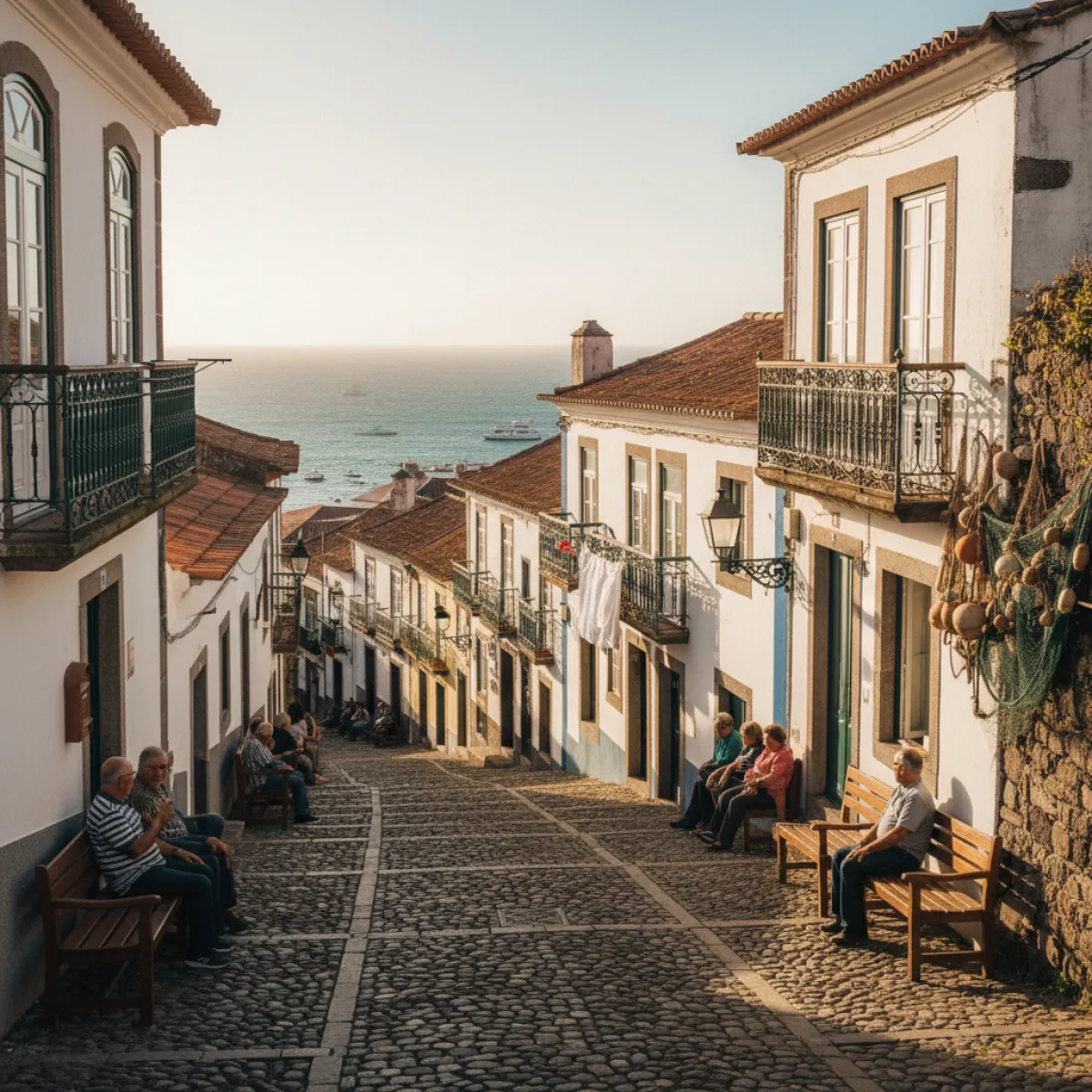
But in the late afternoon, when commerce shuts down and shadows stretch between the 16th-century buildings, Rua Direita transforms. The azulejo tiles on the facades, many original, predating the 1980 earthquake that devastated the city, take on a different quality in the raking light. Wrought-iron gates to interior courtyards stand half-open, revealing the domestic architecture Angra hides behind its street-facing walls: stone staircases, tiny gardens overflowing with hydrangeas, disused washing basins from another era.
This is also the hour to explore Rua da Rosa and Rua da Palha, parallel streets where actual Angrenses live and no guidebook has ever bothered to look. Here, the impérios do Espírito Santo, small, brightly painted chapels scattered across the island, appear on nearly every corner. They're the heart of community life on Terceira, especially during the Espírito Santo festivals in summer, when each neighbourhood opens its império and serves free soup and meat to anyone who shows up.
Mercado Duque de Bragança: Where Angra Actually Shops
The Mercado Duque de Bragança, on Rua do Rego, is where the city stocks its kitchens. It's neither large nor impressive, it's functional, the way a neighbourhood market should be. Island fruit, Terceira cheeses (the queijo vinha d'alhos is non-negotiable), cured meats, and the ever-present chilli peppers that Azoreans put on everything.
Go before 11am, when the selection is best. Buy cheese and corn bread for an improvised lunch on Monte Brasil, it'll be more memorable than any sit-down meal at an average restaurant.
Alcatra: Don't Leave Terceira Without This
Alcatra is Terceira's signature dish: beef rump slow-cooked in a clay pot with red wine, onion, garlic, cloves, and black peppercorns until it falls apart at the touch of a fork. It's served with massa sovada, a sweet bread that seems wrong alongside meat but works. It's one of those dishes that can't be replicated outside its context: the clay, the cooking time, the quality of Terceira's grass-fed beef.
Tasca das Tias in Angra is one of the few places that serves alcatra every single day. It's unpretentious, cheap, and good, the three things that matter. If you want to go deeper, a hands-on alcatra cooking class on Terceira teaches you the logic behind the technique, not just the eating.
For those exploring Azorean food culture across islands, the gastronomic trek through Ponta Delgada offers a useful contrast, São Miguel's approach to the table is entirely different.
Cabo da Praia: For Those Who Know How to Wait
East of Angra, Cabo da Praia is a stretch of coastline that almost nobody visits. It's a place of wind, dark basalt, and quiet, and birds. Terceira sits on an Atlantic migratory route, and Cabo da Praia is one of the island's best spots for observation.
If this interests you even slightly, the Cabo da Praia birdwatching expedition with ComunicAir is led by people who know the migratory cycles and where to look. You don't need to be an ornithologist, just patient, and happy to be somewhere no one else is.
Beyond Angra: The Azorean Triangle
Terceira is often the second or third island on an Azores itinerary, after São Miguel and before Faial. If you're planning the hop to Horta, our 24-hour Horta guide is a solid starting point, it's a completely different city from Angra, more cosmopolitan and oriented toward the sea in a way Terceira isn't. And if you like a good vantage point, the best rooftops and panoramic views in Horta are worth the detour.
Practical Information
Angra do Heroísmo has direct flights from Lisbon (about 2h30) and frequent inter-island connections. Lajes Airport is roughly 20 minutes from the centre by car. To explore the island properly, renting a car is essentially mandatory, buses exist but are infrequent and don't cover the most interesting spots.
For accommodation, skip the large hotels near the marina and look for restored houses within the historic centre, on the streets between Praça Velha and the Sé Cathedral. Several are available at reasonable prices, with the advantage of being walking distance from everything that matters.
The weather on Terceira is unpredictable year-round. Always carry a waterproof jacket, even in July. And don't complain about the rain, it's what keeps the island so green it almost hurts your eyes.