Angra do Heroísmo in the Rain: A Real Plan B
Rain in Terceira arrives without warning and leaves the same way, but Angra do Heroísmo has a 17th-century convent, a converted military hospital, and a Dona Amélia pastry worth any downpour. Here's the itinerary I'd pick on purpose, rain or not.
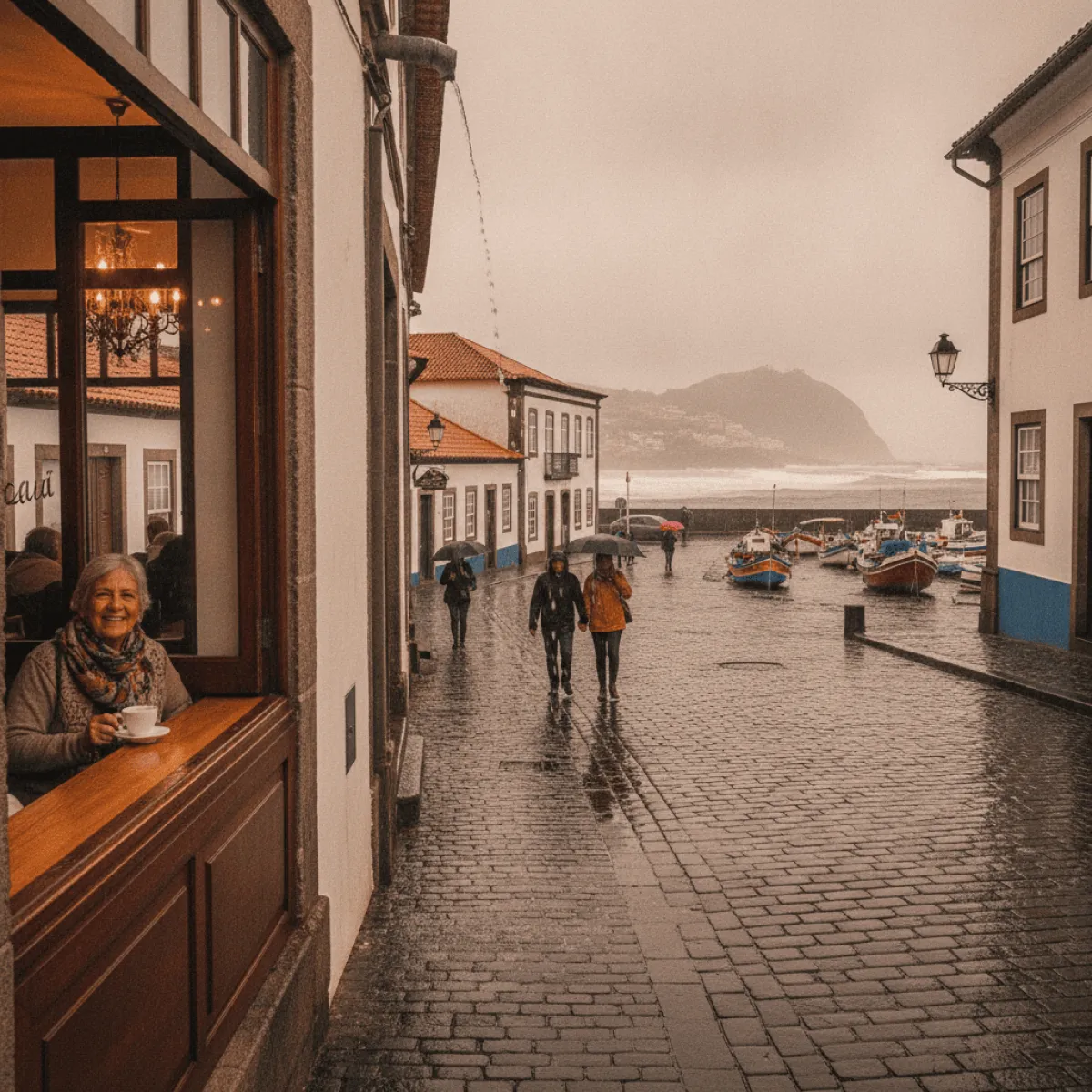
An island that changes its mind four times a day
There's an old joke in the Azores that isn't really a joke: on Terceira, if you don't like the weather, wait twenty minutes. Angra do Heroísmo sits exposed to the Atlantic on both sides, with nothing between it and Canada, which means squalls that arrive without warning, sit for half an hour, and vanish as if nothing happened. The mistake short-stay visitors make is treating rain as a reason to hide in the hotel room. Angra doesn't reward that kind of wasted time. This was the capital of the archipelago for centuries, a mandatory stopover on the routes to India and Brazil, and that history left behind a density of heritage that most mainland district capitals would envy. Under a roof, there's more to see here than people tend to assume.
This isn't a backup plan. It's the itinerary I'd choose on purpose, rain or not.
The convent that became a museum and still feels like one
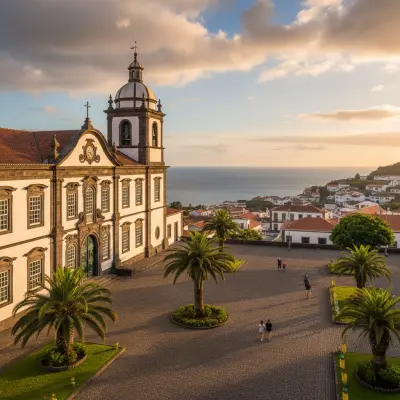
The Museu de Angra do Heroísmo, housed in the São Francisco building, occupies the former Convento de São Francisco, one of the largest religious buildings in the Azores, with the church built from 1663 and consecrated in 1672. The building has served as a secondary school, a seminary, and a meteorological station before becoming a museum in 1969, and that layered institutional life is still legible in the corridors: cloisters that still smell faintly of wet stone, a cruciform three-nave church that doubles as a pantheon, holding the tomb of Paulo da Gama, brother of Vasco da Gama, among other names from Azorean history. The main exhibition, "Do Mar e da Terra: uma história no Atlântico," fills the entire top floor and tells the island's story through ethnography, weaponry, painting, furniture, and natural history, without collapsing into generic display cases. Give it an hour and a half at minimum, more if you actually read the labels. It's the kind of museum you duck into to escape the rain and leave wondering why you didn't come on day one.
The military hospital nobody expects to visit
Five minutes on foot, next to the imposing Castelo de São João Baptista, sits the Núcleo de História Militar Manuel Coelho Baptista de Lima, installed in the former Hospital Militar da Boa Nova, built in the early 17th century and considered the oldest permanent military hospital in Portuguese territory. Opened as a museum in 2016, it's the only military-themed museum in Portugal not under the Ministry of Defence, which already tells you something about the independence of the narrative inside. The collection of edged and firearms, uniforms, artillery pieces, and transport equipment is really a pretext for telling the story of Baptista de Lima, an Angra-born intellectual who tried to build an Azorean identity distinct from the ethnographic regionalism of the early 20th century. This isn't a museum of weapons in disconnected glass cases. It's an island history lesson wearing a military-museum costume, and it works particularly well in the afternoon, when the light coming through the old hospital's tall windows is still enough to read the labels without pulling out your phone flashlight.
Contemporary art where nobody thinks to look
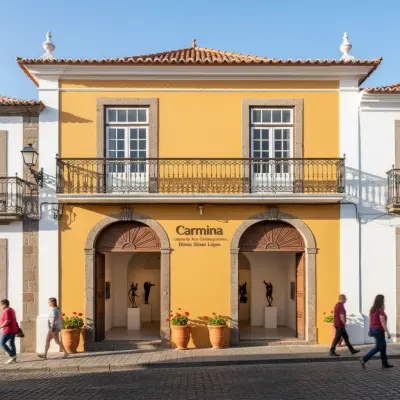
Most visitors associate Angra with 17th-century Dutch tiles and baroque facades, and they're not wrong: the Sé Cathedral, the largest church in the archipelago, holds the finest collection of Dutch tiles outside the Netherlands. But Carmina, the Dimas Simas Lopes Contemporary Art Gallery, is the counterpoint almost nobody thinks to look for on a rainy day, and that's exactly why it's worth the detour. Founded in 2004 by artist Dimas Simas Lopes, it ran for eight years as an art laboratory and cultural meeting point on the island before being donated to the Autonomous Region and folded into the Museu de Angra do Heroísmo in 2020. It's now part of a contemporary collection of over a thousand works by roughly 120 artists, spanning painting, sculpture, photography, drawing, and installation, and since 2023 it has hosted Lux Fecit, the museum's resident analogue photography club. It's a small space, no pretensions of being a major international museum, and that's probably why it works: you walk in, see serious work by Azorean artists, and walk out twenty minutes or an hour later, depending on what's showing. Don't go looking for international names. Go looking for what Terceira is making right now, with no middlemen.
Where to eat when the wind takes your umbrella
Rua de São João, number 67, in the old town, is where you'll find O Forno, a pastry shop that's been making its own sweets for decades and turns into the best possible place to watch a downpour on a bad-weather day. Order the queijada da Dona Amélia, a local sweet with a caramel-and-spice flavor you won't find on the mainland, plus one of the savory meat pastries, which double as a snack or a fast lunch on your way between museums. This isn't fine dining, it's neighborhood pastry-making done with real seriousness, and that contrast, colonial-era building outside, counter full of locals inside, is exactly what makes it memorable. Go mid-morning, before lunch, while there's still somewhere to sit and the trays haven't been picked clean.
Learning to cook alcatra instead of just eating it
If the rain refuses to let up all day, there's one option that actually turns bad weather into one of the best mornings of the trip: The Mastery of Alcatra: A Hands-on Traditional Cooking Class in Terceira. Alcatra is the island's defining dish, meat slow-cooked in a tall, slightly tapered, unglazed red clay pot, historically tied to the festivities of the Divino Espírito Santo and now a fixture of Sunday tables across the island. This experience teaches you to build the dish from scratch, indoors, which makes it one of the only activities in Angra that actually improves with bad weather outside rather than in spite of it. Book ahead, especially in peak season, since group sizes are usually kept small on purpose to keep things personal. You'll leave knowing how to make a dish that, frankly, most tourist restaurants on the island don't make as well as the family teaching you will.
Getting around without getting soaked
Angra do Heroísmo has the advantage of being compact: the historic center, a UNESCO World Heritage Site since 1983 and the first Portuguese city to receive that designation, fits entirely within a twenty-minute walk between the harbor, the Sé, and Alto da Memória. That means even with rain, you rarely need more than five or ten minutes between one stop and the next, which changes everything about how a bad-weather day plays out. Bring a windbreaker rather than an umbrella, because the wind off the bay tends to turn umbrellas inside out before you reach the next corner, and that's close to guaranteed on any visit between October and April. Taxis exist, but for short hops within the historic center they rarely save you any real time over walking.
- Museu de Angra do Heroísmo: paid entry, closed Mondays, check locally before you go.
- Núcleo de História Militar: ticket can usually be combined with the main museum, check seasonal hours locally.
- Carmina: check opening hours on site, entry is generally free or symbolic.
- O Forno: open daily, best visited mid-morning.
- Alcatra cooking class: advance booking required, confirm availability and duration when you book.
And if the sun comes back by mid-afternoon
It happens often enough to plan for it: squalls on Terceira rarely last a full day without a break. If you're building out more than one day on the island, it's worth structuring your visit around a broader plan, like the one in Angra do Heroísmo in 24 Hours, at a Local's Pace, which balances the sunny-day stops with the museum days instead of forcing either. Angra isn't a city that runs out of things to do on a rainy day, and it isn't a city you sacrifice to one either. If anything, it's a place you get to know better once the weather forces you to slow down and actually walk into the buildings instead of just photographing them from outside.